Q99LE1
Gene name |
Rilpl2 |
Protein name |
RILP-like protein 2 |
Names |
Rab-interacting lysosomal-like protein 2 |
Species |
Mus musculus (Mouse) |
KEGG Pathway |
mmu:80291 |
EC number |
|
Protein Class |
|
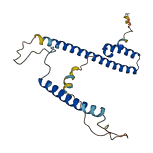
Descriptions
The autoinhibited protein was predicted that may have potential autoinhibitory elements via cis-regPred.
Autoinhibitory domains (AIDs)
Target domain |
|
Relief mechanism |
|
Assay |
cis-regPred |
Accessory elements
No accessory elements
Autoinhibited structure

Activated structure
2 structures for Q99LE1
| Entry ID | Method | Resolution | Chain | Position | Source |
|---|---|---|---|---|---|
| 4KP3 | X-ray | 240 A | C/D | 1-97 | PDB |
| AF-Q99LE1-F1 | Predicted | AlphaFoldDB |
17 variants for Q99LE1
| Variant ID(s) | Position | Change | Description | Diseaes Association | Provenance |
|---|---|---|---|---|---|
| rs6313020 | 3 | D>E | No | EVA | |
| rs3388793789 | 82 | E>K | No | EVA | |
| rs3388784673 | 86 | L>F | No | EVA | |
| rs3388778167 | 126 | E>* | No | EVA | |
| rs3388792558 | 128 | R>S | No | EVA | |
| rs3388793802 | 130 | V>* | No | EVA | |
| rs3388787701 | 132 | Q>E | No | EVA | |
| rs3388793570 | 133 | E>* | No | EVA | |
| rs3388797433 | 134 | R>G | No | EVA | |
| rs3396188523 | 141 | L>Q | No | EVA | |
| rs3396132239 | 142 | L>Q | No | EVA | |
| rs3388786891 | 154 | G>D | No | EVA | |
| rs3388790780 | 163 | G>R | No | EVA | |
| rs3396202801 | 171 | V>A | No | EVA | |
| rs219179216 | 171 | V>M | No | EVA | |
| rs224357056 | 177 | G>S | No | EVA | |
| rs3413157889 | 190 | S>P | No | EVA |
No associated diseases with Q99LE1
6 GO annotations of cellular component
| Name | Definition |
|---|---|
| centrosome | A structure comprised of a core structure (in most organisms, a pair of centrioles) and peripheral material from which a microtubule-based structure, such as a spindle apparatus, is organized. Centrosomes occur close to the nucleus during interphase in many eukaryotic cells, though in animal cells it changes continually during the cell-division cycle. |
| ciliary basal body | A membrane-tethered, short cylindrical array of microtubules and associated proteins found at the base of a eukaryotic cilium (also called flagellum) that is similar in structure to a centriole and derives from it. The cilium basal body is the site of assembly and remodelling of the cilium and serves as a nucleation site for axoneme growth. As well as anchoring the cilium, it is thought to provide a selective gateway regulating the entry of ciliary proteins and vesicles by intraflagellar transport. |
| cilium | A specialized eukaryotic organelle that consists of a filiform extrusion of the cell surface and of some cytoplasmic parts. Each cilium is largely bounded by an extrusion of the cytoplasmic (plasma) membrane, and contains a regular longitudinal array of microtubules, anchored to a basal body. |
| cytoplasm | The contents of a cell excluding the plasma membrane and nucleus, but including other subcellular structures. |
| cytosol | The part of the cytoplasm that does not contain organelles but which does contain other particulate matter, such as protein complexes. |
| membrane | A lipid bilayer along with all the proteins and protein complexes embedded in it an attached to it. |
2 GO annotations of molecular function
| Name | Definition |
|---|---|
| identical protein binding | Binding to an identical protein or proteins. |
| protein dimerization activity | The formation of a protein dimer, a macromolecular structure consists of two noncovalently associated identical or nonidentical subunits. |
3 GO annotations of biological process
| Name | Definition |
|---|---|
| cilium assembly | The assembly of a cilium, a specialized eukaryotic organelle that consists of a filiform extrusion of the cell surface. Each cilium is bounded by an extrusion of the cytoplasmic membrane, and contains a regular longitudinal array of microtubules, anchored basally in a centriole. |
| epithelial cell morphogenesis | The change in form that occurs when an epithelial cell progresses from its initial formation to its mature state. |
| protein transport from ciliary membrane to plasma membrane | The directed movement of protein from ciliary membrane to plasma membrane. |
No homologous proteins in AiPD
| UniProt AC | Gene Name | Protein Name | Species | Evidence Code |
|---|---|---|---|---|
| No homologous proteins | ||||
| 10 | 20 | 30 | 40 | 50 | 60 |
| MEDHPVREEE | DGEEDEGALA | KSPLQLTTDD | VYDISYVVGR | ELMALGSDPR | VTRLQFKIVR |
| 70 | 80 | 90 | 100 | 110 | 120 |
| VMEMLETLVN | EGSLAVEELR | MERDNLKQEV | EGLRKAGVSG | AQVNLGPDKM | VVDLTDPNRP |
| 130 | 140 | 150 | 160 | 170 | 180 |
| RFTLQELREV | LQERNKLKSQ | LLLVQEELQC | YRSGLLPPRE | TPGGRREKDA | VVAMGNGEKE |
| 190 | |||||
| ERTIMKKLFS | FRSGKHT |