Q99J09
Gene name |
Wdr77 (Mep50) |
Protein name |
Methylosome protein 50 |
Names |
MEP-50, WD repeat-containing protein 77 |
Species |
Mus musculus (Mouse) |
KEGG Pathway |
mmu:70465 |
EC number |
|
Protein Class |
|
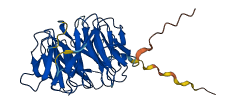
Descriptions
The autoinhibited protein was predicted that may have potential autoinhibitory elements via cis-regPred.
Autoinhibitory domains (AIDs)
Target domain |
|
Relief mechanism |
|
Assay |
cis-regPred |
Accessory elements
No accessory elements
Autoinhibited structure

Activated structure
1 structures for Q99J09
| Entry ID | Method | Resolution | Chain | Position | Source |
|---|---|---|---|---|---|
| AF-Q99J09-F1 | Predicted | AlphaFoldDB |
25 variants for Q99J09
| Variant ID(s) | Position | Change | Description | Diseaes Association | Provenance |
|---|---|---|---|---|---|
| rs3388656399 | 54 | W>G | No | EVA | |
| rs3388654673 | 55 | V>I | No | EVA | |
| rs3388644269 | 63 | D>G | No | EVA | |
| rs3388655853 | 75 | A>V | No | EVA | |
| rs3388658594 | 98 | S>A | No | EVA | |
| rs3388637646 | 145 | K>R | No | EVA | |
| rs3388654717 | 166 | H>Q | No | EVA | |
| rs3388655901 | 174 | A>V | No | EVA | |
| rs3388656484 | 176 | S>Y | No | EVA | |
| rs3388648546 | 184 | L>H | No | EVA | |
| rs248421637 | 206 | M>I | No | EVA | |
| rs244195809 | 207 | A>G | No | EVA | |
| rs3388658692 | 220 | W>R | No | EVA | |
| rs3388650049 | 221 | H>Q | No | EVA | |
| rs3388650434 | 223 | Q>R | No | EVA | |
| rs3388652930 | 224 | Q>H | No | EVA | |
| rs13475467 | 246 | S>G | No | EVA | |
| rs3388637634 | 253 | V>G | No | EVA | |
| rs238483061 | 257 | G>C | No | EVA | |
| rs3388644268 | 301 | R>G | No | EVA | |
| rs3388637714 | 307 | P>Q | No | EVA | |
| rs3388650438 | 314 | T>S | No | EVA | |
| rs3388657561 | 320 | H>L | No | EVA | |
| rs3388648538 | 339 | S>N | No | EVA | |
| rs3388652967 | 342 | E>K | No | EVA |
No associated diseases with Q99J09
6 regional properties for Q99J09
| Type | Name | Position | InterPro Accession |
|---|---|---|---|
| repeat | WD40 repeat | 70 - 107 | IPR001680-1 |
| repeat | WD40 repeat | 115 - 198 | IPR001680-2 |
| repeat | WD40 repeat | 201 - 241 | IPR001680-3 |
| repeat | WD40 repeat | 244 - 284 | IPR001680-4 |
| repeat | WD40 repeat | 286 - 326 | IPR001680-5 |
| conserved_site | WD40 repeat, conserved site | 140 - 154 | IPR019775 |
6 GO annotations of cellular component
| Name | Definition |
|---|---|
| cytoplasm | The contents of a cell excluding the plasma membrane and nucleus, but including other subcellular structures. |
| cytosol | The part of the cytoplasm that does not contain organelles but which does contain other particulate matter, such as protein complexes. |
| Golgi apparatus | A membrane-bound cytoplasmic organelle of the endomembrane system that further processes the core oligosaccharides (e.g. N-glycans) added to proteins in the endoplasmic reticulum and packages them into membrane-bound vesicles. The Golgi apparatus operates at the intersection of the secretory, lysosomal, and endocytic pathways. |
| methylosome | A large (20 S) protein complex that possesses protein arginine methyltransferase activity and modifies specific arginines to dimethylarginines in the arginine- and glycine-rich domains of several spliceosomal Sm proteins, thereby targeting these proteins to the survival of motor neurons (SMN) complex for assembly into small nuclear ribonucleoprotein (snRNP) core particles. Proteins found in the methylosome include the methyltransferase JBP1 (PRMT5), pICln (CLNS1A), MEP50 (WDR77), and unmethylated forms of SM proteins that have RG domains. |
| nucleoplasm | That part of the nuclear content other than the chromosomes or the nucleolus. |
| nucleus | A membrane-bounded organelle of eukaryotic cells in which chromosomes are housed and replicated. In most cells, the nucleus contains all of the cell's chromosomes except the organellar chromosomes, and is the site of RNA synthesis and processing. In some species, or in specialized cell types, RNA metabolism or DNA replication may be absent. |
2 GO annotations of molecular function
| Name | Definition |
|---|---|
| methyl-CpG binding | Binding to a methylated cytosine/guanine dinucleotide. |
| nuclear receptor coactivator activity | A transcription coactivator activity that activates or increases the transcription of specific gene sets via binding to a DNA-bound nuclear receptor, either on its own or as part of a complex. Coactivators often act by altering chromatin structure and modifications. For example, one class of transcription coregulators modifies chromatin structure through covalent modification of histones. A second class remodels the conformation of chromatin in an ATP-dependent fashion. A third class modulates interactions of DNA-bound DNA-binding transcription factors with other transcription coregulators. A fourth class of coactivator activity is the bridging of a DNA-binding transcription factor to the general (basal) transcription machinery. The Mediator complex, which bridges sequence-specific DNA binding transcription factors and RNA polymerase, is also a transcription coactivator. |
10 GO annotations of biological process
| Name | Definition |
|---|---|
| epithelial cell proliferation involved in prostate gland development | The multiplication or reproduction of epithelial cells, resulting in the expansion of a cell population that contributes to the progression of the prostate gland over time. |
| histone H4-R3 methylation | The modification of histone H4 by addition of a methyl group to arginine at position 3 of the histone. |
| negative regulation of cell population proliferation | Any process that stops, prevents or reduces the rate or extent of cell proliferation. |
| negative regulation of epithelial cell proliferation involved in prostate gland development | Any process that decreases the rate, frequency or extent of epithelial cell proliferation that contributes to the progression of the prostate gland over time. |
| oocyte axis specification | The establishment, maintenance and elaboration of an axis in the oocyte. An example of this is found in Drosophila melanogaster. |
| positive regulation of cell population proliferation | Any process that activates or increases the rate or extent of cell proliferation. |
| positive regulation of mRNA splicing, via spliceosome | Any process that activates or increases the rate or extent of mRNA splicing via a spliceosomal mechanism. |
| regulation of transcription by RNA polymerase II | Any process that modulates the frequency, rate or extent of transcription mediated by RNA polymerase II. |
| secretory columnal luminar epithelial cell differentiation involved in prostate glandular acinus development | The process in which a relatively unspecialized epithelial cell acquires specialized features of a secretory columnal luminar epithelial cell of the prostate. |
| spliceosomal snRNP assembly | The aggregation, arrangement and bonding together of one or more snRNA and multiple protein components to form a ribonucleoprotein complex that is involved in formation of the spliceosome. |
No homologous proteins in AiPD
| UniProt AC | Gene Name | Protein Name | Species | Evidence Code |
|---|---|---|---|---|
| No homologous proteins | ||||
| 10 | 20 | 30 | 40 | 50 | 60 |
| MRKDTPPPLV | PPAAREWNLP | PNAPACMERQ | LEAARYRSDG | SLLLGVSSLS | GRCWVGSLWF |
| 70 | 80 | 90 | 100 | 110 | 120 |
| FKDPSAAPNE | GFCSAGVQTE | AGVADLTWVG | DKGILVASDS | GAVELWELDE | NETLIVSKFC |
| 130 | 140 | 150 | 160 | 170 | 180 |
| KYEHDDIVST | VTVLSSGTQA | VSGSKDCCIK | IWDLAQQVSL | NSYRAHAGQV | TCVAASPHKD |
| 190 | 200 | 210 | 220 | 230 | 240 |
| SVFLSCSEDS | RILLWDTRCP | KPASQMACNA | SGYLPTALAW | HPQQSEVFVF | GDENGSVSLV |
| 250 | 260 | 270 | 280 | 290 | 300 |
| DTKNASCTLS | SAVHSQGVTR | LVFSPHSVPL | LTSLSEDCSL | AVLDSSLSEV | FRSRAHRDFV |
| 310 | 320 | 330 | 340 | ||
| RDATWSPLNH | SLLTTVGWDH | QVIHHVVPLE | PLPNPGPDSV | VE |