Q99394
Gene name |
TRS33 (YOR115C, O3251, YOR3251C) |
Protein name |
Trafficking protein particle complex subunit 33 |
Names |
TRAPP subunit 33, Transport protein particle 33 kDa subunit |
Species |
Saccharomyces cerevisiae (strain ATCC 204508 / S288c) (Baker's yeast) |
KEGG Pathway |
sce:YOR115C |
EC number |
|
Protein Class |
|
Descriptions
The autoinhibited protein was predicted that may have potential autoinhibitory elements via cis-regPred.
Autoinhibitory domains (AIDs)
Target domain |
|
Relief mechanism |
|
Assay |
cis-regPred |
Accessory elements
No accessory elements
Autoinhibited structure

Activated structure
11 structures for Q99394
| Entry ID | Method | Resolution | Chain | Position | Source |
|---|---|---|---|---|---|
| 7E2C | EM | 418 A | B | 1-268 | PDB |
| 7E2D | EM | 371 A | B | 1-268 | PDB |
| 7E8S | EM | 436 A | B/M | 1-268 | PDB |
| 7E8T | EM | 380 A | B | 1-268 | PDB |
| 7E93 | EM | 654 A | B/M | 1-268 | PDB |
| 7E94 | EM | 467 A | B/M | 1-268 | PDB |
| 7EA3 | EM | 431 A | B/O | 1-268 | PDB |
| 7KMT | EM | 370 A | E | 1-268 | PDB |
| 7U05 | EM | 370 A | E/e | 1-268 | PDB |
| 7U06 | EM | 420 A | E/e | 1-268 | PDB |
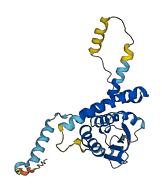
| AF-Q99394-F1 | Predicted | AlphaFoldDB |
4 variants for Q99394
| Variant ID(s) | Position | Change | Description | Diseaes Association | Provenance |
|---|---|---|---|---|---|
| s15-539240 | 76 | S>F | No | SGRP | |
| s15-539208 | 87 | R>G | No | SGRP | |
| s15-539037 | 144 | P>A | No | SGRP | |
| s15-538715 | 251 | K>R | No | SGRP |
No associated diseases with Q99394
No regional properties for Q99394
| Type | Name | Position | InterPro Accession |
|---|---|---|---|
| No domain, repeats, and functional sites for Q99394 | |||
9 GO annotations of cellular component
| Name | Definition |
|---|---|
| cis-Golgi network | The network of interconnected tubular and cisternal structures located at the convex side of the Golgi apparatus, which abuts the endoplasmic reticulum. |
| cytosol | The part of the cytoplasm that does not contain organelles but which does contain other particulate matter, such as protein complexes. |
| endoplasmic reticulum | The irregular network of unit membranes, visible only by electron microscopy, that occurs in the cytoplasm of many eukaryotic cells. The membranes form a complex meshwork of tubular channels, which are often expanded into slitlike cavities called cisternae. The ER takes two forms, rough (or granular), with ribosomes adhering to the outer surface, and smooth (with no ribosomes attached). |
| phagophore assembly site | Punctate structures proximal to the endoplasmic reticulum which are the sites where the Atg machinery assembles upon autophagy induction. |
| trans-Golgi network | The network of interconnected tubular and cisternal structures located within the Golgi apparatus on the side distal to the endoplasmic reticulum, from which secretory vesicles emerge. The trans-Golgi network is important in the later stages of protein secretion where it is thought to play a key role in the sorting and targeting of secreted proteins to the correct destination. |
| TRAPP complex | A large complex that acts as a tethering factor involved in transporting vesicles from the ER through the Golgi to the plasma membrane. A TRAPP (transport protein particle) complex has a core set of proteins which are joined by specific subunits depending on the cellular component where a given TRAPP complex is active. |
| TRAPPI protein complex | A complex that tethers COPII vesicles at ER-Golgi intermediate compartment. Its role in this part of the vesicular transport may start at the ER exit sites. Binds to a component of the COPII coat. In yeast it includes the following subunits: Bet3 (as homodimer), Bet5, Trs20, Trs23, Trs31, Trs33 which are regarded as the core subunits of all TRAPP complexes in yeast. |
| TRAPPII protein complex | A complex that mediates intra-Golgi traffic, Golgi exit, endosome-to-Golgi traffic, and the trafficking of autophagy proteins from Golgi to the phagophore assembly site. Binds to a component of the COPI coat. In yeast it includes the following subunits: Bet3 (as homodimer), Bet5, Tca17, Trs20, Trs23, Trs31, Trs33, Trs65, Trs120, Trs130. The whole complex is thought to dimerize with itself. |
| TRAPPIII protein complex | A complex that functions in anterograde transport at the Golgi and also regulates autophagy. In yeast it includes at least the following subunits: Bet3 (as homodimer), Bet5, Trs20, Trs23, Trs31, Trs33, Trs85. TRAPPIII may include further, as yet undescribed, proteins. |
No GO annotations of molecular function
| Name | Definition |
|---|---|
| No GO annotations for molecular function |
9 GO annotations of biological process
| Name | Definition |
|---|---|
| endoplasmic reticulum to Golgi vesicle-mediated transport | The directed movement of substances from the endoplasmic reticulum (ER) to the Golgi, mediated by COP II vesicles. Small COP II coated vesicles form from the ER and then fuse directly with the cis-Golgi. Larger structures are transported along microtubules to the cis-Golgi. |
| intra-Golgi vesicle-mediated transport | The directed movement of substances within the Golgi, mediated by small transport vesicles. These either fuse with the cis-Golgi or with each other to form the membrane stacks known as the cis-Golgi reticulum (network). |
| macroautophagy | The major inducible pathway for the general turnover of cytoplasmic constituents in eukaryotic cells, it is also responsible for the degradation of active cytoplasmic enzymes and organelles during nutrient starvation. Macroautophagy involves the formation of double-membrane-bounded autophagosomes which enclose the cytoplasmic constituent targeted for degradation in a membrane-bounded structure. Autophagosomes then fuse with a lysosome (or vacuole) releasing single-membrane-bounded autophagic bodies that are then degraded within the lysosome (or vacuole). Some types of macroautophagy, e.g. pexophagy, mitophagy, involve selective targeting of the targets to be degraded. |
| positive regulation of macroautophagy | Any process, such as recognition of nutrient depletion, that activates or increases the rate of macroautophagy to bring cytosolic macromolecules to the vacuole/lysosome for degradation. |
| protein localization to phagophore assembly site | Any process in which a protein is transported to, or maintained at, the phagophore assembly site (PAS). |
| protein-containing complex assembly | The aggregation, arrangement and bonding together of a set of macromolecules to form a protein-containing complex. |
| protein-containing complex localization | A localization process that acts on a protein complex; the complex is transported to, or maintained in, a specific location. |
| regulation of GTPase activity | Any process that modulates the rate of GTP hydrolysis by a GTPase. |
| retrograde transport, endosome to Golgi | The directed movement of membrane-bounded vesicles from endosomes back to the trans-Golgi network where they are recycled for further rounds of transport. |
No homologous proteins in AiPD
| UniProt AC | Gene Name | Protein Name | Species | Evidence Code |
|---|---|---|---|---|
| No homologous proteins | ||||
| 10 | 20 | 30 | 40 | 50 | 60 |
| MSSTHSNNVG | HPQSSPQGPL | TEQQRAQQQY | QIFENSLPKV | SQSVYQMLLN | EMVPLAMGIE |
| 70 | 80 | 90 | 100 | 110 | 120 |
| RQISGDVISS | DSNVTSENGN | INNMIKRLKI | EEHHTVDIIR | SHNLIHELYK | ADEEEKEKVL |
| 130 | 140 | 150 | 160 | 170 | 180 |
| ARLRNIGFQI | GLKLSELLIF | SNNPNLKFKE | MDLLLIMKFI | CRDVWKQIFG | KQIDNLKTNH |
| 190 | 200 | 210 | 220 | 230 | 240 |
| RGTFYLLDYD | YRPIQSFSLE | EDAKNEELKM | IEPFLEIPVG | IIRGVLSSLG | YSSEEVICLA |
| 250 | 260 | ||||
| SFIDRPTDRP | KTAFPKGVSF | HVQVTMPQ |