Q98TY9
Gene name |
akt1 |
Protein name |
RAC-alpha serine/threonine-protein kinase |
Names |
Protein kinase Akt-1, xAkt, Protein kinase B, alpha, PKB alpha, RAC-PK-alpha |
Species |
Xenopus laevis (African clawed frog) |
KEGG Pathway |
xla:399170 |
EC number |
|
Protein Class |
|
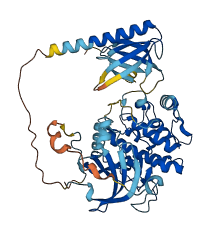
Descriptions
The autoinhibited protein was predicted that may have potential autoinhibitory elements via cis-regPred.
Autoinhibitory domains (AIDs)
Target domain |
|
Relief mechanism |
|
Assay |
cis-regPred |
Accessory elements
292-315 (Activation loop from InterPro)
Target domain |
125-479 (Catalytic domain of the Serine/Threonine Kinase, Protein Kinase B alpha, also called Akt1) |
Relief mechanism |
|
Assay |
|
Autoinhibited structure

Activated structure
1 structures for Q98TY9
| Entry ID | Method | Resolution | Chain | Position | Source |
|---|---|---|---|---|---|
| AF-Q98TY9-F1 | Predicted | AlphaFoldDB |
No variants for Q98TY9
| Variant ID(s) | Position | Change | Description | Diseaes Association | Provenance |
|---|---|---|---|---|---|
| No variants for Q98TY9 | |||||
No associated diseases with Q98TY9
8 regional properties for Q98TY9
| Type | Name | Position | InterPro Accession |
|---|---|---|---|
| domain | Protein kinase domain | 151 - 409 | IPR000719 |
| domain | AGC-kinase, C-terminal | 410 - 481 | IPR000961 |
| domain | Pleckstrin homology domain | 5 - 110 | IPR001849 |
| active_site | Serine/threonine-protein kinase, active site | 271 - 283 | IPR008271 |
| binding_site | Protein kinase, ATP binding site | 157 - 190 | IPR017441 |
| domain | Protein kinase, C-terminal | 430 - 475 | IPR017892 |
| domain | Protein kinase B alpha, catalytic domain | 125 - 479 | IPR034676 |
| domain | Protein Kinase B, pleckstrin homology domain | 4 - 111 | IPR039026 |
2 GO annotations of cellular component
| Name | Definition |
|---|---|
| cytoplasm | The contents of a cell excluding the plasma membrane and nucleus, but including other subcellular structures. |
| nucleus | A membrane-bounded organelle of eukaryotic cells in which chromosomes are housed and replicated. In most cells, the nucleus contains all of the cell's chromosomes except the organellar chromosomes, and is the site of RNA synthesis and processing. In some species, or in specialized cell types, RNA metabolism or DNA replication may be absent. |
4 GO annotations of molecular function
| Name | Definition |
|---|---|
| ATP binding | Binding to ATP, adenosine 5'-triphosphate, a universally important coenzyme and enzyme regulator. |
| potassium channel activator activity | Binds to and increases the activity of a potassium channel, resulting in its opening. |
| protein serine kinase activity | Catalysis of the reactions: ATP + protein serine = ADP + protein serine phosphate. |
| protein serine/threonine kinase activity | Catalysis of the reactions: ATP + protein serine = ADP + protein serine phosphate, and ATP + protein threonine = ADP + protein threonine phosphate. |
18 GO annotations of biological process
| Name | Definition |
|---|---|
| carbohydrate transport | The directed movement of carbohydrate into, out of or within a cell, or between cells, by means of some agent such as a transporter or pore. Carbohydrates are a group of organic compounds based of the general formula Cx(H2O)y. |
| glucose metabolic process | The chemical reactions and pathways involving glucose, the aldohexose gluco-hexose. D-glucose is dextrorotatory and is sometimes known as dextrose; it is an important source of energy for living organisms and is found free as well as combined in homo- and hetero-oligosaccharides and polysaccharides. |
| glycogen biosynthetic process | The chemical reactions and pathways resulting in the formation of glycogen, a polydisperse, highly branched glucan composed of chains of D-glucose residues. |
| insulin receptor signaling pathway | The series of molecular signals generated as a consequence of the insulin receptor binding to insulin. |
| insulin-like growth factor receptor signaling pathway | The series of molecular signals initiated by a ligand binding to an insulin-like growth factor receptor on the surface of a target cell, and ending with the regulation of a downstream cellular process, e.g. transcription. |
| negative regulation of apoptotic process | Any process that stops, prevents, or reduces the frequency, rate or extent of cell death by apoptotic process. |
| negative regulation of cysteine-type endopeptidase activity involved in apoptotic process | Any process that stops, prevents, or reduces the frequency, rate or extent of a cysteine-type endopeptidase activity involved in the apoptotic process. |
| negative regulation of release of cytochrome c from mitochondria | Any process that decreases the rate, frequency or extent of release of cytochrome c from mitochondria, the process in which cytochrome c is enabled to move from the mitochondrial intermembrane space into the cytosol, which is an early step in apoptosis and leads to caspase activation. |
| nervous system development | The process whose specific outcome is the progression of nervous tissue over time, from its formation to its mature state. |
| peptidyl-serine phosphorylation | The phosphorylation of peptidyl-serine to form peptidyl-O-phospho-L-serine. |
| positive regulation of endothelial cell proliferation | Any process that activates or increases the rate or extent of endothelial cell proliferation. |
| positive regulation of lipid biosynthetic process | Any process that activates or increases the frequency, rate or extent of the chemical reactions and pathways resulting in the formation of lipids. |
| positive regulation of protein localization to cell surface | Any process that activates or increases the frequency, rate or extent of protein localization to the cell surface. |
| protein kinase B signaling | A series of reactions, mediated by the intracellular serine/threonine kinase protein kinase B (also called AKT), which occurs as a result of a single trigger reaction or compound. |
| protein phosphorylation | The process of introducing a phosphate group on to a protein. |
| regulation of apoptotic process | Any process that modulates the occurrence or rate of cell death by apoptotic process. |
| regulation of neuron projection development | Any process that modulates the rate, frequency or extent of neuron projection development. Neuron projection development is the process whose specific outcome is the progression of a neuron projection over time, from its formation to the mature structure. A neuron projection is any process extending from a neural cell, such as axons or dendrites (collectively called neurites). |
| response to growth factor | Any process that results in a change in state or activity of a cell or an organism (in terms of movement, secretion, enzyme production, gene expression, etc.) as a result of a growth factor stimulus. |
No homologous proteins in AiPD
| UniProt AC | Gene Name | Protein Name | Species | Evidence Code |
|---|---|---|---|---|
| No homologous proteins | ||||
| 10 | 20 | 30 | 40 | 50 | 60 |
| MNEVAIVKEG | WLHKRGEYIK | TWRPRYFLLK | SDGTFIGYKE | RPQDVDQLET | PLNNFSVAKC |
| 70 | 80 | 90 | 100 | 110 | 120 |
| QLMKTERPKP | NTFIIRCLQW | TTVIERTFHV | DSPEEREEWI | QVIQHVADNL | KKQEEEMMEV |
| 130 | 140 | 150 | 160 | 170 | 180 |
| RSGDSPSDNS | GAEEMEVSHS | KPKHKVTMNE | FEYLKLLGKG | TFGKVILVKE | KATGRYYAMK |
| 190 | 200 | 210 | 220 | 230 | 240 |
| ILKKEVIVAK | DEVAHTLTEN | RVLQNSRHPF | LTALKYSFQT | HDRLCFVMEY | ANGGELFFHL |
| 250 | 260 | 270 | 280 | 290 | 300 |
| SRERIFSEDR | ARFYGAEIVS | ALDYLHSEKN | VVYRDLKLEN | LMLDKDGHIK | ITDFGLCKEG |
| 310 | 320 | 330 | 340 | 350 | 360 |
| IKDGATMKTF | CGTPEYLAPE | VLEDNDYGRA | VDWWGLGVVM | YEMMCGRLPF | YNQDHEKLFE |
| 370 | 380 | 390 | 400 | 410 | 420 |
| LILMEEIRFP | RTLLPEAKSL | LSGLLKKDPK | QRLGGGPDDA | KEIMQHKFFA | GIVWQDVYEK |
| 430 | 440 | 450 | 460 | 470 | 480 |
| KLVPPFKPQV | TSETDTRYFD | EEFTAQMITI | TPPDQDDNFE | FVDNERRPHF | PQFSYSASGN |
| A |