Q98998
Gene name |
htr1a |
Protein name |
5-hydroxytryptamine receptor 1A |
Names |
5-HT-1A, 5-HT1A, x5-HT1A, Serotonin receptor 1A |
Species |
Xenopus laevis (African clawed frog) |
KEGG Pathway |
xla:378605 |
EC number |
|
Protein Class |
|
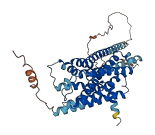
Descriptions
The autoinhibited protein was predicted that may have potential autoinhibitory elements via cis-regPred.
Autoinhibitory domains (AIDs)
Target domain |
|
Relief mechanism |
|
Assay |
cis-regPred |
Accessory elements
No accessory elements
Autoinhibited structure

Activated structure
1 structures for Q98998
| Entry ID | Method | Resolution | Chain | Position | Source |
|---|---|---|---|---|---|
| AF-Q98998-F1 | Predicted | AlphaFoldDB |
No variants for Q98998
| Variant ID(s) | Position | Change | Description | Diseaes Association | Provenance |
|---|---|---|---|---|---|
| No variants for Q98998 | |||||
No associated diseases with Q98998
1 regional properties for Q98998
| Type | Name | Position | InterPro Accession |
|---|---|---|---|
| domain | GPCR, rhodopsin-like, 7TM | 47 - 386 | IPR017452 |
3 GO annotations of cellular component
| Name | Definition |
|---|---|
| dendrite | A neuron projection that has a short, tapering, morphology. Dendrites receive and integrate signals from other neurons or from sensory stimuli, and conduct nerve impulses towards the axon or the cell body. In most neurons, the impulse is conveyed from dendrites to axon via the cell body, but in some types of unipolar neuron, the impulse does not travel via the cell body. |
| integral component of membrane | The component of a membrane consisting of the gene products and protein complexes having at least some part of their peptide sequence embedded in the hydrophobic region of the membrane. |
| integral component of plasma membrane | The component of the plasma membrane consisting of the gene products and protein complexes having at least some part of their peptide sequence embedded in the hydrophobic region of the membrane. |
1 GO annotations of molecular function
| Name | Definition |
|---|---|
| G protein-coupled serotonin receptor activity | Combining with the biogenic amine serotonin and transmitting the signal across the membrane by activating an associated G-protein. Serotonin (5-hydroxytryptamine) is a neurotransmitter and hormone found in vertebrates and invertebrates. |
8 GO annotations of biological process
| Name | Definition |
|---|---|
| adenylate cyclase-inhibiting serotonin receptor signaling pathway | An adenylate cyclase-inhibiting G protein-coupled receptor signaling pathway initiated by serotonin binding to its receptor, and ending with the regulation of a downstream cellular process. |
| behavior | The internally coordinated responses (actions or inactions) of animals (individuals or groups) to internal or external stimuli, via a mechanism that involves nervous system activity. |
| DNA replication | The cellular metabolic process in which a cell duplicates one or more molecules of DNA. DNA replication begins when specific sequences, known as origins of replication, are recognized and bound by initiation proteins, and ends when the original DNA molecule has been completely duplicated and the copies topologically separated. The unit of replication usually corresponds to the genome of the cell, an organelle, or a virus. The template for replication can either be an existing DNA molecule or RNA. |
| regulation of behavior | Any process that modulates the frequency, rate or extent of behavior, the internally coordinated responses (actions or inactions) of whole living organisms (individuals or groups) to internal or external stimuli. |
| regulation of G1/S transition of mitotic cell cycle | Any signalling pathway that modulates the activity of a cell cycle cyclin-dependent protein kinase to modulate the switch from G1 phase to S phase of the mitotic cell cycle. |
| regulation of hormone secretion | Any process that modulates the frequency, rate or extent of the regulated release of a hormone from a cell. |
| regulation of vasoconstriction | Any process that modulates the frequency, rate or extent of reductions in the diameter of blood vessels. |
| serotonin receptor signaling pathway | The series of molecular signals generated as a consequence of a serotonin receptor binding to one of its physiological ligands. |
No homologous proteins in AiPD
| UniProt AC | Gene Name | Protein Name | Species | Evidence Code |
|---|---|---|---|---|
| No homologous proteins | ||||
| 10 | 20 | 30 | 40 | 50 | 60 |
| MDASNNTTSW | NILQRGRMGP | SWRRCPVSYQ | IIASLFLGRS | FSAGIFGNAC | VIAAIALERS |
| 70 | 80 | 90 | 100 | 110 | 120 |
| LQNVANYLIG | SLAVTDLMVS | VLVLPMAAQN | QVLNKWTLGQ | VTCDIFISLD | VLCCTSSILH |
| 130 | 140 | 150 | 160 | 170 | 180 |
| LCAIALDRYW | AITDPIDYVN | KRTPRRAAVL | ISITWIVGFS | ISIPPMLGWR | TPEDRSDPNA |
| 190 | 200 | 210 | 220 | 230 | 240 |
| CRISEDPGYT | IYSTFGAFYI | PLILMLVLYG | KIFKAARFRI | RKTVKKAEKK | KVADTCLSVS |
| 250 | 260 | 270 | 280 | 290 | 300 |
| QQSPKEKQRG | AQQELEEVGG | AQAQRCVNGA | IRHGEEGAVL | EIIEVHHYVN | SKCHLHCKPV |
| 310 | 320 | 330 | 340 | 350 | 360 |
| PPPEQLPPAL | KNDRATEAKR | KVALARERKT | VKTLGIIMGT | FILCWLPFFI | VALVLPFCET |
| 370 | 380 | 390 | 400 | ||
| CHMPHLLFDI | ITWLGYSNSL | LNPIIYAYFN | KDFQSAFKKI | IKCKFCRQ |