Q983U5
Gene name |
fumC |
Protein name |
Fumarate hydratase class II |
Names |
Fumarase C, Aerobic fumarase, Iron-independent fumarase |
Species |
Mesorhizobium japonicum (strain LMG 29417 / CECT 9101 / MAFF 303099) (Mesorhizobium loti (strain MAFF 303099)) |
KEGG Pathway |
mlo:mll8172 |
EC number |
4.2.1.2: Hydro-lyases |
Protein Class |
|
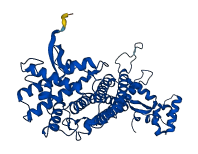
Descriptions
The autoinhibited protein was predicted that may have potential autoinhibitory elements via cis-regPred.
Autoinhibitory domains (AIDs)
Target domain |
|
Relief mechanism |
|
Assay |
cis-regPred |
Accessory elements
No accessory elements
Autoinhibited structure

Activated structure
1 structures for Q983U5
| Entry ID | Method | Resolution | Chain | Position | Source |
|---|---|---|---|---|---|
| AF-Q983U5-F1 | Predicted | AlphaFoldDB |
No variants for Q983U5
| Variant ID(s) | Position | Change | Description | Diseaes Association | Provenance |
|---|---|---|---|---|---|
| No variants for Q983U5 | |||||
No associated diseases with Q983U5
9 regional properties for Q983U5
| Type | Name | Position | InterPro Accession |
|---|---|---|---|
| domain | Elongation factor EFG, domain V-like | 600 - 687 | IPR000640 |
| domain | Translational (tr)-type GTP-binding domain | 10 - 285 | IPR000795 |
| domain | Translation elongation factor EFTu-like, domain 2 | 324 - 391 | IPR004161 |
| domain | Small GTP-binding protein domain | 11 - 182 | IPR005225 |
| domain | Translation elongation factor EFG/EF2, domain IV | 479 - 598 | IPR005517 |
| domain | Elongation factor G, domain III | 405 - 480 | IPR009022 |
| conserved_site | Tr-type G domain, conserved site | 53 - 68 | IPR031157 |
| domain | EFG, domain V | 603 - 680 | IPR035649 |
| domain | Elongation Factor G, domain II | 404 - 478 | IPR041095 |
Functions
| Description | ||
|---|---|---|
| EC Number | 4.2.1.2 | Hydro-lyases |
| Subcellular Localization |
|
|
| PANTHER Family | ||
| PANTHER Subfamily | ||
| PANTHER Protein Class | ||
| PANTHER Pathway Category | No pathway information available | |
1 GO annotations of cellular component
| Name | Definition |
|---|---|
| tricarboxylic acid cycle enzyme complex | Any of the heteromeric enzymes that act in the TCA cycle. |
1 GO annotations of molecular function
| Name | Definition |
|---|---|
| fumarate hydratase activity | Catalysis of the reaction: (S)-malate = fumarate + H(2)O. |
2 GO annotations of biological process
| Name | Definition |
|---|---|
| fumarate metabolic process | The chemical reactions and pathways involving fumarate, the anion of trans-1,2-ethenedicarboxylic acid, the diastereoisomer of maleate. It is a key intermediate in metabolism and is formed in the TCA cycle from succinate and converted into malate. |
| tricarboxylic acid cycle | A nearly universal metabolic pathway in which the acetyl group of acetyl coenzyme A is effectively oxidized to two CO2 and four pairs of electrons are transferred to coenzymes. The acetyl group combines with oxaloacetate to form citrate, which undergoes successive transformations to isocitrate, 2-oxoglutarate, succinyl-CoA, succinate, fumarate, malate, and oxaloacetate again, thus completing the cycle. In eukaryotes the tricarboxylic acid is confined to the mitochondria. See also glyoxylate cycle. |
No homologous proteins in AiPD
| UniProt AC | Gene Name | Protein Name | Species | Evidence Code |
|---|---|---|---|---|
| No homologous proteins | ||||
| 10 | 20 | 30 | 40 | 50 | 60 |
| MTVAKTRTET | DTFGPIEVAA | DRYWGAQAQR | SLGNFKIGWE | KQPASIVRAL | GVVKRAAAEV |
| 70 | 80 | 90 | 100 | 110 | 120 |
| NMEMKRLDPV | VGKAIVDAAQ | EVIDGKLNDH | FPLVVWQTGS | GTQSNMNANE | VISNRAIEML |
| 130 | 140 | 150 | 160 | 170 | 180 |
| GGVMGSKKPV | HPNDHVNMSQ | SSNDTYPTAM | HIACAEQVVH | HLIPALHHLH | KALDAKARAF |
| 190 | 200 | 210 | 220 | 230 | 240 |
| NHIIKIGRTH | TQDATPLTLG | QEFSGYAAQV | ASSIKRIEMT | LPGLQELAQG | GTAVGTGLNA |
| 250 | 260 | 270 | 280 | 290 | 300 |
| PVGFAEKVAD | RIAAITGIAF | VTAPNKFEAL | AAHDSMVFSH | GAINAAAAAL | FKIANDIRFL |
| 310 | 320 | 330 | 340 | 350 | 360 |
| GSGPRSGLGE | LSLPENEPGS | SIMPGKVNPT | QCEAMTQVCV | QVFGNNAALT | FAGSQGHFEL |
| 370 | 380 | 390 | 400 | 410 | 420 |
| NVYNPLMAYN | FLQSVQLLSD | ASVSFTDNCV | VGIEAREDNI | KAALDRSLML | VTALAPTIGY |
| 430 | 440 | 450 | 460 | ||
| DNAAKIAKTA | HKNGTTLREE | ALATGLVSEV | DYDRLVRPED | MTHPG |