Q97VF1
Gene name |
ape1 (SSO2675, C30_037) |
Protein name |
Probable aminopeptidase 1 |
Names |
|
Species |
Saccharolobus solfataricus (strain ATCC 35092 / DSM 1617 / JCM 11322 / P2) (Sulfolobus solfataricus) |
KEGG Pathway |
sso:SSO2675 |
EC number |
|
Protein Class |
|
Descriptions
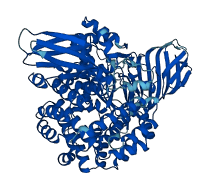
The autoinhibited protein was predicted that may have potential autoinhibitory elements via cis-regPred.
Autoinhibitory domains (AIDs)
Target domain |
|
Relief mechanism |
|
Assay |
cis-regPred |
Accessory elements
No accessory elements
Autoinhibited structure

Activated structure
1 structures for Q97VF1
| Entry ID | Method | Resolution | Chain | Position | Source |
|---|---|---|---|---|---|
| AF-Q97VF1-F1 | Predicted | AlphaFoldDB |
No variants for Q97VF1
| Variant ID(s) | Position | Change | Description | Diseaes Association | Provenance |
|---|---|---|---|---|---|
| No variants for Q97VF1 | |||||
No associated diseases with Q97VF1
1 GO annotations of cellular component
| Name | Definition |
|---|---|
| cytoplasm | The contents of a cell excluding the plasma membrane and nucleus, but including other subcellular structures. |
3 GO annotations of molecular function
| Name | Definition |
|---|---|
| metalloaminopeptidase activity | Catalysis of the hydrolysis of a single N-terminal amino acid residue from a polypeptide chain by a mechanism in which water acts as a nucleophile, one or two metal ions hold the water molecule in place, and charged amino acid side chains are ligands for the metal ions. |
| peptide binding | Binding to a peptide, an organic compound comprising two or more amino acids linked by peptide bonds. |
| zinc ion binding | Binding to a zinc ion (Zn). |
2 GO annotations of biological process
| Name | Definition |
|---|---|
| peptide catabolic process | The chemical reactions and pathways resulting in the breakdown of peptides, compounds of 2 or more (but usually less than 100) amino acids where the alpha carboxyl group of one is bound to the alpha amino group of another. |
| proteolysis | The hydrolysis of proteins into smaller polypeptides and/or amino acids by cleavage of their peptide bonds. |
No homologous proteins in AiPD
| UniProt AC | Gene Name | Protein Name | Species | Evidence Code |
|---|---|---|---|---|
| No homologous proteins | ||||
| 10 | 20 | 30 | 40 | 50 | 60 |
| MPNIEKYEIF | LDFNGNEYEG | VEKIYLNSEE | EKLELDSVNL | EIRSVKSDGK | DTKFELKGEK |
| 70 | 80 | 90 | 100 | 110 | 120 |
| LVIYGKIERE | LEIKFKGKAS | RDSILGIYVA | PYDGKGMITT | QFEAVYARRF | IPCFDHPAMK |
| 130 | 140 | 150 | 160 | 170 | 180 |
| ARFKLSVRVQ | KGLKVISNMP | VERIEEDVDG | KVIYRFQETP | KMSTYLLYLG | IDEFEEISDN |
| 190 | 200 | 210 | 220 | 230 | 240 |
| SKQPTVILAT | VPGKSKRGLF | AINVARKVIE | FYEKYFEIPY | QLPKVHLIQV | PEFAAGAMEN |
| 250 | 260 | 270 | 280 | 290 | 300 |
| WGAITFRETA | LLADDSSSIS | QKFRVAEVVA | HELAHQWFGN | LVTLKWWDDL | WLNESFATFM |
| 310 | 320 | 330 | 340 | 350 | 360 |
| SYKSIKHLFP | QWDSEGHLIY | DESIGALEDD | SLSTTHPIEA | HVKDPHEIEQ | MFDNISYGKG |
| 370 | 380 | 390 | 400 | 410 | 420 |
| ASILKMIEAY | VGEENFRRGV | VNYLNSFKFG | NAEGKDLWNS | ISNAAGQSIG | EIMADWITKP |
| 430 | 440 | 450 | 460 | 470 | 480 |
| GYPVIFVNAY | GNSIRFSQKR | FTLLDSGLNE | VYKVPITYEI | NDKFGTLLLD | KESAEIRLDE |
| 490 | 500 | 510 | 520 | 530 | 540 |
| GLKSIKVNIN | RTGFYRVLYD | SLNLAFSSKL | NAYEELGLVN | DYWNFLLADL | IDAKTYFGVI |
| 550 | 560 | 570 | 580 | 590 | 600 |
| GRFVYTSNSF | VSREITSQLL | TLYYLFKKNY | GKDFLVNQVK | IFRKANDDLG | KLAYSTVISA |
| 610 | 620 | 630 | 640 | 650 | 660 |
| LARMDEEFAL | GLSTLFDQYE | NIDSNIKEAV | AIAYAVTNND | FNTLLEKYKR | YTIDEEKNRI |
| 670 | 680 | 690 | 700 | 710 | 720 |
| LSAISSLRDP | SIVVKVFSLI | FERNIKAQDT | RFVISSLLHN | PHIREEVCSY | LMNNFEEVKK |
| 730 | 740 | 750 | 760 | 770 | 780 |
| FVNTVYGGPW | GLGSIVRSMS | FCGVDKPKDI | IDFLEKVKFK | EIERPIKESE | ERIKVYSRLK |
| QNLP |