Q97GC0
Gene name |
fprA2 (CA_C2449) |
Protein name |
Flavo-diiron protein FprA2 |
Names |
FDP 2, Flavoprotein A2, H(2)O-forming NADH oxidase, NADH oxidase, NADH:O(2) oxidoreductase |
Species |
Clostridium acetobutylicum (strain ATCC 824 / DSM 792 / JCM 1419 / LMG 5710 / VKM B-1787) |
KEGG Pathway |
cac:CA_C2449 |
EC number |
1.6.3.4: With oxygen as acceptor |
Protein Class |
|
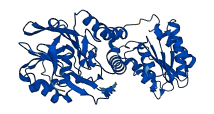
Descriptions
The autoinhibited protein was predicted that may have potential autoinhibitory elements via cis-regPred.
Autoinhibitory domains (AIDs)
Target domain |
|
Relief mechanism |
|
Assay |
cis-regPred |
Accessory elements
No accessory elements
Autoinhibited structure

Activated structure
1 structures for Q97GC0
| Entry ID | Method | Resolution | Chain | Position | Source |
|---|---|---|---|---|---|
| AF-Q97GC0-F1 | Predicted | AlphaFoldDB |
No variants for Q97GC0
| Variant ID(s) | Position | Change | Description | Diseaes Association | Provenance |
|---|---|---|---|---|---|
| No variants for Q97GC0 | |||||
No associated diseases with Q97GC0
Functions
| Description | ||
|---|---|---|
| EC Number | 1.6.3.4 | With oxygen as acceptor |
| Subcellular Localization |
|
|
| PANTHER Family | ||
| PANTHER Subfamily | ||
| PANTHER Protein Class | ||
| PANTHER Pathway Category | No pathway information available | |
No GO annotations of cellular component
| Name | Definition |
|---|---|
| No GO annotations for cellular component |
5 GO annotations of molecular function
| Name | Definition |
|---|---|
| electron transfer activity | Any molecular entity that serves as an electron acceptor and electron donor in an electron transport chain. An electron transport chain is a process in which a series of electron carriers operate together to transfer electrons from donors to any of several different terminal electron acceptors to generate a transmembrane electrochemical gradient. |
| FMN binding | Binding to flavin mono nucleotide. Flavin mono nucleotide (FMN) is the coenzyme or the prosthetic group of various flavoprotein oxidoreductase enzymes. |
| iron ion binding | Binding to an iron (Fe) ion. |
| nitric oxide reductase activity | Catalysis of the reaction: H(2)O + 2 ferricytochrome c + nitrous oxide = 2 H(+) + 2 ferrocytochrome c + 2 nitric oxide. |
| oxidoreductase activity, acting on NAD(P)H, oxygen as acceptor | Catalysis of an oxidation-reduction (redox) reaction in which NADH or NADPH acts as a hydrogen or electron donor and reduces an oxygen molecule. |
2 GO annotations of biological process
| Name | Definition |
|---|---|
| reactive oxygen species metabolic process | The chemical reactions and pathways involving a reactive oxygen species, any molecules or ions formed by the incomplete one-electron reduction of oxygen. They contribute to the microbicidal activity of phagocytes, regulation of signal transduction and gene expression, and the oxidative damage to biopolymers. |
| response to toxic substance | Any process that results in a change in state or activity of a cell or an organism (in terms of movement, secretion, enzyme production, gene expression, etc.) as a result of a toxic stimulus. |
No homologous proteins in AiPD
| UniProt AC | Gene Name | Protein Name | Species | Evidence Code |
|---|---|---|---|---|
| No homologous proteins | ||||
| 10 | 20 | 30 | 40 | 50 | 60 |
| MPAIKIKDNI | FSVGVLNPSL | RIFDIIMKTE | YGTSYNAYLI | KGKKNVLIDT | VHGRFFDEYL |
| 70 | 80 | 90 | 100 | 110 | 120 |
| ENIKSVIDPS | SIDYVIMNHC | EPDHSGSLAR | LYEVAPQIKV | IASNAGKIYL | KNITNKETLD |
| 130 | 140 | 150 | 160 | 170 | 180 |
| VKAVKTNDTL | DIGNGKVLKF | AIAPFLHWPD | SMFTILEEDK | IAFTCDFLGC | HFCEPRMFDT |
| 190 | 200 | 210 | 220 | 230 | 240 |
| KITYMPKYEK | SFKEYYDAIF | SPFKPYVVKG | LDILDALDLD | FIATSHGPIL | TREGLLAASK |
| 250 | 260 | 270 | 280 | 290 | 300 |
| QKYRDLSSEI | QSTTKYIPIF | YCSAYGNTEI | LANEIASGIK | SVLNDANIEM | LDIINYDYSD |
| 310 | 320 | 330 | 340 | 350 | 360 |
| LKEKINICDA | FMLGTPTINK | DALFPIWELI | GGIDAVNCKN | KPASAFGSFG | WSGEAIPFVI |
| 370 | 380 | 390 | |||
| SRLKELKLKV | FQDGFTCLFV | PSEDDIKKAF | KFGEDFAKSI |