Q979Y8
Gene name |
srp54 |
Protein name |
Signal recognition particle 54 kDa protein |
Names |
SRP54 |
Species |
Thermoplasma volcanium (strain ATCC 51530 / DSM 4299 / JCM 9571 / NBRC 15438 / GSS1) |
KEGG Pathway |
tvo:TVG1046103 |
EC number |
3.6.5.4: Acting on GTP; involved in cellular and subcellular movement |
Protein Class |
|
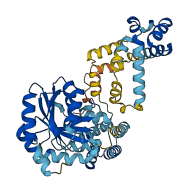
Descriptions
The autoinhibited protein was predicted that may have potential autoinhibitory elements via cis-regPred.
Autoinhibitory domains (AIDs)
Target domain |
|
Relief mechanism |
|
Assay |
cis-regPred |
Accessory elements
No accessory elements
Autoinhibited structure

Activated structure
1 structures for Q979Y8
| Entry ID | Method | Resolution | Chain | Position | Source |
|---|---|---|---|---|---|
| AF-Q979Y8-F1 | Predicted | AlphaFoldDB |
No variants for Q979Y8
| Variant ID(s) | Position | Change | Description | Diseaes Association | Provenance |
|---|---|---|---|---|---|
| No variants for Q979Y8 | |||||
No associated diseases with Q979Y8
6 regional properties for Q979Y8
| Type | Name | Position | InterPro Accession |
|---|---|---|---|
| repeat | WD40 repeat | 24 - 60 | IPR001680-1 |
| repeat | WD40 repeat | 62 - 101 | IPR001680-2 |
| repeat | WD40 repeat | 181 - 217 | IPR001680-3 |
| repeat | WD40 repeat | 220 - 258 | IPR001680-4 |
| repeat | WD40 repeat | 411 - 451 | IPR001680-5 |
| domain | Lethal giant larvae homologue 2 | 272 - 372 | IPR013577 |
Functions
| Description | ||
|---|---|---|
| EC Number | 3.6.5.4 | Acting on GTP; involved in cellular and subcellular movement |
| Subcellular Localization |
|
|
| PANTHER Family | ||
| PANTHER Subfamily | ||
| PANTHER Protein Class | ||
| PANTHER Pathway Category | No pathway information available | |
1 GO annotations of cellular component
| Name | Definition |
|---|---|
| signal recognition particle | A complex of protein and RNA which facilitates translocation of proteins across membranes. |
3 GO annotations of molecular function
| Name | Definition |
|---|---|
| 7S RNA binding | Binding to a 7S RNA, the RNA component of the signal recognition particle (SRP). |
| GTP binding | Binding to GTP, guanosine triphosphate. |
| GTPase activity | Catalysis of the reaction: GTP + H2O = GDP + H+ + phosphate. |
1 GO annotations of biological process
| Name | Definition |
|---|---|
| SRP-dependent cotranslational protein targeting to membrane | The targeting of proteins to a membrane that occurs during translation and is dependent upon two key components, the signal-recognition particle (SRP) and the SRP receptor. SRP is a cytosolic particle that transiently binds to the endoplasmic reticulum (ER) signal sequence in a nascent protein, to the large ribosomal unit, and to the SRP receptor in the ER membrane. |
No homologous proteins in AiPD
| UniProt AC | Gene Name | Protein Name | Species | Evidence Code |
|---|---|---|---|---|
| No homologous proteins | ||||
| 10 | 20 | 30 | 40 | 50 | 60 |
| MVLESLSSSL | RETIRKITGS | TYIDKNTVKE | ISKDLQRILL | KADVNVQTVL | NITKEMERRA |
| 70 | 80 | 90 | 100 | 110 | 120 |
| LEEKPPVGMA | HQDYMVKIIY | EELLKILGEP | SNVELKPQTI | MLVGLYGHGK | TTSAGKLSRF |
| 130 | 140 | 150 | 160 | 170 | 180 |
| FMKKGLSAGL | IAADVHRYAA | YEQLQQIAES | VNAKFYGDPK | EKDPVKIIKN | GLEVLKDAQV |
| 190 | 200 | 210 | 220 | 230 | 240 |
| KIIDTSGRDS | LDSDLIEEIR | RIKEAVKPDQ | VLMVIDATMG | QQAGPESKAI | NDAVGVTGII |
| 250 | 260 | 270 | 280 | 290 | 300 |
| ITKMDGTAKG | GGALSAVAKM | RVPIYFIGTG | EHMDDMEIFD | PKKFLSRLLG | LGDLETLFET |
| 310 | 320 | 330 | 340 | 350 | 360 |
| VKEANITEEE | AQKSFEKLMT | GKFNLKDMYD | VWEKFSRPGL | MKKLVDSLPL | AKLPGSQKIN |
| 370 | 380 | 390 | 400 | 410 | 420 |
| DDQILTAEQK | LQRYRIIMDS | MTFQELENPE | IINAKRITRI | ARGAGVREED | VRMLLKEFKA |
| 430 | 440 | 450 | |||
| MKNNMKLMKG | NRGFKKILQS | NFRSGNFGLD | DLGLK |