Q96YL5
Gene name |
nadE |
Protein name |
NH(3)-dependent NAD(+) synthetase |
Names |
|
Species |
Sulfurisphaera tokodaii (strain DSM 16993 / JCM 10545 / NBRC 100140 / 7) (Sulfolobus tokodaii) |
KEGG Pathway |
sto:STK_21590 |
EC number |
6.3.1.5: Acid--ammonia (or amine) ligases (amide synthases) |
Protein Class |
|
Descriptions
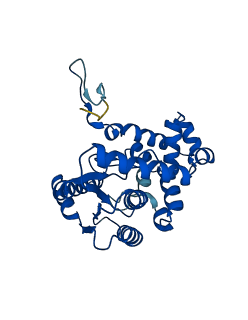
The autoinhibited protein was predicted that may have potential autoinhibitory elements via cis-regPred.
Autoinhibitory domains (AIDs)
Target domain |
|
Relief mechanism |
|
Assay |
cis-regPred |
Accessory elements
No accessory elements
Autoinhibited structure

Activated structure
1 structures for Q96YL5
| Entry ID | Method | Resolution | Chain | Position | Source |
|---|---|---|---|---|---|
| AF-Q96YL5-F1 | Predicted | AlphaFoldDB |
No variants for Q96YL5
| Variant ID(s) | Position | Change | Description | Diseaes Association | Provenance |
|---|---|---|---|---|---|
| No variants for Q96YL5 | |||||
No associated diseases with Q96YL5
1 regional properties for Q96YL5
| Type | Name | Position | InterPro Accession |
|---|---|---|---|
| domain | NAD/GMP synthase | 19 - 258 | IPR022310 |
Functions
| Description | ||
|---|---|---|
| EC Number | 6.3.1.5 | Acid--ammonia (or amine) ligases (amide synthases) |
| Subcellular Localization |
|
|
| PANTHER Family | ||
| PANTHER Subfamily | ||
| PANTHER Protein Class | ||
| PANTHER Pathway Category | No pathway information available | |
1 GO annotations of cellular component
| Name | Definition |
|---|---|
| cytoplasm | The contents of a cell excluding the plasma membrane and nucleus, but including other subcellular structures. |
5 GO annotations of molecular function
| Name | Definition |
|---|---|
| ATP binding | Binding to ATP, adenosine 5'-triphosphate, a universally important coenzyme and enzyme regulator. |
| glutaminase activity | Catalysis of the reaction: L-glutamine + H2O = L-glutamate + NH3. |
| metal ion binding | Binding to a metal ion. |
| NAD+ synthase (glutamine-hydrolyzing) activity | Catalysis of the reaction: ATP + deamido-NAD+ + L-glutamine + H2O = AMP + diphosphate + NAD+ + L-glutamate. |
| NAD+ synthase activity | Catalysis of the reaction: ATP + deamido-NAD+ + NH3 = AMP + diphosphate + NAD+. |
1 GO annotations of biological process
| Name | Definition |
|---|---|
| NAD biosynthetic process | The chemical reactions and pathways resulting in the formation of nicotinamide adenine dinucleotide, a coenzyme present in most living cells and derived from the B vitamin nicotinic acid; biosynthesis may be of either the oxidized form, NAD, or the reduced form, NADH. |
No homologous proteins in AiPD
| UniProt AC | Gene Name | Protein Name | Species | Evidence Code |
|---|---|---|---|---|
| No homologous proteins | ||||
| 10 | 20 | 30 | 40 | 50 | 60 |
| MMPEYVRKKL | TLDFGQVTDY | IVRRIREYIE | ESKKEGGIIG | LSGGIDSSVT | TILLSRATNN |
| 70 | 80 | 90 | 100 | 110 | 120 |
| FYILLMPTSS | TPQKDIEDAM | KIIKIVNGEN | KYSYINIDEI | INEFSSIVNI | SDKIVIGNIK |
| 130 | 140 | 150 | 160 | 170 | 180 |
| ARVRMTLLYA | FAQKMNYLVI | GTGDKSEIML | GYFTKYGDGG | VDVLPIGDLY | KTQVRMLGNY |
| 190 | 200 | 210 | 220 | 230 | 240 |
| LGVPEEIVKK | PPSPALWEGQ | TAEGEIGLDY | ETIDSILYLK | FEEMREPEEI | AEMTKTSYDK |
| 250 | 260 | 270 | |||
| VIKIINMVKT | SQHKRLPPEI | FRLSGRAINS | DWRYPRQWG |