Q96W30
Gene name |
HSP70-2 (PAAG_08003) |
Protein name |
Heat shock 70 kDa protein 2 |
Names |
|
Species |
Paracoccidioides lutzii (strain ATCC MYA-826 / Pb01) (Paracoccidioides brasiliensis) |
KEGG Pathway |
pbl:PAAG_08003 |
EC number |
|
Protein Class |
|
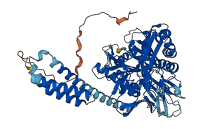
Descriptions
The autoinhibited protein was predicted that may have potential autoinhibitory elements via cis-regPred.
Autoinhibitory domains (AIDs)
Target domain |
|
Relief mechanism |
|
Assay |
cis-regPred |
Accessory elements
No accessory elements
Autoinhibited structure

Activated structure
1 structures for Q96W30
| Entry ID | Method | Resolution | Chain | Position | Source |
|---|---|---|---|---|---|
| AF-Q96W30-F1 | Predicted | AlphaFoldDB |
No variants for Q96W30
| Variant ID(s) | Position | Change | Description | Diseaes Association | Provenance |
|---|---|---|---|---|---|
| No variants for Q96W30 | |||||
No associated diseases with Q96W30
3 regional properties for Q96W30
| Type | Name | Position | InterPro Accession |
|---|---|---|---|
| conserved_site | Heat shock protein 70, conserved site | 7 - 14 | IPR018181-1 |
| conserved_site | Heat shock protein 70, conserved site | 195 - 208 | IPR018181-2 |
| conserved_site | Heat shock protein 70, conserved site | 332 - 346 | IPR018181-3 |
1 GO annotations of cellular component
| Name | Definition |
|---|---|
| cytosol | The part of the cytoplasm that does not contain organelles but which does contain other particulate matter, such as protein complexes. |
4 GO annotations of molecular function
| Name | Definition |
|---|---|
| ATP binding | Binding to ATP, adenosine 5'-triphosphate, a universally important coenzyme and enzyme regulator. |
| ATP hydrolysis activity | Catalysis of the reaction: ATP + H2O = ADP + H+ phosphate. ATP hydrolysis is used in some reactions as an energy source, for example to catalyze a reaction or drive transport against a concentration gradient. |
| ATP-dependent protein folding chaperone | Binding to a protein or a protein-containing complex to assist the protein folding process, driven by ATP hydrolysis. |
| unfolded protein binding | Binding to an unfolded protein. |
2 GO annotations of biological process
| Name | Definition |
|---|---|
| protein quality control for misfolded or incompletely synthesized proteins | The chemical reactions and pathways resulting in the breakdown of misfolded or attenuated proteins. |
| SRP-dependent cotranslational protein targeting to membrane, translocation | The process during cotranslational membrane targeting wherein proteins move across a membrane. SRP and its receptor initiate the transfer of the nascent chain across the endoplasmic reticulum (ER) membrane; they then dissociate from the chain, which is transferred to a set of transmembrane proteins, collectively called the translocon. Once the nascent chain translocon complex is assembled, the elongating chain passes directly from the large ribosomal subunit into the centers of the translocon, a protein-lined channel within the membrane. The growing chain is never exposed to the cytosol and does not fold until it reaches the ER lumen. |
No homologous proteins in AiPD
| UniProt AC | Gene Name | Protein Name | Species | Evidence Code |
|---|---|---|---|---|
| No homologous proteins | ||||
| 10 | 20 | 30 | 40 | 50 | 60 |
| MAPAIGIDLG | TTYSCVGIFR | DDRIEIIAND | QGNRTTPSFV | AFTDTERLIG | DAAKNQVAMN |
| 70 | 80 | 90 | 100 | 110 | 120 |
| PSNTVFDAKR | LIGRKFADPE | VQSDMKHFPF | KVIDKAGKPV | ISVEFKGEEK | QFTPEEISSM |
| 130 | 140 | 150 | 160 | 170 | 180 |
| VLTKMRETAE | SYLGGTVNNA | VVTVPAYFND | SQRQATKDAG | LIAGLNVLRI | INEPTAAAIA |
| 190 | 200 | 210 | 220 | 230 | 240 |
| YGLDKKAEGE | RNVLIFDLGG | GTFDVSLLTI | EEGIFEVKST | AGDTHLGGED | FDNRLVNHFV |
| 250 | 260 | 270 | 280 | 290 | 300 |
| NEFKRKHKKD | LSSNARALRR | LRTACERAKR | TLSSAAQTSI | EIDSLYEGID | FYTSITRARF |
| 310 | 320 | 330 | 340 | 350 | 360 |
| EELCQDLFRS | TMDPVERVLR | DAKIDKSSVH | EIVLVGGSTR | IPRIQKLVSD | FFNGKEPNKS |
| 370 | 380 | 390 | 400 | 410 | 420 |
| INPDEAVAYG | AAVQAAILSG | DTTSKSTNEI | LLLDVAPLSV | GIETAGGVMT | PLIKRNTTIP |
| 430 | 440 | 450 | 460 | 470 | 480 |
| TKKSETFSTF | ADNQPGVLIQ | VFEGERARTK | DNNLLGKFEL | TGIPPAPRGV | PQIEVTFDVD |
| 490 | 500 | 510 | 520 | 530 | 540 |
| ANGIMNVSAL | EKGTGKTNKI | VITNDKGRLS | KEEIERMLAE | AEKYKAEDEA | EASRISAKNG |
| 550 | 560 | 570 | 580 | 590 | 600 |
| LESYAYSLRN | TISDSKVDEK | LDASDKEKLK | TEIDKTVSWL | DENQTATKEE | FEAQQKELES |
| 610 | 620 | 630 | 640 | 650 | |
| VANPIMMKFY | GAGGEGGAPG | AGFPGAGGPG | GFPGAGAGGA | HSGGDDGPTV | EEVD |