Q96UX5
Gene name |
HSP78 (CAALFM_C203390CA, CaO19.8501, CaO19.882) |
Protein name |
Heat shock protein 78, mitochondrial |
Names |
|
Species |
Candida albicans (strain SC5314 / ATCC MYA-2876) (Yeast) |
KEGG Pathway |
cal:CAALFM_C203390CA |
EC number |
|
Protein Class |
|
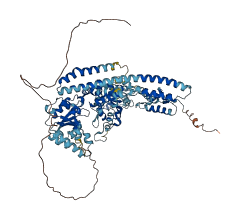
Descriptions
The autoinhibited protein was predicted that may have potential autoinhibitory elements via cis-regPred.
Autoinhibitory domains (AIDs)
Target domain |
|
Relief mechanism |
|
Assay |
cis-regPred |
Accessory elements
No accessory elements
Autoinhibited structure

Activated structure
1 structures for Q96UX5
| Entry ID | Method | Resolution | Chain | Position | Source |
|---|---|---|---|---|---|
| AF-Q96UX5-F1 | Predicted | AlphaFoldDB |
No variants for Q96UX5
| Variant ID(s) | Position | Change | Description | Diseaes Association | Provenance |
|---|---|---|---|---|---|
| No variants for Q96UX5 | |||||
No associated diseases with Q96UX5
8 regional properties for Q96UX5
| Type | Name | Position | InterPro Accession |
|---|---|---|---|
| domain | AAA+ ATPase domain | 125 - 271 | IPR003593-1 |
| domain | AAA+ ATPase domain | 526 - 672 | IPR003593-2 |
| domain | ATPase, AAA-type, core | 130 - 235 | IPR003959-1 |
| domain | ATPase, AAA-type, core | 525 - 693 | IPR003959-2 |
| conserved_site | ClpA/B, conserved site 1 | 221 - 233 | IPR018368 |
| domain | Clp ATPase, C-terminal | 699 - 788 | IPR019489 |
| conserved_site | ClpA/B, conserved site 2 | 560 - 578 | IPR028299 |
| domain | ClpA/ClpB, AAA lid domain | 269 - 370 | IPR041546 |
2 GO annotations of cellular component
| Name | Definition |
|---|---|
| cytoplasm | The contents of a cell excluding the plasma membrane and nucleus, but including other subcellular structures. |
| mitochondrial matrix | The gel-like material, with considerable fine structure, that lies in the matrix space, or lumen, of a mitochondrion. It contains the enzymes of the tricarboxylic acid cycle and, in some organisms, the enzymes concerned with fatty acid oxidation. |
5 GO annotations of molecular function
| Name | Definition |
|---|---|
| ATP binding | Binding to ATP, adenosine 5'-triphosphate, a universally important coenzyme and enzyme regulator. |
| ATP hydrolysis activity | Catalysis of the reaction: ATP + H2O = ADP + H+ phosphate. ATP hydrolysis is used in some reactions as an energy source, for example to catalyze a reaction or drive transport against a concentration gradient. |
| chaperone binding | Binding to a chaperone protein, a class of proteins that bind to nascent or unfolded polypeptides and ensure correct folding or transport. |
| misfolded protein binding | Binding to a misfolded protein. |
| unfolded protein binding | Binding to an unfolded protein. |
7 GO annotations of biological process
| Name | Definition |
|---|---|
| cellular heat acclimation | Any process that increases heat tolerance of a cell in response to high temperatures. |
| cellular response to heat | Any process that results in a change in state or activity of a cell (in terms of movement, secretion, enzyme production, gene expression, etc.) as a result of a heat stimulus, a temperature stimulus above the optimal temperature for that organism. |
| chaperone cofactor-dependent protein refolding | The process of assisting in the correct posttranslational noncovalent assembly of proteins, which is dependent on additional protein cofactors. This process occurs over one or several cycles of nucleotide hydrolysis-dependent binding and release. |
| mitochondrial genome maintenance | The maintenance of the structure and integrity of the mitochondrial genome; includes replication and segregation of the mitochondrial chromosome. |
| protein refolding | The process carried out by a cell that restores the biological activity of an unfolded or misfolded protein, using helper proteins such as chaperones. |
| protein stabilization | Any process involved in maintaining the structure and integrity of a protein and preventing it from degradation or aggregation. |
| protein unfolding | The process of assisting in the disassembly of non-covalent linkages in a protein or protein aggregate, often where the proteins are in a non-functional or denatured state. |
No homologous proteins in AiPD
| UniProt AC | Gene Name | Protein Name | Species | Evidence Code |
|---|---|---|---|---|
| No homologous proteins | ||||
| 10 | 20 | 30 | 40 | 50 | 60 |
| MLSSRIPKGK | LLKQTSATSY | LNLAKSMPIT | TARYRPNQYY | ANELAKLNVF | TIHNIPSPCF |
| 70 | 80 | 90 | 100 | 110 | 120 |
| SQVRNFHSSF | PRKLQMQQTE | QGDNRPALEK | FGSDLTQLAK | EGKLDPVIGR | DHEIRRTIQI |
| 130 | 140 | 150 | 160 | 170 | 180 |
| LSRRTKNNPV | LIGNAGTGKT | AVMEGLAQRI | IRGEVPDSMK | DKQIITLDLA | GIISGAKYRG |
| 190 | 200 | 210 | 220 | 230 | 240 |
| DFESKLKSIL | KEVEEKNGKV | ILFIDEFHLL | MGLGKAEGSI | DASNLLKPAL | ARGKLSMCGA |
| 250 | 260 | 270 | 280 | 290 | 300 |
| TTIEEYRKYV | EKDAALARRF | SPVTVNEPTV | EDTISILRGL | KERYEVHHGV | RIMDSALVTA |
| 310 | 320 | 330 | 340 | 350 | 360 |
| ALYSNRYITD | RFLPDKAIDL | VDEASSTLRL | QHESRPDAIA | TLDRQIMTIE | IELESLRKEE |
| 370 | 380 | 390 | 400 | 410 | 420 |
| DQLSIDRKHK | LEKELEVKKS | ELKELTDQWE | SEKRAIDAVK | NAKSELEKAK | YELEQATREG |
| 430 | 440 | 450 | 460 | 470 | 480 |
| DYARASRIQY | ASIPELQDKI | QELSKNELAA | KSSNLLHDSV | TSEDIAGVIS | KMTGIPVNNL |
| 490 | 500 | 510 | 520 | 530 | 540 |
| LKGEKDKLLD | MNILLRQSVV | GQDEAIDAVS | DAVRLQRAGL | TSENRPIASF | MFLGPTGTGK |
| 550 | 560 | 570 | 580 | 590 | 600 |
| TEGGKSLAQF | LFNDKNAVVR | FDMSEFQEKH | TISRLIGSPP | GYVGYEESGE | LTEAVRRKPY |
| 610 | 620 | 630 | 640 | 650 | 660 |
| SVVLFDEFEK | AHPDLSKLLL | QVLDEGSLTD | SHGKKIDFKN | TIIVMTSNIG | QEILLADKNT |
| 670 | 680 | 690 | 700 | 710 | 720 |
| YEDGHINSEV | KSQVLENLRH | HYAPEFLNRI | DDIVVFNRLS | KTALKEILDI | RLREIGDRLV |
| 730 | 740 | 750 | 760 | 770 | 780 |
| DKRIILQLTD | EAKTLLCDMG | YDPTYGARPL | NRVLRKKLLD | PLAMRLIKGQ | VQENETVKVE |
| 790 | 800 | 810 | |||
| VKDHKIYVVP | NHSEGTVIEK | EEDYFKEDKD | DN |