Q96563
Gene name |
HEMA2 |
Protein name |
Glutamyl-tRNA reductase 2 |
Names |
GluTR |
Species |
Hordeum vulgare (Barley) |
KEGG Pathway |
|
EC number |
1.2.1.70: With NAD(+) or NADP(+) as acceptor |
Protein Class |
|
Descriptions
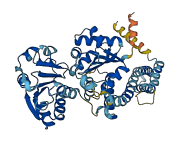
The autoinhibited protein was predicted that may have potential autoinhibitory elements via cis-regPred.
Autoinhibitory domains (AIDs)
Target domain |
|
Relief mechanism |
|
Assay |
cis-regPred |
Accessory elements
No accessory elements
Autoinhibited structure

Activated structure
1 structures for Q96563
| Entry ID | Method | Resolution | Chain | Position | Source |
|---|---|---|---|---|---|
| AF-Q96563-F1 | Predicted | AlphaFoldDB |
No variants for Q96563
| Variant ID(s) | Position | Change | Description | Diseaes Association | Provenance |
|---|---|---|---|---|---|
| No variants for Q96563 | |||||
No associated diseases with Q96563
4 regional properties for Q96563
| Type | Name | Position | InterPro Accession |
|---|---|---|---|
| domain | Quinate/shikimate 5-dehydrogenase/glutamyl-tRNA reductase | 185 - 326 | IPR006151 |
| domain | Glutamyl-tRNA reductase, N-terminal | 19 - 169 | IPR015895 |
| domain | Tetrapyrrole biosynthesis, glutamyl-tRNA reductase, dimerisation domain | 340 - 445 | IPR015896 |
| conserved_site | Glutamyl-tRNA reductase, conserved site | 112 - 135 | IPR018214 |
Functions
| Description | ||
|---|---|---|
| EC Number | 1.2.1.70 | With NAD(+) or NADP(+) as acceptor |
| Subcellular Localization |
|
|
| PANTHER Family | ||
| PANTHER Subfamily | ||
| PANTHER Protein Class | ||
| PANTHER Pathway Category | No pathway information available | |
1 GO annotations of cellular component
| Name | Definition |
|---|---|
| chloroplast | A chlorophyll-containing plastid with thylakoids organized into grana and frets, or stroma thylakoids, and embedded in a stroma. |
2 GO annotations of molecular function
| Name | Definition |
|---|---|
| glutamyl-tRNA reductase activity | Catalysis of the reaction: (S)-4-amino-5-oxopentanoate + NADP(+) + tRNA(Glu) = L-glutamyl-tRNA(Glu) + H(+) + NADPH. |
| NADP binding | Binding to nicotinamide-adenine dinucleotide phosphate, a coenzyme involved in many redox and biosynthetic reactions; binding may be to either the oxidized form, NADP+, or the reduced form, NADPH. |
2 GO annotations of biological process
| Name | Definition |
|---|---|
| chlorophyll biosynthetic process | The chemical reactions and pathways resulting in the formation of chlorophyll, any compound of magnesium complexed in a porphyrin (tetrapyrrole) ring and which functions as a photosynthetic pigment, from less complex precursors. |
| protoporphyrinogen IX biosynthetic process | The chemical reactions and pathways resulting in the formation of protoporphyrinogen IX. |
No homologous proteins in AiPD
| UniProt AC | Gene Name | Protein Name | Species | Evidence Code |
|---|---|---|---|---|
| No homologous proteins | ||||
| 10 | 20 | 30 | 40 | 50 | 60 |
| QFKISADRYI | KEKSSIAVIG | LSVHTAPVDM | REKLAVAEEL | WPRAISELTS | LNHIEEAAVL |
| 70 | 80 | 90 | 100 | 110 | 120 |
| STCNRMEIYV | VALSWNRGIR | EVVDWMSKKS | GIPASELREH | LFMLRDSGAT | RHLFEVSAGL |
| 130 | 140 | 150 | 160 | 170 | 180 |
| DSLVLGEGQI | LAQVKQVVRN | GQNSGGLGKN | IDRMFKDAIT | AGKRARCETN | ISAGAVSVSS |
| 190 | 200 | 210 | 220 | 230 | 240 |
| AAVELAMMKL | PKSECLSARM | LLIGAGKMGK | LVVKHLIAKG | CKKVVVVNRS | VERVDAIREE |
| 250 | 260 | 270 | 280 | 290 | 300 |
| MKDIEIVYRP | LTEMYEAAAD | ADVVFTSTAS | ESLLFTKEHA | EALPPISLAM | GGVRLFVDIS |
| 310 | 320 | 330 | 340 | 350 | 360 |
| VPRNVGACLS | QVEHARVYNV | DDLKEVVEAN | KEDRVRKAME | AQAIITQELK | RFEAWRDSLE |
| 370 | 380 | 390 | 400 | 410 | 420 |
| TVPTIKKLRS | YADRIRASEL | DKCLQKIGED | NLNKKTRRSI | EELSTGIVNK | LLHGPLQHLR |
| 430 | 440 | 450 | 460 | ||
| CDGSDSRTLD | ETLDNMHALN | RMFNLDTEKA | VLEQKIKAKV | EKTQS |