Q96250
Gene name |
ATPC (At2g33040, F25I18.22) |
Protein name |
ATP synthase subunit gamma, mitochondrial |
Names |
F-ATPase gamma subunit |
Species |
Arabidopsis thaliana (Mouse-ear cress) |
KEGG Pathway |
ath:AT2G33040 |
EC number |
|
Protein Class |
|
Descriptions
The autoinhibited protein was predicted that may have potential autoinhibitory elements via cis-regPred.
Autoinhibitory domains (AIDs)
Target domain |
|
Relief mechanism |
|
Assay |
cis-regPred |
Accessory elements
No accessory elements
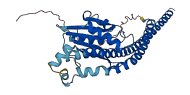
Autoinhibited structure

Activated structure
1 structures for Q96250
| Entry ID | Method | Resolution | Chain | Position | Source |
|---|---|---|---|---|---|
| AF-Q96250-F1 | Predicted | AlphaFoldDB |
12 variants for Q96250
| Variant ID(s) | Position | Change | Description | Diseaes Association | Provenance |
|---|---|---|---|---|---|
| tmp_2_14021038_C_A | 4 | A>S | No | 1000Genomes | |
| tmp_2_14021035_C_A | 5 | V>F | No | 1000Genomes | |
| ENSVATH00257989 | 10 | G>A | No | 1000Genomes | |
| ENSVATH14580186 | 11 | R>G | No | 1000Genomes | |
| tmp_2_14020545_C_G | 34 | E>D | No | 1000Genomes | |
| tmp_2_14020538_G_T | 37 | L>I | No | 1000Genomes | |
| ENSVATH14580153 | 102 | V>A | No | 1000Genomes | |
| tmp_2_14019948_G_C | 130 | A>G | No | 1000Genomes | |
| ENSVATH05647820 | 136 | A>T | No | 1000Genomes | |
| tmp_2_14019843_G_C | 138 | P>A | No | 1000Genomes | |
| tmp_2_14019832_T_G | 141 | E>D | No | 1000Genomes | |
| tmp_2_14019522_C_T | 208 | A>T | No | 1000Genomes |
No associated diseases with Q96250
1 regional properties for Q96250
| Type | Name | Position | InterPro Accession |
|---|---|---|---|
| conserved_site | ATP synthase, F1 complex, gamma subunit conserved site | 307 - 320 | IPR023632 |
9 GO annotations of cellular component
| Name | Definition |
|---|---|
| chloroplast | A chlorophyll-containing plastid with thylakoids organized into grana and frets, or stroma thylakoids, and embedded in a stroma. |
| cytoplasm | The contents of a cell excluding the plasma membrane and nucleus, but including other subcellular structures. |
| endoplasmic reticulum | The irregular network of unit membranes, visible only by electron microscopy, that occurs in the cytoplasm of many eukaryotic cells. The membranes form a complex meshwork of tubular channels, which are often expanded into slitlike cavities called cisternae. The ER takes two forms, rough (or granular), with ribosomes adhering to the outer surface, and smooth (with no ribosomes attached). |
| mitochondrial proton-transporting ATP synthase complex | A proton-transporting ATP synthase complex found in the mitochondrial membrane. |
| mitochondrial proton-transporting ATP synthase complex, catalytic sector F(1) | The catalytic sector of the mitochondrial hydrogen-transporting ATP synthase; it comprises the catalytic core and central stalk, and is peripherally associated with the mitochondrial inner membrane when the entire ATP synthase is assembled. |
| mitochondrion | A semiautonomous, self replicating organelle that occurs in varying numbers, shapes, and sizes in the cytoplasm of virtually all eukaryotic cells. It is notably the site of tissue respiration. |
| nucleolus | A small, dense body one or more of which are present in the nucleus of eukaryotic cells. It is rich in RNA and protein, is not bounded by a limiting membrane, and is not seen during mitosis. Its prime function is the transcription of the nucleolar DNA into 45S ribosomal-precursor RNA, the processing of this RNA into 5.8S, 18S, and 28S components of ribosomal RNA, and the association of these components with 5S RNA and proteins synthesized outside the nucleolus. This association results in the formation of ribonucleoprotein precursors; these pass into the cytoplasm and mature into the 40S and 60S subunits of the ribosome. |
| nucleus | A membrane-bounded organelle of eukaryotic cells in which chromosomes are housed and replicated. In most cells, the nucleus contains all of the cell's chromosomes except the organellar chromosomes, and is the site of RNA synthesis and processing. In some species, or in specialized cell types, RNA metabolism or DNA replication may be absent. |
| plant-type cell wall | A more or less rigid stucture lying outside the cell membrane of a cell and composed of cellulose and pectin and other organic and inorganic substances. |
2 GO annotations of molecular function
| Name | Definition |
|---|---|
| proton-transporting ATP synthase activity, rotational mechanism | Enables the synthesis of ATP from ADP and phosphate by the transfer of protons from one side of a membrane to the other by a rotational mechanism driven by a gradient according to the reaction: ADP + H2O + phosphate + H+(in) -> ATP + H+(out). |
| zinc ion binding | Binding to a zinc ion (Zn). |
1 GO annotations of biological process
| Name | Definition |
|---|---|
| proton motive force-driven ATP synthesis | The transport of protons across a membrane to generate an electrochemical gradient (proton-motive force) that powers ATP synthesis. |
No homologous proteins in AiPD
| UniProt AC | Gene Name | Protein Name | Species | Evidence Code |
|---|---|---|---|---|
| No homologous proteins | ||||
| 10 | 20 | 30 | 40 | 50 | 60 |
| MAMAVFRREG | RRLLPSIAAR | PIAAIRSPLS | SDQEEGLLGV | RSISTQVVRN | RMKSVKNIQK |
| 70 | 80 | 90 | 100 | 110 | 120 |
| ITKAMKMVAA | SKLRAVQGRA | ENSRGLWQPF | TALLGDNPSI | DVKKSVVVTL | SSDKGLCGGI |
| 130 | 140 | 150 | 160 | 170 | 180 |
| NSTVVKVSRA | LYKLNAGPEK | EVQFVIVGEK | AKAIMFRDSK | NDIVLSVTEL | NKNPLNYAQV |
| 190 | 200 | 210 | 220 | 230 | 240 |
| SVLADDILKN | VEFDALRIVY | NKFHSVVAFL | PTVSTVLSPE | IIEKESEIGG | KLGELDSYEI |
| 250 | 260 | 270 | 280 | 290 | 300 |
| EGGETKGEIL | QNLAEFQFSC | VMFNAVLENA | CSEMGARMSA | MDSSSRNAGE | MLDRLTLTYN |
| 310 | 320 | ||||
| RTRQASITTE | LIEIISGASA | LEAAK |