Q95YH0
Gene name |
cdk8 (DDB_G0267442) |
Protein name |
Probable cyclin-dependent kinase 8 |
Names |
Ddcdk8 |
Species |
Dictyostelium discoideum (Slime mold) |
KEGG Pathway |
ddi:DDB_G0267442 |
EC number |
2.7.11.22: Protein-serine/threonine kinases |
Protein Class |
|
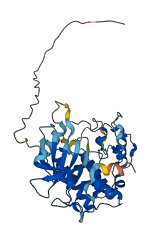
Descriptions
The autoinhibited protein was predicted that may have potential autoinhibitory elements via cis-regPred.
Autoinhibitory domains (AIDs)
Target domain |
|
Relief mechanism |
|
Assay |
cis-regPred |
Accessory elements
193-218 (Activation loop from InterPro)
Target domain |
44-348 (Protein kinase domain) |
Relief mechanism |
|
Assay |
|
Autoinhibited structure

Activated structure
1 structures for Q95YH0
| Entry ID | Method | Resolution | Chain | Position | Source |
|---|---|---|---|---|---|
| AF-Q95YH0-F1 | Predicted | AlphaFoldDB |
No variants for Q95YH0
| Variant ID(s) | Position | Change | Description | Diseaes Association | Provenance |
|---|---|---|---|---|---|
| No variants for Q95YH0 | |||||
No associated diseases with Q95YH0
2 regional properties for Q95YH0
| Type | Name | Position | InterPro Accession |
|---|---|---|---|
| domain | ResB-like domain | 30 - 292 | IPR007816-1 |
| domain | ResB-like domain | 307 - 444 | IPR007816-2 |
Functions
| Description | ||
|---|---|---|
| EC Number | 2.7.11.22 | Protein-serine/threonine kinases |
| Subcellular Localization |
|
|
| PANTHER Family | ||
| PANTHER Subfamily | ||
| PANTHER Protein Class | ||
| PANTHER Pathway Category | No pathway information available | |
3 GO annotations of cellular component
| Name | Definition |
|---|---|
| cytosol | The part of the cytoplasm that does not contain organelles but which does contain other particulate matter, such as protein complexes. |
| mediator complex | A protein complex that interacts with the carboxy-terminal domain of the largest subunit of RNA polymerase II and plays an active role in transducing the signal from a transcription factor to the transcriptional machinery. The mediator complex is required for activation of transcription of most protein-coding genes, but can also act as a transcriptional corepressor. The Saccharomyces complex contains several identifiable subcomplexes: a head domain comprising Srb2, -4, and -5, Med6, -8, and -11, and Rox3 proteins; a middle domain comprising Med1, -4, and -7, Nut1 and -2, Cse2, Rgr1, Soh1, and Srb7 proteins; a tail consisting of Gal11p, Med2p, Pgd1p, and Sin4p; and a regulatory subcomplex comprising Ssn2, -3, and -8, and Srb8 proteins. Metazoan mediator complexes have similar modular structures and include homologs of yeast Srb and Med proteins. |
| nucleus | A membrane-bounded organelle of eukaryotic cells in which chromosomes are housed and replicated. In most cells, the nucleus contains all of the cell's chromosomes except the organellar chromosomes, and is the site of RNA synthesis and processing. In some species, or in specialized cell types, RNA metabolism or DNA replication may be absent. |
5 GO annotations of molecular function
| Name | Definition |
|---|---|
| ATP binding | Binding to ATP, adenosine 5'-triphosphate, a universally important coenzyme and enzyme regulator. |
| cyclin-dependent protein serine/threonine kinase activity | Cyclin-dependent catalysis of the reactions: ATP + protein serine = ADP + protein serine phosphate, and ATP + protein threonine = ADP + protein threonine phosphate. |
| cyclin-dependent protein serine/threonine kinase regulator activity | Modulates the activity of a cyclin-dependent protein serine/threonine kinase, enzymes of the protein kinase family that are regulated through association with cyclins and other proteins. |
| protein serine kinase activity | Catalysis of the reactions: ATP + protein serine = ADP + protein serine phosphate. |
| RNA polymerase II CTD heptapeptide repeat kinase activity | Catalysis of the reaction: ATP + RNA polymerase II large subunit CTD heptapeptide repeat (YSPTSPS) = ADP + H+ + phosphorylated RNA polymerase II. |
7 GO annotations of biological process
| Name | Definition |
|---|---|
| aggregation involved in sorocarp development | The process whose specific outcome is the progression of the aggregate over time, from its formation to the point when a slug is formed. Aggregate development begins in response to starvation and continues by the chemoattractant-mediated movement of cells toward each other. The aggregate is a multicellular structure that gives rise to the slug. |
| G1/S transition of mitotic cell cycle | The mitotic cell cycle transition by which a cell in G1 commits to S phase. The process begins with the build up of G1 cyclin-dependent kinase (G1 CDK), resulting in the activation of transcription of G1 cyclins. The process ends with the positive feedback of the G1 cyclins on the G1 CDK which commits the cell to S phase, in which DNA replication is initiated. |
| positive regulation of gene expression | Any process that increases the frequency, rate or extent of gene expression. Gene expression is the process in which a gene's coding sequence is converted into a mature gene product (protein or RNA). |
| protein phosphorylation | The process of introducing a phosphate group on to a protein. |
| protein stabilization | Any process involved in maintaining the structure and integrity of a protein and preventing it from degradation or aggregation. |
| regulation of aggregation involved in sorocarp development | Any process that modulates the frequency, rate or extent of aggregation during sorocarp development. Aggregation involved in sorocarp development is the process whose specific outcome is the progression of the aggregate over time, from its formation to the point when a slug is formed. Aggregate development begins in response to starvation and continues by the chemoattractant-mediated movement of cells toward each other. The aggregate is a multicellular structure that gives rise to the slug. |
| sorocarp spore cell differentiation | The process in which a relatively unspecialized cell acquires specialized features of a sorocarp spore cell, a cell of the sorocarp sorus. A sorocarp is the fruiting body characteristic of certain cellular slime moulds (e.g., Dictyosteliida) and consists of both stalk and a sorus (spore mass). |
No homologous proteins in AiPD
| UniProt AC | Gene Name | Protein Name | Species | Evidence Code |
|---|---|---|---|---|
| No homologous proteins | ||||
| 10 | 20 | 30 | 40 | 50 | 60 |
| MNTHNQSSNQ | NGGGSGGGGG | GGGSSTFSPI | VLTSTYRLDV | QEKYTFSYEI | GSGTYGMVYK |
| 70 | 80 | 90 | 100 | 110 | 120 |
| ADDKKRPNNK | VAVKKFRSTK | EGEGLSLTAY | REIGLLKELS | NENIVKLLDV | CLNPKDKLLY |
| 130 | 140 | 150 | 160 | 170 | 180 |
| LIFDYAEFDL | FGIIKYHREN | GSHFSDATIK | SLIWQVLNGI | HYLHSNWVIH | RDLKPSNILV |
| 190 | 200 | 210 | 220 | 230 | 240 |
| MGEGKECGTV | KIGDFGLARI | FQSPLKPLNE | NGVVVTIWYR | SPELLLGSKH | YTRAVDIWAI |
| 250 | 260 | 270 | 280 | 290 | 300 |
| GCIFAELITT | KPLFPGKEKD | PKIPSLFQDD | QVEKIIRVLG | KPTLDMWPDI | KHLPEWKRLS |
| 310 | 320 | 330 | 340 | 350 | 360 |
| SMEAFPNSLA | KCVGIDENSQ | AYDLLSKMIL | YDPSKRITAS | EALDHPYFKE | LPLPLPNAFS |
| 370 | |||||
| KPIPYPPRLP | INKKKREFDD |