Q95RV2
Gene name |
cav |
Protein name |
Telomere-binding protein cav |
Names |
Anonymous fast evolving 1G5, HP1/ORC-associated protein, HOAP p55, Protein caravaggio |
Species |
Drosophila melanogaster (Fruit fly) |
KEGG Pathway |
dme:Dmel_CG6219 |
EC number |
|
Protein Class |
|
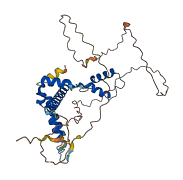
Descriptions
The autoinhibited protein was predicted that may have potential autoinhibitory elements via cis-regPred.
Autoinhibitory domains (AIDs)
Target domain |
|
Relief mechanism |
|
Assay |
cis-regPred |
Accessory elements
No accessory elements
Autoinhibited structure

Activated structure
1 structures for Q95RV2
| Entry ID | Method | Resolution | Chain | Position | Source |
|---|---|---|---|---|---|
| AF-Q95RV2-F1 | Predicted | AlphaFoldDB |
7 variants for Q95RV2
| Variant ID(s) | Position | Change | Description | Diseaes Association | Provenance |
|---|---|---|---|---|---|
| 27 | K>N | strain: NC350 and NC358 [UniProt] | No | ||
| 144 | S>T | strain: Canton-S [UniProt] | No | ||
| 149 | W>C | strain: Canton-S [UniProt] | No | ||
| 154 | S>T | strain: Australia 2, Kenya 38, Kenya 43, Peru and USA 3 [UniProt] | No | ||
| 198 | M>I | strain: Australia 5 [UniProt] | No | ||
| 236 | N>Y | strain: Japan [UniProt] | No | ||
| 273 | Y>F | strain: Australia 5 and USA 1 [UniProt] | No |
No associated diseases with Q95RV2
Functions
4 GO annotations of cellular component
| Name | Definition |
|---|---|
| chromosome, centromeric region | The region of a chromosome that includes the centromeric DNA and associated proteins. In monocentric chromosomes, this region corresponds to a single area of the chromosome, whereas in holocentric chromosomes, it is evenly distributed along the chromosome. |
| chromosome, telomeric region | The end of a linear chromosome, required for the integrity and maintenance of the end. A chromosome telomere usually includes a region of telomerase-encoded repeats the length of which rarely exceeds 20 bp each and that permits the formation of a telomeric loop (T-loop). The telomeric repeat region is usually preceded by a sub-telomeric region that is gene-poor but rich in repetitive elements. Some telomeres only consist of the latter part (for eg. D. melanogaster telomeres). |
| nucleus | A membrane-bounded organelle of eukaryotic cells in which chromosomes are housed and replicated. In most cells, the nucleus contains all of the cell's chromosomes except the organellar chromosomes, and is the site of RNA synthesis and processing. In some species, or in specialized cell types, RNA metabolism or DNA replication may be absent. |
| telomere cap complex | A complex of DNA and protein located at the end of a linear chromosome that protects and stabilizes a linear chromosome. |
1 GO annotations of molecular function
| Name | Definition |
|---|---|
| telomeric DNA binding | Binding to a telomere, a specific structure at the end of a linear chromosome required for the integrity and maintenance of the end. |
2 GO annotations of biological process
| Name | Definition |
|---|---|
| telomere capping | A process in which telomeres are protected from degradation and fusion, thereby ensuring chromosome stability by protecting the ends from both degradation and from being recognized as damaged DNA. May be mediated by specific single- or double-stranded telomeric DNA binding proteins. |
| telomere maintenance | Any process that contributes to the maintenance of proper telomeric length and structure by affecting and monitoring the activity of telomeric proteins, the length of telomeric DNA and the replication and repair of the DNA. These processes includes those that shorten, lengthen, replicate and repair the telomeric DNA sequences. |
No homologous proteins in AiPD
| UniProt AC | Gene Name | Protein Name | Species | Evidence Code |
|---|---|---|---|---|
| No homologous proteins | ||||
| 10 | 20 | 30 | 40 | 50 | 60 |
| MLLLLCVNMS | GTQMSAFLRK | YLADEDKKIR | AQFKESDPNN | KLILWMHEKT | RITEEDLARP |
| 70 | 80 | 90 | 100 | 110 | 120 |
| YTEDEVKELC | LRTKVKVDMT | AWNCLWEAKK | RFEAKGRFVN | KSERFINRMY | MKAVRRKMVQ |
| 130 | 140 | 150 | 160 | 170 | 180 |
| PYPEEFVAQR | REIVAAETKK | QNISRLDRWQ | KKKSQNLSAP | ESSPDAHASS | NDAVQSHEDQ |
| 190 | 200 | 210 | 220 | 230 | 240 |
| ANTNLSSLSQ | MNFQVEAMAP | PGVSSSDLSG | IGDDEDEQQQ | SGFQDENINR | PETEINENSV |
| 250 | 260 | 270 | 280 | 290 | 300 |
| RCDPINLGRM | RTGCINSQAN | NSFRNTESDP | DYYMFGTQLS | TLVRPTSTQE | PDDQVNCPET |
| 310 | 320 | 330 | 340 | ||
| EMNESWVRCD | QINSESLSIG | PSIDSEGTIT | FQNTESEPID | VTSIA |