Q95NH6
Gene name |
AttC |
Protein name |
Attacin-C |
Names |
|
Species |
Drosophila melanogaster (Fruit fly) |
KEGG Pathway |
dme:Dmel_CG4740 |
EC number |
|
Protein Class |
|
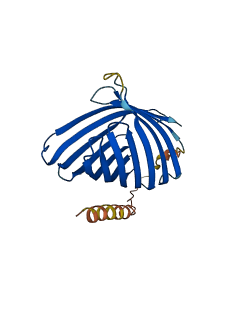
Descriptions
The autoinhibited protein was predicted that may have potential autoinhibitory elements via cis-regPred.
Autoinhibitory domains (AIDs)
Target domain |
|
Relief mechanism |
|
Assay |
cis-regPred |
Accessory elements
No accessory elements
Autoinhibited structure

Activated structure
1 structures for Q95NH6
| Entry ID | Method | Resolution | Chain | Position | Source |
|---|---|---|---|---|---|
| AF-Q95NH6-F1 | Predicted | AlphaFoldDB |
2 variants for Q95NH6
| Variant ID(s) | Position | Change | Description | Diseaes Association | Provenance |
|---|---|---|---|---|---|
| 27 | Y>del | strain: Berkeley [UniProt] | No | ||
| 165 | G>E | strain: Berkeley [UniProt] | No |
No associated diseases with Q95NH6
2 GO annotations of cellular component
| Name | Definition |
|---|---|
| extracellular region | The space external to the outermost structure of a cell. For cells without external protective or external encapsulating structures this refers to space outside of the plasma membrane. This term covers the host cell environment outside an intracellular parasite. |
| extracellular space | That part of a multicellular organism outside the cells proper, usually taken to be outside the plasma membranes, and occupied by fluid. |
No GO annotations of molecular function
| Name | Definition |
|---|---|
| No GO annotations for molecular function |
6 GO annotations of biological process
| Name | Definition |
|---|---|
| antibacterial humoral response | An immune response against bacteria mediated through a body fluid. Examples of this process are the antibacterial humoral responses in Mus musculus and Drosophila melanogaster. |
| defense response | Reactions, triggered in response to the presence of a foreign body or the occurrence of an injury, which result in restriction of damage to the organism attacked or prevention/recovery from the infection caused by the attack. |
| defense response to Gram-positive bacterium | Reactions triggered in response to the presence of a Gram-positive bacterium that act to protect the cell or organism. |
| humoral immune response | An immune response mediated through a body fluid. |
| innate immune response | Innate immune responses are defense responses mediated by germline encoded components that directly recognize components of potential pathogens. |
| response to bacterium | Any process that results in a change in state or activity of a cell or an organism (in terms of movement, secretion, enzyme production, gene expression, etc.) as a result of a stimulus from a bacterium. |
No homologous proteins in AiPD
| UniProt AC | Gene Name | Protein Name | Species | Evidence Code |
|---|---|---|---|---|
| No homologous proteins | ||||
| 10 | 20 | 30 | 40 | 50 | 60 |
| MSKIVLLIVV | IVGVLGSLAV | ALPQRPYTQP | LIYYPPPPTP | PRIYRARRQV | LGGSLTSNPS |
| 70 | 80 | 90 | 100 | 110 | 120 |
| GGADARLDLS | KAVGTPDHHV | IGQVFAAGNT | QTKPVSTPVT | SGATLGYNNH | GHGLELTKTH |
| 130 | 140 | 150 | 160 | 170 | 180 |
| TPGVRDSFQQ | TATANLFNNG | VHNLDAKAFA | SQNQLANGFK | FDRNGAALDY | SHIKGHGATL |
| 190 | 200 | 210 | 220 | 230 | 240 |
| THANIPGLGK | QLELGGRANL | WQSQDRNTRL | DLGSTASKWT | SGPFKGQTDL | GANLGLSHYF |
| G |