Q94JQ4
Gene name |
RIDA |
Protein name |
Reactive Intermediate Deaminase A, chloroplastic |
Names |
2-iminobutanoate/2-iminopropanoate deaminase |
Species |
Arabidopsis thaliana (Mouse-ear cress) |
KEGG Pathway |
ath:AT3G20390 |
EC number |
3.5.99.10: In other compounds |
Protein Class |
|
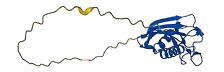
Descriptions
The autoinhibited protein was predicted that may have potential autoinhibitory elements via cis-regPred.
Autoinhibitory domains (AIDs)
Target domain |
|
Relief mechanism |
|
Assay |
cis-regPred |
Accessory elements
No accessory elements
Autoinhibited structure

Activated structure
3 structures for Q94JQ4
| Entry ID | Method | Resolution | Chain | Position | Source |
|---|---|---|---|---|---|
| 5HP7 | X-ray | 200 A | A | 68-187 | PDB |
| 5HP8 | X-ray | 230 A | A/B/C | 68-187 | PDB |
| AF-Q94JQ4-F1 | Predicted | AlphaFoldDB |
12 variants for Q94JQ4
| Variant ID(s) | Position | Change | Description | Diseaes Association | Provenance |
|---|---|---|---|---|---|
| tmp_3_7111661_G_A | 12 | P>L | No | 1000Genomes | |
| ENSVATH05869139 | 15 | D>N | No | 1000Genomes | |
| ENSVATH02169168 | 18 | T>S | No | 1000Genomes | |
| tmp_3_7111635_G_T | 21 | R>S | No | 1000Genomes | |
| tmp_3_7111593_C_T | 35 | A>T | No | 1000Genomes | |
| ENSVATH13952298 | 47 | S>Y | No | 1000Genomes | |
| ENSVATH02169167 | 55 | L>F | No | 1000Genomes | |
| tmp_3_7111046_C_T | 108 | S>N | No | 1000Genomes | |
| tmp_3_7110625_C_T | 120 | M>I | No | 1000Genomes | |
| ENSVATH10803071 | 126 | A>T | No | 1000Genomes | |
| ENSVATH10803070 | 126 | A>V | No | 1000Genomes | |
| ENSVATH13952273 | 140 | M>T | No | 1000Genomes |
No associated diseases with Q94JQ4
1 regional properties for Q94JQ4
| Type | Name | Position | InterPro Accession |
|---|---|---|---|
| conserved_site | RidA, conserved site | 163 - 181 | IPR019897 |
Functions
| Description | ||
|---|---|---|
| EC Number | 3.5.99.10 | In other compounds |
| Subcellular Localization |
|
|
| PANTHER Family | ||
| PANTHER Subfamily | ||
| PANTHER Protein Class | ||
| PANTHER Pathway Category | No pathway information available | |
8 GO annotations of cellular component
| Name | Definition |
|---|---|
| chloroplast | A chlorophyll-containing plastid with thylakoids organized into grana and frets, or stroma thylakoids, and embedded in a stroma. |
| chloroplast envelope | The double lipid bilayer enclosing the chloroplast and separating its contents from the rest of the cytoplasm; includes the intermembrane space. |
| chloroplast stroma | The space enclosed by the double membrane of a chloroplast but excluding the thylakoid space. It contains DNA, ribosomes and some temporary products of photosynthesis. |
| cytosol | The part of the cytoplasm that does not contain organelles but which does contain other particulate matter, such as protein complexes. |
| mitochondrion | A semiautonomous, self replicating organelle that occurs in varying numbers, shapes, and sizes in the cytoplasm of virtually all eukaryotic cells. It is notably the site of tissue respiration. |
| plant-type vacuole | A closed structure that is completely surrounded by a unit membrane, contains liquid, and retains the same shape regardless of cell cycle phase. An example of this structure is found in Arabidopsis thaliana. |
| plastid | Any member of a family of organelles found in the cytoplasm of plants and some protists, which are membrane-bounded and contain DNA. Plant plastids develop from a common type, the proplastid. |
| thylakoid | A membranous cellular structure that bears the photosynthetic pigments in plants, algae, and cyanobacteria. In cyanobacteria thylakoids are of various shapes and are attached to, or continuous with, the plasma membrane. In eukaryotes they are flattened, membrane-bounded disk-like structures located in the chloroplasts; in the chloroplasts of higher plants the thylakoids form dense stacks called grana. Isolated thylakoid preparations can carry out photosynthetic electron transport and the associated phosphorylation. |
3 GO annotations of molecular function
| Name | Definition |
|---|---|
| 2-iminobutanoate deaminase activity | Catalysis of the reaction: 2-iminobutanoate + H2O = 2-oxobutanoate + NH4(+). |
| 2-iminopropanoate deaminase activity | Catalysis of the reaction: 2-iminopropanoate + H2O = NH4(+) + pyruvate. |
| deaminase activity | Catalysis of the removal of an amino group from a substrate, producing a substituted or nonsubstituted ammonia (NH3/NH2R). |
4 GO annotations of biological process
| Name | Definition |
|---|---|
| branched-chain amino acid biosynthetic process | The chemical reactions and pathways resulting in the formation of amino acids containing a branched carbon skeleton, comprising isoleucine, leucine and valine. |
| isoleucine biosynthetic process | The chemical reactions and pathways resulting in the formation of isoleucine, (2R*,3R*)-2-amino-3-methylpentanoic acid. |
| organonitrogen compound catabolic process | The chemical reactions and pathways resulting in the breakdown of organonitrogen compound. |
| response to toxic substance | Any process that results in a change in state or activity of a cell or an organism (in terms of movement, secretion, enzyme production, gene expression, etc.) as a result of a toxic stimulus. |
No homologous proteins in AiPD
| UniProt AC | Gene Name | Protein Name | Species | Evidence Code |
|---|---|---|---|---|
| No homologous proteins | ||||
| 10 | 20 | 30 | 40 | 50 | 60 |
| MTWSVFRSIN | TPTLDLSTAL | RSTRTPLVAA | GVGCATFAGV | SLFRMSSRSP | PFASLSVSAS |
| 70 | 80 | 90 | 100 | 110 | 120 |
| SVKKEVVSTE | KAPAALGPYS | QAIKANNLVF | LSGVLGLIPE | TGKFVSESVE | DQTEQVLKNM |
| 130 | 140 | 150 | 160 | 170 | 180 |
| GEILKASGAD | YSSVVKTTIM | LADLADFKTV | NEIYAKYFPA | PSPARSTYQV | AALPLNAKIE |
| IECIATL |