Q949S9
Gene name |
MOS4 (BCAS2, SPF27, At3g18165, MRC8.16) |
Protein name |
Pre-mRNA-splicing factor SPF27 homolog |
Names |
Modifier of SNC1 member 4, Protein BCAS2 homolog |
Species |
Arabidopsis thaliana (Mouse-ear cress) |
KEGG Pathway |
ath:AT3G18165 |
EC number |
|
Protein Class |
|
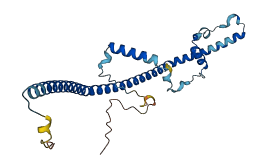
Descriptions
The autoinhibited protein was predicted that may have potential autoinhibitory elements via cis-regPred.
Autoinhibitory domains (AIDs)
Target domain |
|
Relief mechanism |
|
Assay |
cis-regPred |
Accessory elements
No accessory elements
Autoinhibited structure

Activated structure
1 structures for Q949S9
| Entry ID | Method | Resolution | Chain | Position | Source |
|---|---|---|---|---|---|
| AF-Q949S9-F1 | Predicted | AlphaFoldDB |
21 variants for Q949S9
| Variant ID(s) | Position | Change | Description | Diseaes Association | Provenance |
|---|---|---|---|---|---|
| tmp_3_6223252_C_A | 2 | A>E | No | 1000Genomes | |
| ENSVATH05855009 | 10 | M>I | No | 1000Genomes | |
| ENSVATH00330863 | 14 | T>K | No | 1000Genomes | |
| tmp_3_6223320_G_A | 25 | A>T | No | 1000Genomes | |
| tmp_3_6223332_G_A | 29 | V>I | No | 1000Genomes | |
| tmp_3_6223382_T_G | 45 | I>M | No | 1000Genomes | |
| tmp_3_6223401_T_A | 52 | L>M | No | 1000Genomes | |
| ENSVATH05855011 | 61 | S>T | No | 1000Genomes | |
| tmp_3_6223453_A_T | 69 | K>M | No | 1000Genomes | |
| tmp_3_6223924_T_C | 82 | C>R | No | 1000Genomes | |
| tmp_3_6224039_A_G | 120 | D>G | No | 1000Genomes | |
| tmp_3_6224038_G_A | 120 | D>N | No | 1000Genomes | |
| ENSVATH00330868 | 121 | A>D | No | 1000Genomes | |
| ENSVATH13939963 | 125 | Q>P | No | 1000Genomes | |
| ENSVATH00330878 | 210 | V>I | No | 1000Genomes | |
| ENSVATH05855021 | 214 | E>D | No | 1000Genomes | |
| tmp_3_6224883_C_T | 220 | A>V | No | 1000Genomes | |
| tmp_3_6224885_A_G | 221 | M>V | No | 1000Genomes | |
| ENSVATH05855022 | 233 | A>S | No | 1000Genomes | |
| ENSVATH05855024 | 237 | G>D | No | 1000Genomes | |
| ENSVATH05855025 | 251 | Q>K | No | 1000Genomes |
No associated diseases with Q949S9
No regional properties for Q949S9
| Type | Name | Position | InterPro Accession |
|---|---|---|---|
| No domain, repeats, and functional sites for Q949S9 | |||
5 GO annotations of cellular component
| Name | Definition |
|---|---|
| catalytic step 2 spliceosome | A spliceosomal complex that contains three snRNPs, including U5, bound to a splicing intermediate in which the first catalytic cleavage of the 5' splice site has occurred. The precise subunit composition differs significantly from that of the catalytic step 1, or activated, spliceosome, and includes many proteins in addition to those found in the associated snRNPs. |
| cytosol | The part of the cytoplasm that does not contain organelles but which does contain other particulate matter, such as protein complexes. |
| nucleolus | A small, dense body one or more of which are present in the nucleus of eukaryotic cells. It is rich in RNA and protein, is not bounded by a limiting membrane, and is not seen during mitosis. Its prime function is the transcription of the nucleolar DNA into 45S ribosomal-precursor RNA, the processing of this RNA into 5.8S, 18S, and 28S components of ribosomal RNA, and the association of these components with 5S RNA and proteins synthesized outside the nucleolus. This association results in the formation of ribonucleoprotein precursors; these pass into the cytoplasm and mature into the 40S and 60S subunits of the ribosome. |
| nucleus | A membrane-bounded organelle of eukaryotic cells in which chromosomes are housed and replicated. In most cells, the nucleus contains all of the cell's chromosomes except the organellar chromosomes, and is the site of RNA synthesis and processing. In some species, or in specialized cell types, RNA metabolism or DNA replication may be absent. |
| Prp19 complex | A protein complex consisting of Prp19 and associated proteins that is involved in the transition from the precatalytic spliceosome to the activated form that catalyzes step 1 of splicing, and which remains associated with the spliceosome through the second catalytic step. It is widely conserved, found in both yeast and mammals, though the exact composition varies. In S. cerevisiae, it contains Prp19p, Ntc20p, Snt309p, Isy1p, Syf2p, Cwc2p, Prp46p, Clf1p, Cef1p, and Syf1p. |
No GO annotations of molecular function
| Name | Definition |
|---|---|
| No GO annotations for molecular function |
5 GO annotations of biological process
| Name | Definition |
|---|---|
| defense response to bacterium | Reactions triggered in response to the presence of a bacterium that act to protect the cell or organism. |
| defense response to fungus | Reactions triggered in response to the presence of a fungus that act to protect the cell or organism. |
| innate immune response | Innate immune responses are defense responses mediated by germline encoded components that directly recognize components of potential pathogens. |
| mRNA processing | Any process involved in the conversion of a primary mRNA transcript into one or more mature mRNA(s) prior to translation into polypeptide. |
| RNA splicing | The process of removing sections of the primary RNA transcript to remove sequences not present in the mature form of the RNA and joining the remaining sections to form the mature form of the RNA. |
No homologous proteins in AiPD
| UniProt AC | Gene Name | Protein Name | Species | Evidence Code |
|---|---|---|---|---|
| No homologous proteins | ||||
| 10 | 20 | 30 | 40 | 50 | 60 |
| MATNNGDVLM | LEATPEAARP | WASAANAEVI | DALPYIDDDY | GNPLIKSEVD | RLVEEEMRRS |
| 70 | 80 | 90 | 100 | 110 | 120 |
| SKKPADFLKD | LPPLPKFDFK | NCPVLGKEYE | RVRAGKPPVR | IDFESRYKLE | MPPANKRNDD |
| 130 | 140 | 150 | 160 | 170 | 180 |
| AAWKQYLQKN | QRSLQQKLIE | LENLELMSKL | GPELWRQNNH | RLEVFLTRMQ | RLAQEQNEEI |
| 190 | 200 | 210 | 220 | 230 | 240 |
| EKVNRERKYH | QQTTSYELNA | LSQEWRQLCV | KNMEIQSACA | MLETQIDSFK | KEAAERGWNL |
| 250 | |||||
| EEKLENVEPL | QMQ |