Q945B7
Gene name |
CRD1 (AT103) |
Protein name |
Magnesium-protoporphyrin IX monomethyl ester [oxidative] cyclase, chloroplastic |
Names |
Mg-protoporphyrin IX monomethyl ester oxidative cyclase |
Species |
Euphorbia esula (Leafy spurge) |
KEGG Pathway |
|
EC number |
1.14.13.81: With NADH or NADPH as one donor, and incorporation of one atom of oxygen |
Protein Class |
|
Descriptions
The autoinhibited protein was predicted that may have potential autoinhibitory elements via cis-regPred.
Autoinhibitory domains (AIDs)
Target domain |
|
Relief mechanism |
|
Assay |
cis-regPred |
Accessory elements
No accessory elements
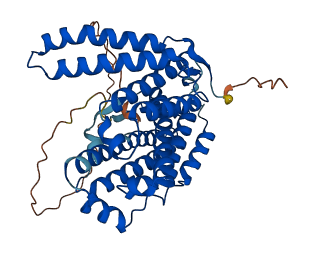
Autoinhibited structure

Activated structure
1 structures for Q945B7
| Entry ID | Method | Resolution | Chain | Position | Source |
|---|---|---|---|---|---|
| AF-Q945B7-F1 | Predicted | AlphaFoldDB |
No variants for Q945B7
| Variant ID(s) | Position | Change | Description | Diseaes Association | Provenance |
|---|---|---|---|---|---|
| No variants for Q945B7 | |||||
No associated diseases with Q945B7
Functions
| Description | ||
|---|---|---|
| EC Number | 1.14.13.81 | With NADH or NADPH as one donor, and incorporation of one atom of oxygen |
| Subcellular Localization |
|
|
| PANTHER Family | ||
| PANTHER Subfamily | ||
| PANTHER Protein Class | ||
| PANTHER Pathway Category | No pathway information available | |
1 GO annotations of cellular component
| Name | Definition |
|---|---|
| chloroplast | A chlorophyll-containing plastid with thylakoids organized into grana and frets, or stroma thylakoids, and embedded in a stroma. |
2 GO annotations of molecular function
| Name | Definition |
|---|---|
| magnesium-protoporphyrin IX monomethyl ester (oxidative) cyclase activity | Catalysis of the reaction: magnesium protoporphyrin IX 13-monomethyl ester + 3 NADPH + 3 H+ + 3 O2 = divinylprotochlorophyllide + 3 NADP+ + 5 H2O. |
| metal ion binding | Binding to a metal ion. |
2 GO annotations of biological process
| Name | Definition |
|---|---|
| chlorophyll biosynthetic process | The chemical reactions and pathways resulting in the formation of chlorophyll, any compound of magnesium complexed in a porphyrin (tetrapyrrole) ring and which functions as a photosynthetic pigment, from less complex precursors. |
| photosynthesis | The synthesis by organisms of organic chemical compounds, especially carbohydrates, from carbon dioxide (CO2) using energy obtained from light rather than from the oxidation of chemical compounds. |
No homologous proteins in AiPD
| UniProt AC | Gene Name | Protein Name | Species | Evidence Code |
|---|---|---|---|---|
| No homologous proteins | ||||
| 10 | 20 | 30 | 40 | 50 | 60 |
| MAAEMALVKP | ITPKFINPMR | TFSSSSKFST | IKMSATSQSN | TTTTATKPSK | KGNKKEINET |
| 70 | 80 | 90 | 100 | 110 | 120 |
| LLTPRFYTTD | FDEMETLFNT | EINKKLNQSE | FEALLQEFKT | DYNQTHFVRN | KEFKEAADKM |
| 130 | 140 | 150 | 160 | 170 | 180 |
| QGPLRQIFVE | FLERSCTAEF | SGFLLYKELG | RRLKKTNPVV | AEIFSLMSRD | EARHAGFLNK |
| 190 | 200 | 210 | 220 | 230 | 240 |
| GLSDFNYALD | LGFLTKARKY | TFFKPKFIFY | ATYLSEKIGY | WRYITIYRHL | KENPEYQCYP |
| 250 | 260 | 270 | 280 | 290 | 300 |
| IFKYFENWCQ | DENRHGDFFS | ALMKAQPQFL | NDWKAKLWAR | FFCLSVYVTM | YLNDCQRTAF |
| 310 | 320 | 330 | 340 | 350 | 360 |
| YEGIGLDTKE | FDMHVIIETN | RTTARIFPAV | LDVENPEFKR | KLDRMVVINQ | KLQAVGETED |
| 370 | 380 | 390 | 400 | ||
| NSVVKNLKRV | PLIAALVSEI | LAAYLMPPIE | SGSVDFAEFE | PKLVY |