Descriptions
The autoinhibited protein was predicted that may have potential autoinhibitory elements via cis-regPred.
Autoinhibitory domains (AIDs)
Target domain |
|
Relief mechanism |
|
Assay |
cis-regPred |
Accessory elements
No accessory elements
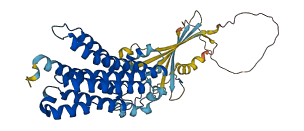
Autoinhibited structure

Activated structure
1 structures for Q94177
| Entry ID | Method | Resolution | Chain | Position | Source |
|---|---|---|---|---|---|
| AF-Q94177-F1 | Predicted | AlphaFoldDB |
No variants for Q94177
| Variant ID(s) | Position | Change | Description | Diseaes Association | Provenance |
|---|---|---|---|---|---|
| No variants for Q94177 | |||||
No associated diseases with Q94177
4 regional properties for Q94177
| Type | Name | Position | InterPro Accession |
|---|---|---|---|
| domain | DNA topoisomerase, type IIA, domain A | 18 - 479 | IPR002205 |
| repeat | DNA gyrase/topoisomerase IV, subunit A, C-terminal repeat | 567 - 613 | IPR006691-1 |
| repeat | DNA gyrase/topoisomerase IV, subunit A, C-terminal repeat | 620 - 659 | IPR006691-2 |
| repeat | DNA gyrase/topoisomerase IV, subunit A, C-terminal repeat | 665 - 702 | IPR006691-3 |
2 GO annotations of cellular component
| Name | Definition |
|---|---|
| integral component of membrane | The component of a membrane consisting of the gene products and protein complexes having at least some part of their peptide sequence embedded in the hydrophobic region of the membrane. |
| plasma membrane | The membrane surrounding a cell that separates the cell from its external environment. It consists of a phospholipid bilayer and associated proteins. |
1 GO annotations of molecular function
| Name | Definition |
|---|---|
| signaling receptor activity | Receiving a signal and transmitting it in the cell to initiate a change in cell activity. A signal is a physical entity or change in state that is used to transfer information in order to trigger a response. |
4 GO annotations of biological process
| Name | Definition |
|---|---|
| adiponectin-activated signaling pathway | The series of molecular signals initiated by adiponectin binding to its receptor on the surface of a cell, and ending with the regulation of a downstream cellular process, e.g. transcription. |
| fatty acid oxidation | The removal of one or more electrons from a fatty acid, with or without the concomitant removal of a proton or protons, by reaction with an electron-accepting substance, by addition of oxygen or by removal of hydrogen. |
| hormone-mediated signaling pathway | The series of molecular signals mediated by the detection of a hormone. |
| positive regulation of fatty acid oxidation | Any process that activates or increases the frequency, rate or extent of fatty acid oxidation. |
No homologous proteins in AiPD
| UniProt AC | Gene Name | Protein Name | Species | Evidence Code |
|---|---|---|---|---|
| No homologous proteins | ||||
| 10 | 20 | 30 | 40 | 50 | 60 |
| MNPDEVNRAL | GHYLNDADSG | ELVVEDSTTV | QVKNPEARKT | GDKIEVFYSR | KTTVVSPTNS |
| 70 | 80 | 90 | 100 | 110 | 120 |
| DDEDADFCSD | SELLPQQEGH | RSRATSFAGR | IRAGSDDEAM | PKHTILRYRR | KKGGQWREIN |
| 130 | 140 | 150 | 160 | 170 | 180 |
| LQGTPDKRKD | DEDELEVDVK | EDRSEQTGIV | TKTYEARWKV | LKYEHLPEWL | QDNEFLRHGH |
| 190 | 200 | 210 | 220 | 230 | 240 |
| RPPLPSFSEC | FKSIWSLHTE | TGNIWTHLIG | CVAFFFLACW | FLTRPDNHIQ | FQEKVVFSFF |
| 250 | 260 | 270 | 280 | 290 | 300 |
| FAGAVLCLGL | SFAFHTLSCH | SVNVVKIFCK | LDYMGISLLI | IGSFIPWIYY | GFYCRREPKI |
| 310 | 320 | 330 | 340 | 350 | 360 |
| TYIAMVSVLG | IGAIVVSLWD | KFSESRFRPI | RAAVFVGMGC | SGVIPTIHYI | ITDGVHSLFA |
| 370 | 380 | 390 | 400 | 410 | 420 |
| DNSFHWLLLM | AFLYLLGAGL | YATRTPERFF | PGKCDIWFQS | HQLFHTCVVI | AAFVHYYGIS |
| 430 | |||||
| EMAFARLNEQ | CPVR |