Q93WD2
Gene name |
Lhcb4 |
Protein name |
Chlorophyll a-b binding protein CP29 |
Names |
Lhcbm4 |
Species |
Chlamydomonas reinhardtii (Chlamydomonas smithii) |
KEGG Pathway |
cre:CHLRE_17g720250v5 |
EC number |
|
Protein Class |
|
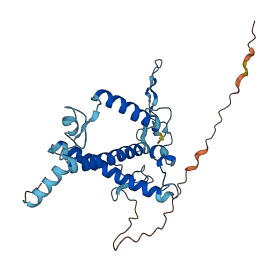
Descriptions
The autoinhibited protein was predicted that may have potential autoinhibitory elements via cis-regPred.
Autoinhibitory domains (AIDs)
Target domain |
|
Relief mechanism |
|
Assay |
cis-regPred |
Accessory elements
No accessory elements
Autoinhibited structure

Activated structure
4 structures for Q93WD2
| Entry ID | Method | Resolution | Chain | Position | Source |
|---|---|---|---|---|---|
| 6KAC | EM | 270 A | R/r | 1-280 | PDB |
| 6KAD | EM | 340 A | R/r | 1-280 | PDB |
| 6KAF | EM | 373 A | R/r | 1-280 | PDB |
| AF-Q93WD2-F1 | Predicted | AlphaFoldDB |
No variants for Q93WD2
| Variant ID(s) | Position | Change | Description | Diseaes Association | Provenance |
|---|---|---|---|---|---|
| No variants for Q93WD2 | |||||
No associated diseases with Q93WD2
No regional properties for Q93WD2
| Type | Name | Position | InterPro Accession |
|---|---|---|---|
| No domain, repeats, and functional sites for Q93WD2 | |||
4 GO annotations of cellular component
| Name | Definition |
|---|---|
| integral component of membrane | The component of a membrane consisting of the gene products and protein complexes having at least some part of their peptide sequence embedded in the hydrophobic region of the membrane. |
| photosystem I | A photosystem that contains an iron-sulfur reaction center associated with accessory pigments and electron carriers. In cyanobacteria and chloroplasts, photosystem I functions as a light-dependent plastocyanin-ferredoxin oxidoreductase, transferring electrons from plastocyanin to ferredoxin; in photosynthetic bacteria that have only a single type I photosystem, such as the green sulfur bacteria, electrons can go either to ferredoxin (Fd) -> NAD+ or to menaquinone (MK) -> Cytb/FeS -> Cytc555 -> photosystem I (cyclic photophosphorylation). |
| photosystem II | A photosystem that contains a pheophytin-quinone reaction center with associated accessory pigments and electron carriers. In cyanobacteria and chloroplasts, in the presence of light, PSII functions as a water-plastoquinone oxidoreductase, transferring electrons from water to plastoquinone, whereas other photosynthetic bacteria carry out anoxygenic photosynthesis and oxidize other compounds to re-reduce the photoreaction center. |
| thylakoid light-harvesting complex | A thylakoid membrane complex of chlorophylls a and b together with chlorophyll a-b binding proteins. In addition, LHCs contain a number of other proteins, the function of which is speculative, together with accessory pigments. The LHCs capture and transfer energy to photosystems I and II. An example of this is found in Arabidopsis thaliana. |
2 GO annotations of molecular function
| Name | Definition |
|---|---|
| chlorophyll binding | Binding to a chlorophyll; a compound of magnesium complexed in a porphyrin (tetrapyrrole) ring and which functions as a photosynthetic pigment. |
| metal ion binding | Binding to a metal ion. |
1 GO annotations of biological process
| Name | Definition |
|---|---|
| photosynthesis, light harvesting | Absorption and transfer of the energy absorbed from light photons between photosystem reaction centers. |
No homologous proteins in AiPD
| UniProt AC | Gene Name | Protein Name | Species | Evidence Code |
|---|---|---|---|---|
| No homologous proteins | ||||
| 10 | 20 | 30 | 40 | 50 | 60 |
| MVFKFPTPPG | TQKKAGTTAT | KPAPKATTKK | VATSTGTRSG | GVGYRKYQGD | ALWLPNTTRP |
| 70 | 80 | 90 | 100 | 110 | 120 |
| EWLDGSLPGD | RGFDPLGLSK | PSEFVVIGVD | ENDQNAAKNN | KGSVEAIVQA | TPDEVSSENR |
| 130 | 140 | 150 | 160 | 170 | 180 |
| LAPYSEVFGL | ARFRECELIH | GRWAMLACLG | ALVAEATTGV | SWVEAGKVEL | DGASYAGLSL |
| 190 | 200 | 210 | 220 | 230 | 240 |
| PFSITQLIWI | EVILVGGAEF | YRNSETNPEK | RCYPGGVFDP | LKLASEDEER | AFRLKTAEIK |
| 250 | 260 | 270 | |||
| HARLAMVSFF | GYGVQALSTG | EGALGSLAKF | ADGLNNGKGL |