Q93ST4
Gene name |
hemA |
Protein name |
Glutamyl-tRNA reductase |
Names |
GluTR |
Species |
Chlorobaculum tepidum (strain ATCC 49652 / DSM 12025 / NBRC 103806 / TLS) (Chlorobium tepidum) |
KEGG Pathway |
cte:CT1426 |
EC number |
1.2.1.70: With NAD(+) or NADP(+) as acceptor |
Protein Class |
|
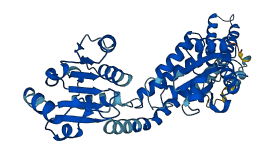
Descriptions
The autoinhibited protein was predicted that may have potential autoinhibitory elements via cis-regPred.
Autoinhibitory domains (AIDs)
Target domain |
|
Relief mechanism |
|
Assay |
cis-regPred |
Accessory elements
No accessory elements
Autoinhibited structure

Activated structure
1 structures for Q93ST4
| Entry ID | Method | Resolution | Chain | Position | Source |
|---|---|---|---|---|---|
| AF-Q93ST4-F1 | Predicted | AlphaFoldDB |
No variants for Q93ST4
| Variant ID(s) | Position | Change | Description | Diseaes Association | Provenance |
|---|---|---|---|---|---|
| No variants for Q93ST4 | |||||
No associated diseases with Q93ST4
Functions
| Description | ||
|---|---|---|
| EC Number | 1.2.1.70 | With NAD(+) or NADP(+) as acceptor |
| Subcellular Localization |
|
|
| PANTHER Family | ||
| PANTHER Subfamily | ||
| PANTHER Protein Class | ||
| PANTHER Pathway Category | No pathway information available | |
No GO annotations of cellular component
| Name | Definition |
|---|---|
| No GO annotations for cellular component |
2 GO annotations of molecular function
| Name | Definition |
|---|---|
| glutamyl-tRNA reductase activity | Catalysis of the reaction: (S)-4-amino-5-oxopentanoate + NADP(+) + tRNA(Glu) = L-glutamyl-tRNA(Glu) + H(+) + NADPH. |
| NADP binding | Binding to nicotinamide-adenine dinucleotide phosphate, a coenzyme involved in many redox and biosynthetic reactions; binding may be to either the oxidized form, NADP+, or the reduced form, NADPH. |
2 GO annotations of biological process
| Name | Definition |
|---|---|
| chlorophyll biosynthetic process | The chemical reactions and pathways resulting in the formation of chlorophyll, any compound of magnesium complexed in a porphyrin (tetrapyrrole) ring and which functions as a photosynthetic pigment, from less complex precursors. |
| protoporphyrinogen IX biosynthetic process | The chemical reactions and pathways resulting in the formation of protoporphyrinogen IX. |
No homologous proteins in AiPD
| UniProt AC | Gene Name | Protein Name | Species | Evidence Code |
|---|---|---|---|---|
| No homologous proteins | ||||
| 10 | 20 | 30 | 40 | 50 | 60 |
| MNIISVGVNH | KTAPIEIRER | IALSEVQNKE | LVTDLVSSGL | ASEAMVVSTC | NRTELYVVPG |
| 70 | 80 | 90 | 100 | 110 | 120 |
| MPEVNCDYLK | DYIISYKNAR | NAVRPEHFFS | RFYCGTARHL | FEVSCAIDSL | VLGEGQILGQ |
| 130 | 140 | 150 | 160 | 170 | 180 |
| VKNAYRIAAE | VGTAGILLTR | LCHTAFSVAK | KVKTRTKLME | GAVSVSYAAV | ELAQKIFSNL |
| 190 | 200 | 210 | 220 | 230 | 240 |
| SMKKVLLIGA | GETGELAAKH | MYAKNARNIV | ITNRTQSKAE | ALAEELGTNR | VLPYESYKEH |
| 250 | 260 | 270 | 280 | 290 | 300 |
| LHEFDIIITA | VSTKEYILNA | AEMQQSMAKR | RLKPVIILDL | GLPRNVDPEV | GALQNMFLKD |
| 310 | 320 | 330 | 340 | 350 | 360 |
| IDALKHIIDK | NLERRRAELP | KVKAIIDEEL | VAFGQWLNTL | KVRPTIVDLQ | SKFLEIKEKE |
| 370 | 380 | 390 | 400 | 410 | 420 |
| LERYRYKVSE | EELRRMEHLT | DRILKKILHH | PIKMLKAPVD | TADNIPSKVN | LVRNIFDLEE |
| PNQSLQ |