Q93LR4
Gene name |
pfkA |
Protein name |
ATP-dependent 6-phosphofructokinase |
Names |
ATP-PFK, Phosphofructokinase, Phosphohexokinase |
Species |
Lysinibacillus sphaericus (Bacillus sphaericus) |
KEGG Pathway |
|
EC number |
2.7.1.11: Phosphotransferases with an alcohol group as acceptor |
Protein Class |
|
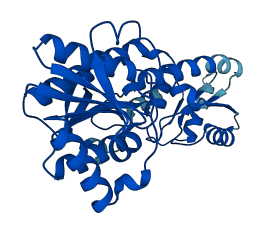
Descriptions
The autoinhibited protein was predicted that may have potential autoinhibitory elements via cis-regPred.
Autoinhibitory domains (AIDs)
Target domain |
|
Relief mechanism |
|
Assay |
cis-regPred |
Accessory elements
No accessory elements
Autoinhibited structure

Activated structure
1 structures for Q93LR4
| Entry ID | Method | Resolution | Chain | Position | Source |
|---|---|---|---|---|---|
| AF-Q93LR4-F1 | Predicted | AlphaFoldDB |
No variants for Q93LR4
| Variant ID(s) | Position | Change | Description | Diseaes Association | Provenance |
|---|---|---|---|---|---|
| No variants for Q93LR4 | |||||
No associated diseases with Q93LR4
5 regional properties for Q93LR4
| Type | Name | Position | InterPro Accession |
|---|---|---|---|
| domain | Alpha-D-phosphohexomutase, C-terminal | 470 - 532 | IPR005843 |
| domain | Alpha-D-phosphohexomutase, alpha/beta/alpha domain I | 42 - 169 | IPR005844 |
| domain | Alpha-D-phosphohexomutase, alpha/beta/alpha domain II | 204 - 305 | IPR005845 |
| domain | Alpha-D-phosphohexomutase, alpha/beta/alpha domain III | 316 - 436 | IPR005846 |
| conserved_site | Alpha-D-phosphohexomutase, conserved site | 137 - 146 | IPR016066 |
Functions
| Description | ||
|---|---|---|
| EC Number | 2.7.1.11 | Phosphotransferases with an alcohol group as acceptor |
| Subcellular Localization |
|
|
| PANTHER Family | ||
| PANTHER Subfamily | ||
| PANTHER Protein Class | ||
| PANTHER Pathway Category | No pathway information available | |
1 GO annotations of cellular component
| Name | Definition |
|---|---|
| cytoplasm | The contents of a cell excluding the plasma membrane and nucleus, but including other subcellular structures. |
3 GO annotations of molecular function
| Name | Definition |
|---|---|
| 6-phosphofructokinase activity | Catalysis of the reaction: ATP + D-fructose-6-phosphate = ADP + D-fructose 1,6-bisphosphate. |
| ATP binding | Binding to ATP, adenosine 5'-triphosphate, a universally important coenzyme and enzyme regulator. |
| metal ion binding | Binding to a metal ion. |
1 GO annotations of biological process
| Name | Definition |
|---|---|
| fructose 6-phosphate metabolic process | The chemical reactions and pathways involving fructose 6-phosphate, also known as F6P. The D-enantiomer is an important intermediate in glycolysis, gluconeogenesis, and fructose metabolism. |
No homologous proteins in AiPD
| UniProt AC | Gene Name | Protein Name | Species | Evidence Code |
|---|---|---|---|---|
| No homologous proteins | ||||
| 10 | 20 | 30 | 40 | 50 | 60 |
| MKKIAVLTSG | GDVPGMNAAI | RAVVRKAAFH | GINVVGIKHG | YEGLVKGYLE | ELDLGSVGGI |
| 70 | 80 | 90 | 100 | 110 | 120 |
| IQRGGTHLNS | ARCPEFKEDA | VQQQGIENLR | AAGIEGLVVI | GGDGSYRGAM | DLVKKGFPAV |
| 130 | 140 | 150 | 160 | 170 | 180 |
| GVPGTIDNDV | PGTEYTIGFD | TALNTVVESI | DKIRDTATSH | ENSFIVEVMG | RDAGDIALWA |
| 190 | 200 | 210 | 220 | 230 | 240 |
| GLAAGAETVL | IPEEDYDLDD | IVARLDRGAA | RGKKHSIIIV | AEGVMSGNEL | AKLIKEKTGK |
| 250 | 260 | 270 | 280 | 290 | 300 |
| ETRVSVLGHI | QRGGSPTARD | RVLASQFGAH | AVELLMEGKY | GRAVGIRNHQ | VIDYDMPEAF |
| 310 | |||||
| EKNHEADVSL | YTLMKELSI |