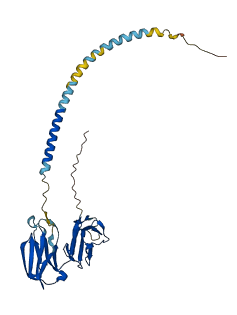
Descriptions
The autoinhibited protein was predicted that may have potential autoinhibitory elements via cis-regPred.
Autoinhibitory domains (AIDs)
Target domain |
|
Relief mechanism |
|
Assay |
cis-regPred |
Accessory elements
No accessory elements
Autoinhibited structure

Activated structure
1 structures for Q92637
| Entry ID | Method | Resolution | Chain | Position | Source |
|---|---|---|---|---|---|
| AF-Q92637-F1 | Predicted | AlphaFoldDB |
No variants for Q92637
| Variant ID(s) | Position | Change | Description | Diseaes Association | Provenance |
|---|---|---|---|---|---|
| No variants for Q92637 | |||||
No associated diseases with Q92637
6 regional properties for Q92637
| Type | Name | Position | InterPro Accession |
|---|---|---|---|
| domain | Immunoglobulin subtype 2 | 34 - 92 | IPR003598-1 |
| domain | Immunoglobulin subtype 2 | 115 - 175 | IPR003598-2 |
| domain | Immunoglobulin subtype | 28 - 101 | IPR003599-1 |
| domain | Immunoglobulin subtype | 109 - 187 | IPR003599-2 |
| domain | Immunoglobulin-like domain | 22 - 86 | IPR007110-1 |
| domain | Immunoglobulin-like domain | 95 - 168 | IPR007110-2 |
4 GO annotations of cellular component
| Name | Definition |
|---|---|
| clathrin-coated endocytic vesicle membrane | The lipid bilayer surrounding a clathrin-coated endocytic vesicle. |
| early endosome membrane | The lipid bilayer surrounding an early endosome. |
| integral component of plasma membrane | The component of the plasma membrane consisting of the gene products and protein complexes having at least some part of their peptide sequence embedded in the hydrophobic region of the membrane. |
| plasma membrane | The membrane surrounding a cell that separates the cell from its external environment. It consists of a phospholipid bilayer and associated proteins. |
3 GO annotations of molecular function
| Name | Definition |
|---|---|
| IgG binding | Binding to an immunoglobulin of an IgG isotype. |
| immunoglobulin receptor activity | Combining with the Fc region of an immunoglobulin protein and transmitting the signal from one side of the membrane to the other to initiate a change in cell activity. |
| transmembrane signaling receptor activity | Combining with an extracellular or intracellular signal and transmitting the signal from one side of the membrane to the other to initiate a change in cell activity or state as part of signal transduction. |
4 GO annotations of biological process
| Name | Definition |
|---|---|
| adaptive immune response | An immune response mediated by cells expressing specific receptors for antigen produced through a somatic diversification process, and allowing for an enhanced secondary response to subsequent exposures to the same antigen (immunological memory). |
| cell surface receptor signaling pathway | The series of molecular signals initiated by activation of a receptor on the surface of a cell. The pathway begins with binding of an extracellular ligand to a cell surface receptor, or for receptors that signal in the absence of a ligand, by ligand-withdrawal or the activity of a constitutively active receptor. The pathway ends with regulation of a downstream cellular process, e.g. transcription. |
| immune response | Any immune system process that functions in the calibrated response of an organism to a potential internal or invasive threat. |
| regulation of immune response | Any process that modulates the frequency, rate or extent of the immune response, the immunological reaction of an organism to an immunogenic stimulus. |
1 homologous proteins in AiPD
| UniProt AC | Gene Name | Protein Name | Species | Evidence Code |
|---|---|---|---|---|
| P12314 | FCGR1A | High affinity immunoglobulin gamma Fc receptor I | Homo sapiens (Human) | PR |
| 10 | 20 | 30 | 40 | 50 | 60 |
| MWFLTTLLLW | VPVDGQVDTT | KAVITLQPPW | VSVFQEETVT | LHCEVLHLPG | SSSTQWFLNG |
| 70 | 80 | 90 | 100 | 110 | 120 |
| TATQTSTPSY | RITSASVNDS | GEYRCQRGLS | GRSDPIQLEI | HRGWLLLQVS | SRVFMEGEPL |
| 130 | 140 | 150 | 160 | 170 | 180 |
| ALRCHAWKDK | LVYNVLYYRN | GKAFKFFHWN | SNLTILKTNI | SHNGTYHCSG | MGKHRYTSAG |
| 190 | 200 | 210 | 220 | 230 | 240 |
| ISQYTVKGLQ | LPTPVWFHVL | FYLAVGIMFL | VNTVLWVTIR | KELKRKKKWN | LEISLDSGHE |
| 250 | 260 | 270 | |||
| KKVISSLQED | RHLEEELKCQ | EQKEEQLQEG | VHRKEPQGAT |