Q92361
Gene name |
SPAC6G9.16c |
Protein name |
Uncharacterized protein C6G9.16c |
Names |
|
Species |
Schizosaccharomyces pombe (strain 972 / ATCC 24843) (Fission yeast) |
KEGG Pathway |
spo:SPAC6G9.16c |
EC number |
|
Protein Class |
|
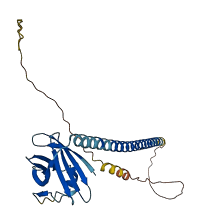
Descriptions
The autoinhibited protein was predicted that may have potential autoinhibitory elements via cis-regPred.
Autoinhibitory domains (AIDs)
Target domain |
|
Relief mechanism |
|
Assay |
cis-regPred |
Accessory elements
No accessory elements
Autoinhibited structure

Activated structure
1 structures for Q92361
| Entry ID | Method | Resolution | Chain | Position | Source |
|---|---|---|---|---|---|
| AF-Q92361-F1 | Predicted | AlphaFoldDB |
5 variants for Q92361
| Variant ID(s) | Position | Change | Description | Diseaes Association | Provenance |
|---|---|---|---|---|---|
| I_3279524_C_T | 92 | V>I | No | Jeffares_SNPs | |
| I_3279315_A_G | 144 | M>T | No | Jeffares_SNPs | |
| I_3279303_T_A | 148 | E>V | No | Jeffares_SNPs | |
| I_3279279_G_A | 156 | S>F | No | Jeffares_SNPs | |
| I_3279258_A_G | 163 | M>T | No | Jeffares_SNPs |
1 associated diseases with Q92361
Without disease ID
No regional properties for Q92361
| Type | Name | Position | InterPro Accession |
|---|---|---|---|
| No domain, repeats, and functional sites for Q92361 | |||
5 GO annotations of cellular component
| Name | Definition |
|---|---|
| chromatin | The ordered and organized complex of DNA, protein, and sometimes RNA, that forms the chromosome. |
| cytoplasm | The contents of a cell excluding the plasma membrane and nucleus, but including other subcellular structures. |
| cytosol | The part of the cytoplasm that does not contain organelles but which does contain other particulate matter, such as protein complexes. |
| DNA ligase IV complex | A eukaryotically conserved protein complex that contains DNA ligase IV and is involved in DNA repair by non-homologous end joining; in addition to the ligase, the complex also contains XRCC4 or a homolog, e.g. Saccharomyces Lif1p. |
| nucleus | A membrane-bounded organelle of eukaryotic cells in which chromosomes are housed and replicated. In most cells, the nucleus contains all of the cell's chromosomes except the organellar chromosomes, and is the site of RNA synthesis and processing. In some species, or in specialized cell types, RNA metabolism or DNA replication may be absent. |
No GO annotations of molecular function
| Name | Definition |
|---|---|
| No GO annotations for molecular function |
2 GO annotations of biological process
| Name | Definition |
|---|---|
| double-strand break repair via nonhomologous end joining | The repair of a double-strand break in DNA in which the two broken ends are rejoined with little or no sequence complementarity. Information at the DNA ends may be lost due to the modification of broken DNA ends. This term covers instances of separate pathways, called classical (or canonical) and alternative nonhomologous end joining (C-NHEJ and A-NHEJ). These in turn may further branch into sub-pathways, but evidence is still unclear. |
| meiotic cell cycle | Progression through the phases of the meiotic cell cycle, in which canonically a cell replicates to produce four offspring with half the chromosomal content of the progenitor cell via two nuclear divisions. |
No homologous proteins in AiPD
| UniProt AC | Gene Name | Protein Name | Species | Evidence Code |
|---|---|---|---|---|
| No homologous proteins | ||||
| 10 | 20 | 30 | 40 | 50 | 60 |
| MKFFLSLKDF | KGEKFVLRSE | LDESSAFLCA | ISPTCRYVLR | DEIPWKRLQR | NVTSESLTDE |
| 70 | 80 | 90 | 100 | 110 | 120 |
| LIVDLLCGRS | ESKHTLQLVV | LENLCRIYIN | YVDPFPLRIA | WFELEQQALK | DHEHFDVLWE |
| 130 | 140 | 150 | 160 | 170 | 180 |
| CSHSIKDLAL | ASMAQQKNEL | QKLMAYTEQL | QEECKSRERK | LIMKFADMIK | NARNNEDNED |
| 190 | 200 | 210 | 220 | 230 | 240 |
| NHHINYEDES | DVGTDEQKQQ | EGVNSSAVSD | TDESAVSDEF | MQIKEEFPMK | ALSASPTADA |
| 250 | 260 | ||||
| SPESAGEDDS | HRRSSHESSE | TVSE |