Q922J3
Gene name |
Clip1 (Kiaa4046, Rsn) |
Protein name |
CAP-Gly domain-containing linker protein 1 |
Names |
Cytoplasmic linker protein 170, CLIP-170, Restin |
Species |
Mus musculus (Mouse) |
KEGG Pathway |
mmu:56430 |
EC number |
|
Protein Class |
|
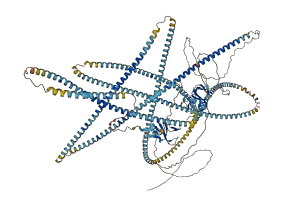
Descriptions
(Annotation based on sequence homology with Q07960)
Rho GTPase-activating protein 1 (p50RhoGAP) comprises an N-terminal BCH domain and a C-terminal GAP domain separated by a proline-rich region. p50RhoGAP contains a non-canonical RhoA-binding motif in its BCH domain and is associated with GAP-mediated cell rounding. In the autoinhibited state, the GAP catalytic residue is being occluded and incapable of RhoA inactivation, and it only becomes accessible upon the release of autoinhibition of GAP from the BCH domain. The lipid binding to BCH domain may initiate the transition for the release of GAP domain from the inactive state to the active state of p50RhoGAP. This leads to the activation of the GAP domain of p50RhoGAP, resulting in the GAP-mediated GTPase inactivation of RhoA.
Autoinhibitory domains (AIDs)
Target domain |
213-278 (CAP-Gly-2 domain) |
Relief mechanism |
Others |
Assay |
|
Accessory elements
No accessory elements
References
- Lansbergen G et al. (2004) "Conformational changes in CLIP-170 regulate its binding to microtubules and dynactin localization", The Journal of cell biology, 166, 1003-14
- Mishima M et al. (2007) "Structural basis for tubulin recognition by cytoplasmic linker protein 170 and its autoinhibition", Proceedings of the National Academy of Sciences of the United States of America, 104, 10346-51
Autoinhibited structure

Activated structure
2 structures for Q922J3
| Entry ID | Method | Resolution | Chain | Position | Source |
|---|---|---|---|---|---|
| 2CP7 | NMR | - | A | 58-128 | PDB |
| AF-Q922J3-F1 | Predicted | AlphaFoldDB |
10 variants for Q922J3
| Variant ID(s) | Position | Change | Description | Diseaes Association | Provenance |
|---|---|---|---|---|---|
| rs245757834 | 50 | T>I | No | Ensembl | |
| rs37960430 | 228 | R>C | No | Ensembl | |
| rs240677501 | 476 | A>V | No | Ensembl | |
| rs245492188 | 602 | I>V | No | Ensembl | |
| rs37875732 | 666 | V>I | No | Ensembl | |
| rs242323999 | 710 | E>K | No | Ensembl | |
| rs29529702 | 738 | E>K | No | Ensembl | |
| rs36902261 | 744 | E>K | No | Ensembl | |
| rs214231814 | 807 | Q>H | No | Ensembl | |
| rs50592074 | 1133 | V>I | No | Ensembl |
No associated diseases with Q922J3
8 regional properties for Q922J3
| Type | Name | Position | InterPro Accession |
|---|---|---|---|
| domain | ABC transporter-like, ATP-binding domain | 478 - 702 | IPR003439-1 |
| domain | ABC transporter-like, ATP-binding domain | 1127 - 1361 | IPR003439-2 |
| domain | AAA+ ATPase domain | 506 - 679 | IPR003593-1 |
| domain | AAA+ ATPase domain | 1153 - 1346 | IPR003593-2 |
| domain | ABC transporter type 1, transmembrane domain | 127 - 404 | IPR011527-1 |
| domain | ABC transporter type 1, transmembrane domain | 793 - 1089 | IPR011527-2 |
| conserved_site | ABC transporter-like, conserved site | 604 - 618 | IPR017871-1 |
| conserved_site | ABC transporter-like, conserved site | 1264 - 1278 | IPR017871-2 |
10 GO annotations of cellular component
| Name | Definition |
|---|---|
| centrosome | A structure comprised of a core structure (in most organisms, a pair of centrioles) and peripheral material from which a microtubule-based structure, such as a spindle apparatus, is organized. Centrosomes occur close to the nucleus during interphase in many eukaryotic cells, though in animal cells it changes continually during the cell-division cycle. |
| cytoplasm | The contents of a cell excluding the plasma membrane and nucleus, but including other subcellular structures. |
| cytoplasmic microtubule | Any microtubule in the cytoplasm of a cell. |
| cytoplasmic vesicle membrane | The lipid bilayer surrounding a cytoplasmic vesicle. |
| microtubule | Any of the long, generally straight, hollow tubes of internal diameter 12-15 nm and external diameter 24 nm found in a wide variety of eukaryotic cells; each consists (usually) of 13 protofilaments of polymeric tubulin, staggered in such a manner that the tubulin monomers are arranged in a helical pattern on the microtubular surface, and with the alpha/beta axes of the tubulin subunits parallel to the long axis of the tubule; exist in equilibrium with pool of tubulin monomers and can be rapidly assembled or disassembled in response to physiological stimuli; concerned with force generation, e.g. in the spindle. |
| microtubule cytoskeleton | The part of the cytoskeleton (the internal framework of a cell) composed of microtubules and associated proteins. |
| microtubule plus-end | The growing (plus) end of a microtubule. In vitro, microtubules polymerize more quickly at the plus end than at the minus end. In vivo, microtubule growth occurs only at the plus end, and the plus end switches between periods of growth and shortening, a behavior known as dynamic instability. |
| nuclear envelope | The double lipid bilayer enclosing the nucleus and separating its contents from the rest of the cytoplasm; includes the intermembrane space, a gap of width 20-40 nm (also called the perinuclear space). |
| nucleus | A membrane-bounded organelle of eukaryotic cells in which chromosomes are housed and replicated. In most cells, the nucleus contains all of the cell's chromosomes except the organellar chromosomes, and is the site of RNA synthesis and processing. In some species, or in specialized cell types, RNA metabolism or DNA replication may be absent. |
| ruffle | Projection at the leading edge of a crawling cell; the protrusions are supported by a microfilament meshwork. |
5 GO annotations of molecular function
| Name | Definition |
|---|---|
| identical protein binding | Binding to an identical protein or proteins. |
| microtubule binding | Binding to a microtubule, a filament composed of tubulin monomers. |
| microtubule plus-end binding | Binding to the plus end of a microtubule. |
| tubulin binding | Binding to monomeric or multimeric forms of tubulin, including microtubules. |
| zinc ion binding | Binding to a zinc ion (Zn). |
5 GO annotations of biological process
| Name | Definition |
|---|---|
| cytoplasmic microtubule organization | A process that is carried out at the cellular level which results in the assembly, arrangement of constituent parts, or disassembly of structures formed of microtubules and associated proteins in the cytoplasm of a cell. |
| microtubule bundle formation | A process that results in a parallel arrangement of microtubules. |
| positive regulation of dendrite development | Any process that activates or increases the frequency, rate or extent of dendrite development. |
| positive regulation of microtubule polymerization | Any process that activates or increases the frequency, rate or extent of microtubule polymerization. |
| protein transport into plasma membrane raft | The directed movement of a protein into a plasma membrane raft. |
4 homologous proteins in AiPD
| UniProt AC | Gene Name | Protein Name | Species | Evidence Code |
|---|---|---|---|---|
| O42184 | CLIP1 | CAP-Gly domain-containing linker protein 1 | Gallus gallus (Chicken) | SS |
| Q9VJE5 | CLIP-190 | Restin homolog | Drosophila melanogaster (Fruit fly) | SS |
| P30622 | CLIP1 | CAP-Gly domain-containing linker protein 1 | Homo sapiens (Human) | EV |
| Q9JK25 | Clip1 | CAP-Gly domain-containing linker protein 1 | Rattus norvegicus (Rat) | EV |
| 10 | 20 | 30 | 40 | 50 | 60 |
| MDPLSELQDD | LTLDDTSQAL | NQLKLASIDE | KNWPSDEMPD | FPKSDDSKSS | SPEPVTHLKW |
| 70 | 80 | 90 | 100 | 110 | 120 |
| DDPYYDIARH | QIVEVAGDDK | YGRKIIVFSA | CRMPPSHQLD | HSKLLGYLKH | TLDQYVESDY |
| 130 | 140 | 150 | 160 | 170 | 180 |
| TLLYLHHGLT | SDNKPSLSWL | RDAYREFDRK | YKKNIKALYI | VHPTMFIKTL | LILFKPLISF |
| 190 | 200 | 210 | 220 | 230 | 240 |
| KFGRKIFYVN | YLSELSEHVK | LEQLGIPRQV | LKYDDFLKST | QKSPATAPKP | MPPRPPLPNQ |
| 250 | 260 | 270 | 280 | 290 | 300 |
| QFGVSLQHLQ | EKSPGQDPIP | IVLRETVAYL | QAHALTTEGI | FRRSANTQVV | REVQQKYNMG |
| 310 | 320 | 330 | 340 | 350 | 360 |
| LPVDFDQYNE | LHLPAVILKT | FLRELPEPLL | TFDLYPHVVG | FLNIDESQRV | EVTQQVLQTL |
| 370 | 380 | 390 | 400 | 410 | 420 |
| PEENYQVLHF | LTAFLVQISA | HCDQNKMTNT | NLAVVFGPNL | LWAKDAAITL | KAINPINTFT |
| 430 | |||||
| KFLLDHQGEL | FPSTDAQGV |