Q920A1
Gene name |
Cysltr2 (Cyslt2) |
Protein name |
Cysteinyl leukotriene receptor 2 |
Names |
CysLTR2 |
Species |
Mus musculus (Mouse) |
KEGG Pathway |
mmu:70086 |
EC number |
|
Protein Class |
|
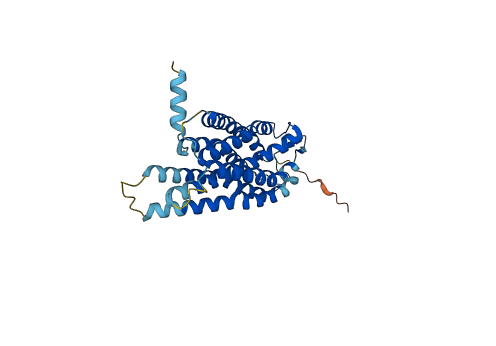
Descriptions
The autoinhibited protein was predicted that may have potential autoinhibitory elements via cis-regPred.
Autoinhibitory domains (AIDs)
Target domain |
|
Relief mechanism |
|
Assay |
cis-regPred |
Accessory elements
No accessory elements
Autoinhibited structure

Activated structure
1 structures for Q920A1
| Entry ID | Method | Resolution | Chain | Position | Source |
|---|---|---|---|---|---|
| AF-Q920A1-F1 | Predicted | AlphaFoldDB |
14 variants for Q920A1
| Variant ID(s) | Position | Change | Description | Diseaes Association | Provenance |
|---|---|---|---|---|---|
| rs3405033966 | 77 | F>C | No | EVA | |
| rs3403812863 | 77 | F>L | No | EVA | |
| rs49161250 | 97 | V>I | No | EVA | |
| rs3389342388 | 105 | N>D | No | EVA | |
| rs242167357 | 170 | S>L | No | EVA | |
| rs3389265784 | 198 | F>Y | No | EVA | |
| rs47678569 | 203 | V>I | No | EVA | |
| rs231359036 | 222 | P>S | No | EVA | |
| rs3389338220 | 223 | R>H | No | EVA | |
| rs3389354018 | 249 | A>T | No | EVA | |
| rs3389305131 | 254 | H>D | No | EVA | |
| rs3389357475 | 256 | V>I | No | EVA | |
| rs262161692 | 274 | T>A | No | EVA | |
| rs262161692 | 274 | T>S | No | EVA |
No associated diseases with Q920A1
1 regional properties for Q920A1
| Type | Name | Position | InterPro Accession |
|---|---|---|---|
| domain | GPCR, rhodopsin-like, 7TM | 53 - 400 | IPR017452 |
2 GO annotations of cellular component
| Name | Definition |
|---|---|
| integral component of plasma membrane | The component of the plasma membrane consisting of the gene products and protein complexes having at least some part of their peptide sequence embedded in the hydrophobic region of the membrane. |
| membrane | A lipid bilayer along with all the proteins and protein complexes embedded in it an attached to it. |
2 GO annotations of molecular function
| Name | Definition |
|---|---|
| cysteinyl leukotriene receptor activity | Combining with a cysteinyl leukotriene to initiate a change in cell activity. Cysteinyl leukotrienes are leukotrienes that contain a peptide group based on cysteine. |
| G protein-coupled peptide receptor activity | Combining with a peptide and transmitting the signal across the membrane by activating an associated G-protein; promotes the exchange of GDP for GTP on the alpha subunit of a heterotrimeric G-protein complex. |
4 GO annotations of biological process
| Name | Definition |
|---|---|
| neuropeptide signaling pathway | A G protein-coupled receptor signaling pathway initiated by a neuropeptide binding to its receptor on the surface of a target cell, and ending with the regulation of a downstream cellular process. |
| positive regulation of angiogenesis | Any process that activates or increases angiogenesis. |
| positive regulation of cell death | Any process that increases the rate or frequency of cell death. Cell death is the specific activation or halting of processes within a cell so that its vital functions markedly cease, rather than simply deteriorating gradually over time, which culminates in cell death. |
| positive regulation of ERK1 and ERK2 cascade | Any process that activates or increases the frequency, rate or extent of signal transduction mediated by the ERK1 and ERK2 cascade. |
| 10 | 20 | 30 | 40 | 50 | 60 |
| MEVTGTPSSY | SNRNCTIENF | KKEFYPIIYL | IIFFWGALGN | GFSIYVFLQT | CKKSTSVNVF |
| 70 | 80 | 90 | 100 | 110 | 120 |
| MLNLATSDFL | FISTLPFRAD | YYFRGSNWIF | GDLACRVMSY | SLYVNMYTSI | YFLTVLSVVR |
| 130 | 140 | 150 | 160 | 170 | 180 |
| FLATVHPFRM | FHVTSVRSAW | ILCGIIWVFI | MASSALLLVN | GQEEKDNIIS | CLELSPQKFK |
| 190 | 200 | 210 | 220 | 230 | 240 |
| SLLIMNHIAV | AVGFLLPFLT | LTVCYLLIIR | ILLKAEIPES | GPRAAHRKAL | TTIVIAMITF |
| 250 | 260 | 270 | 280 | 290 | 300 |
| LLCFLPYHAL | RTLHLVTWDK | DSCGDVLHKA | TVITLTMAAA | NSCFNPFLYY | FAGENFKARL |
| RAIFSKVHL |