Q91ZJ9
Gene name |
Hyal1 |
Protein name |
Hyaluronidase-1 |
Names |
Hyal-1, Hyaluronoglucosaminidase-1 |
Species |
Mus musculus (Mouse) |
KEGG Pathway |
mmu:15586 |
EC number |
3.2.1.35: Glycosidases, ie enzymes hydrolyzing O- and S-glycosyl compounds |
Protein Class |
|
Descriptions
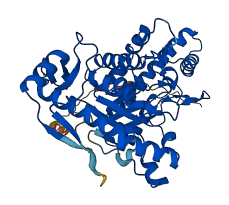
The autoinhibited protein was predicted that may have potential autoinhibitory elements via cis-regPred.
Autoinhibitory domains (AIDs)
Target domain |
|
Relief mechanism |
|
Assay |
cis-regPred |
Accessory elements
No accessory elements
Autoinhibited structure

Activated structure
1 structures for Q91ZJ9
| Entry ID | Method | Resolution | Chain | Position | Source |
|---|---|---|---|---|---|
| AF-Q91ZJ9-F1 | Predicted | AlphaFoldDB |
49 variants for Q91ZJ9
| Variant ID(s) | Position | Change | Description | Diseaes Association | Provenance |
|---|---|---|---|---|---|
| rs13459416 | 16 | P>S | No | EVA | |
| rs3389072519 | 22 | S>F | No | EVA | |
| rs257357711 | 29 | T>I | No | EVA | |
| rs33272312 | 54 | V>M | No | EVA | |
| rs3389050744 | 109 | T>I | No | EVA | |
| rs3389075626 | 115 | P>S | No | EVA | |
| rs3389058760 | 121 | F>L | No | EVA | |
| rs3389079177 | 136 | H>N | No | EVA | |
| rs240449085 | 143 | A>T | No | EVA | |
| rs3389079176 | 146 | P>A | No | EVA | |
| rs3389073810 | 170 | D>N | No | EVA | |
| rs3389072485 | 177 | Q>* | No | EVA | |
| rs3389070915 | 183 | V>D | No | EVA | |
| rs3389066723 | 184 | Q>* | No | EVA | |
| rs3389073789 | 186 | E>G | No | EVA | |
| rs3389045814 | 197 | A>T | No | EVA | |
| rs3389069338 | 203 | F>L | No | EVA | |
| rs3389073802 | 206 | A>T | No | EVA | |
| rs13459417 | 210 | W>R | No | EVA | |
| rs3389071126 | 212 | A>P | No | EVA | |
| rs3389050750 | 220 | V>I | No | EVA | |
| rs3389080106 | 235 | C>G | No | EVA | |
| rs3389075653 | 236 | Y>N | No | EVA | |
| rs3389016530 | 237 | N>T | No | EVA | |
| rs259847055 | 252 | F>C | No | EVA | |
| rs3389050828 | 267 | S>N | No | EVA | |
| rs3389066687 | 269 | A>T | No | EVA | |
| rs30520537 | 284 | E>G | No | EVA | |
| rs3389079192 | 293 | R>S | No | EVA | |
| rs3389045813 | 319 | Y>* | No | EVA | |
| rs243223430 | 321 | M>T | No | EVA | |
| rs3400106225 | 332 | E>V | No | EVA | |
| rs3400106253 | 338 | S>I | No | EVA | |
| rs3389058734 | 359 | E>D | No | EVA | |
| rs3389016542 | 366 | A>T | No | EVA | |
| rs251009360 | 369 | D>N | No | EVA | |
| rs3389045820 | 383 | A>S | No | EVA | |
| rs3389045820 | 383 | A>T | No | EVA | |
| rs3389072484 | 384 | L>I | No | EVA | |
| rs3389069371 | 397 | C>* | No | EVA | |
| rs3389073740 | 423 | G>R | No | EVA | |
| rs240358988 | 427 | S>N | No | EVA | |
| rs3389038343 | 438 | A>T | No | EVA | |
| rs259808614 | 445 | R>K | No | EVA | |
| rs33273575 | 446 | C>S | No | EVA | |
| rs29698623 | 450 | R>C | No | EVA | |
| rs261511268 | 453 | R>S | No | EVA | |
| rs3389050824 | 460 | R>G | No | EVA | |
| rs228270491 | 463 | M>W | No | EVA |
No associated diseases with Q91ZJ9
No regional properties for Q91ZJ9
| Type | Name | Position | InterPro Accession |
|---|---|---|---|
| No domain, repeats, and functional sites for Q91ZJ9 | |||
Functions
| Description | ||
|---|---|---|
| EC Number | 3.2.1.35 | Glycosidases, ie enzymes hydrolyzing O- and S-glycosyl compounds |
| Subcellular Localization |
|
|
| PANTHER Family | ||
| PANTHER Subfamily | ||
| PANTHER Protein Class | ||
| PANTHER Pathway Category | No pathway information available | |
5 GO annotations of cellular component
| Name | Definition |
|---|---|
| cytoplasm | The contents of a cell excluding the plasma membrane and nucleus, but including other subcellular structures. |
| cytoplasmic vesicle | A vesicle found in the cytoplasm of a cell. |
| extracellular space | That part of a multicellular organism outside the cells proper, usually taken to be outside the plasma membranes, and occupied by fluid. |
| hyaluranon cable | A cable structure, surrounding some cell types (e.g. proximal or bronchial tubular epithelial cells), and composed of hyaluranon (HA), a ubiquitous connective tissue glycosaminoglycan. |
| lysosome | A small lytic vacuole that has cell cycle-independent morphology found in most animal cells and that contains a variety of hydrolases, most of which have their maximal activities in the pH range 5-6. The contained enzymes display latency if properly isolated. About 40 different lysosomal hydrolases are known and lysosomes have a great variety of morphologies and functions. |
3 GO annotations of molecular function
| Name | Definition |
|---|---|
| chondroitin hydrolase activity | Catalysis of the hydrolysis of hexosaminic linkages in chondroitin, a linear polymer structure composed of the repeating disaccharide unit [->4)-D-glucuronic acid-(1->3)-N-acetyl-D-galactosamine-(1-], also written as |
| hyaluronan synthase activity | Catalysis of the reaction: UDP-D-glucuronate + UDP-N-acetyl-D-glucosamine = [beta-N-acetyl-D-glucosaminyl-(1->4)-beta-D-glucuronosyl-(1->3)](n) + 2n UDP. |
| hyalurononglucosaminidase activity | Catalysis of the random hydrolysis of (1->4) linkages between N-acetyl-beta-D-glucosamine and D-glucuronate residues in hyaluronate. |
26 GO annotations of biological process
| Name | Definition |
|---|---|
| carbohydrate metabolic process | The chemical reactions and pathways involving carbohydrates, any of a group of organic compounds based of the general formula Cx(H2O)y. |
| cartilage development | The process whose specific outcome is the progression of a cartilage element over time, from its formation to the mature structure. Cartilage elements are skeletal elements that consist of connective tissue dominated by extracellular matrix containing collagen type II and large amounts of proteoglycan, particularly chondroitin sulfate. |
| cellular response to fibroblast growth factor stimulus | Any process that results in a change in state or activity of a cell (in terms of movement, secretion, enzyme production, gene expression, etc.) as a result of an fibroblast growth factor stimulus. |
| cellular response to interleukin-1 | Any process that results in a change in state or activity of a cell (in terms of movement, secretion, enzyme production, gene expression, etc.) as a result of an interleukin-1 stimulus. |
| cellular response to pH | Any process that results in a change in state or activity of a cell (in terms of movement, secretion, enzyme production, gene expression, etc.) as a result of a pH stimulus. pH is a measure of the acidity or basicity of an aqueous solution. |
| cellular response to platelet-derived growth factor stimulus | Any process that results in a change in state or activity of a cell (in terms of movement, secretion, enzyme production, gene expression, etc.) as a result of a platelet-derived growth factor stimulus. |
| cellular response to tumor necrosis factor | Any process that results in a change in state or activity of a cell (in terms of movement, secretion, enzyme production, gene expression, etc.) as a result of a tumor necrosis factor stimulus. |
| cellular response to UV-B | Any process that results in a change in state or activity of a cell (in terms of movement, secretion, enzyme production, gene expression, etc.) as a result of a UV-B radiation stimulus. UV-B radiation (UV-B light) spans the wavelengths 280 to 315 nm. |
| chondroitin sulfate catabolic process | The chemical reactions and pathways resulting in the breakdown of chondroitin sulfate, any member of a group of 10-60 kDa glycosaminoglycans, widely distributed in cartilage and other mammalian connective tissues, the repeat units of which consist of beta-(1,4)-linked D-glucuronyl beta-(1,3)-N-acetyl-D-galactosamine sulfate. |
| embryonic skeletal joint morphogenesis | The process in which the anatomical structures of skeletal joints are generated and organized during the embryonic phase. A skeletal joint is the connecting structure between the bones of the skeleton. |
| hyaluronan biosynthetic process | The chemical reactions and pathways resulting in the formation of hyaluronan, the naturally occurring anionic form of hyaluronic acid, any member of a group of glycosaminoglycans, the repeat units of which consist of beta-1,4 linked D-glucuronyl-beta-(1,3)-N-acetyl-D-glucosamine. |
| hyaluronan catabolic process | The chemical reactions and pathways resulting in the breakdown of hyaluronan, the naturally occurring anionic form of hyaluronic acid, any member of a group of glycosaminoglycans, the repeat units of which consist of beta-1,4 linked D-glucuronyl-beta-(1,3)-N-acetyl-D-glucosamine. |
| hyaluronan metabolic process | The chemical reactions and pathways involving hyaluronan, the naturally occurring anionic form of hyaluronic acid, any member of a group of glycosaminoglycans, the repeat units of which consist of beta-1,4 linked D-glucuronyl-beta-(1,3)-N-acetyl-D-glucosamine. |
| inflammatory response | The immediate defensive reaction (by vertebrate tissue) to infection or injury caused by chemical or physical agents. The process is characterized by local vasodilation, extravasation of plasma into intercellular spaces and accumulation of white blood cells and macrophages. |
| negative regulation of cell growth | Any process that stops, prevents, or reduces the frequency, rate, extent or direction of cell growth. |
| positive regulation of angiogenesis | Any process that activates or increases angiogenesis. |
| positive regulation of cell adhesion | Any process that activates or increases the frequency, rate or extent of cell adhesion. |
| positive regulation of cell growth | Any process that activates or increases the frequency, rate, extent or direction of cell growth. |
| positive regulation of epithelial cell migration | Any process that activates or increases the frequency, rate or extent of epithelial cell migration. |
| positive regulation of epithelial cell proliferation | Any process that activates or increases the rate or extent of epithelial cell proliferation. |
| positive regulation of G1/S transition of mitotic cell cycle | Any signalling pathway that increases or activates a cell cycle cyclin-dependent protein kinase to modulate the switch from G1 phase to S phase of the mitotic cell cycle. |
| positive regulation of growth | Any process that activates or increases the rate or extent of growth, the increase in size or mass of all or part of an organism. |
| positive regulation of hyaluranon cable assembly | Any process that activates or increases the frequency, rate or extent of hyaluranon cable assembly. |
| response to antibiotic | Any process that results in a change in state or activity of a cell or an organism (in terms of movement, secretion, enzyme production, gene expression, etc.) as a result of an antibiotic stimulus. An antibiotic is a chemical substance produced by a microorganism which has the capacity to inhibit the growth of or to kill other microorganisms. |
| response to reactive oxygen species | Any process that results in a change in state or activity of a cell or an organism (in terms of movement, secretion, enzyme production, gene expression, etc.) as a result of a reactive oxygen species stimulus. Reactive oxygen species include singlet oxygen, superoxide, and oxygen free radicals. |
| response to virus | Any process that results in a change in state or activity of a cell or an organism (in terms of movement, secretion, enzyme production, gene expression, etc.) as a result of a stimulus from a virus. |
1 homologous proteins in AiPD
| UniProt AC | Gene Name | Protein Name | Species | Evidence Code |
|---|---|---|---|---|
| Q76HN1 | Hyal1 | Hyaluronidase-1 | Rattus norvegicus (Rat) | PR |
| 10 | 20 | 30 | 40 | 50 | 60 |
| MLGLTQHAQK | VWRMKPFSPE | VSPGSSPATA | GHLLRISTLF | LTLLELAQVC | RGSVVSNRPF |
| 70 | 80 | 90 | 100 | 110 | 120 |
| ITVWNGDTHW | CLTEYGVDVD | VSVFDVVANK | EQSFQGSNMT | IFYREELGTY | PYYTPTGEPV |
| 130 | 140 | 150 | 160 | 170 | 180 |
| FGGLPQNASL | VTHLAHTFQD | IKAAMPEPDF | SGLAVIDWEA | WRPRWAFNWD | SKDIYRQRSM |
| 190 | 200 | 210 | 220 | 230 | 240 |
| ELVQAEHPDW | PETLVEAAAK | NQFQEAAEAW | MAGTLQLGQV | LRPRGLWGYY | GFPDCYNNDF |
| 250 | 260 | 270 | 280 | 290 | 300 |
| LSLNYTGQCP | VFVRDQNDQL | GWLWNQSYAL | YPSIYLPAAL | MGTEKSQMYV | RHRVQEALRV |
| 310 | 320 | 330 | 340 | 350 | 360 |
| AIVSRDPHVP | VMPYVQIFYE | MTDYLLPLEE | LEHSLGESAA | QGVAGAVLWL | SSDKTSTKES |
| 370 | 380 | 390 | 400 | 410 | 420 |
| CQAIKAYMDS | TLGPFIVNVT | SAALLCSEAL | CSGHGRCVRH | PSYPEALLTL | NPASFSIELT |
| 430 | 440 | 450 | 460 | ||
| HDGRPPSLKG | TLSLKDRAQM | AMKFRCRCYR | GWRGKWCDKR | GM |