Q91819
Gene name |
aurka-b (aurka, eg2, stk6) |
Protein name |
Aurora kinase A-B |
Names |
Aurora/IPL1-related kinase 1, ARK-1, Aurora-related kinase 1, Serine/threonine-protein kinase 6-B, Serine/threonine-protein kinase Eg2-B, Serine/threonine-protein kinase aurora-A, p46XlEg22 |
Species |
Xenopus laevis (African clawed frog) |
KEGG Pathway |
xla:398349 |
EC number |
2.7.11.1: Protein-serine/threonine kinases |
Protein Class |
|
Descriptions
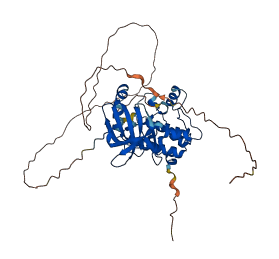
The autoinhibited protein was predicted that may have potential autoinhibitory elements via cis-regPred.
Autoinhibitory domains (AIDs)
Target domain |
|
Relief mechanism |
|
Assay |
cis-regPred |
Accessory elements
280-301 (Activation loop from InterPro)
Target domain |
140-390 (Protein kinase domain) |
Relief mechanism |
|
Assay |
|
Autoinhibited structure

Activated structure
1 structures for Q91819
| Entry ID | Method | Resolution | Chain | Position | Source |
|---|---|---|---|---|---|
| AF-Q91819-F1 | Predicted | AlphaFoldDB |
No variants for Q91819
| Variant ID(s) | Position | Change | Description | Diseaes Association | Provenance |
|---|---|---|---|---|---|
| No variants for Q91819 | |||||
No associated diseases with Q91819
4 regional properties for Q91819
Functions
| Description | ||
|---|---|---|
| EC Number | 2.7.11.1 | Protein-serine/threonine kinases |
| Subcellular Localization |
|
|
| PANTHER Family | ||
| PANTHER Subfamily | ||
| PANTHER Protein Class | ||
| PANTHER Pathway Category | No pathway information available | |
4 GO annotations of cellular component
| Name | Definition |
|---|---|
| centrosome | A structure comprised of a core structure (in most organisms, a pair of centrioles) and peripheral material from which a microtubule-based structure, such as a spindle apparatus, is organized. Centrosomes occur close to the nucleus during interphase in many eukaryotic cells, though in animal cells it changes continually during the cell-division cycle. |
| cytoplasm | The contents of a cell excluding the plasma membrane and nucleus, but including other subcellular structures. |
| spindle microtubule | Any microtubule that is part of a mitotic or meiotic spindle; anchored at one spindle pole. |
| spindle pole | Either of the ends of a spindle, where spindle microtubules are organized; usually contains a microtubule organizing center and accessory molecules, spindle microtubules and astral microtubules. |
6 GO annotations of molecular function
| Name | Definition |
|---|---|
| ATP binding | Binding to ATP, adenosine 5'-triphosphate, a universally important coenzyme and enzyme regulator. |
| kinesin binding | Interacting selectively and non-covalently and stoichiometrically with kinesin, a member of a superfamily of microtubule-based motor proteins that perform force-generating tasks such as organelle transport and chromosome segregation. |
| microtubule binding | Binding to a microtubule, a filament composed of tubulin monomers. |
| protein kinase activity | Catalysis of the phosphorylation of an amino acid residue in a protein, usually according to the reaction: a protein + ATP = a phosphoprotein + ADP. |
| protein serine kinase activity | Catalysis of the reactions: ATP + protein serine = ADP + protein serine phosphate. |
| protein serine/threonine kinase activity | Catalysis of the reactions: ATP + protein serine = ADP + protein serine phosphate, and ATP + protein threonine = ADP + protein threonine phosphate. |
6 GO annotations of biological process
| Name | Definition |
|---|---|
| cell division | The process resulting in division and partitioning of components of a cell to form more cells; may or may not be accompanied by the physical separation of a cell into distinct, individually membrane-bounded daughter cells. |
| meiotic spindle organization | A process that is carried out at the cellular level which results in the assembly, arrangement of constituent parts, or disassembly of the microtubule spindle during a meiotic cell cycle. |
| mitotic centrosome separation | Separation of duplicated centrosome components at the beginning of mitosis. The centriole pair within each centrosome becomes part of a separate microtubule organizing center that nucleates a radial array of microtubules called an aster. The two asters move to opposite sides of the nucleus to form the two poles of the mitotic spindle. |
| mitotic spindle assembly | Mitotic bipolar spindle assembly begins with spindle microtubule nucleation from the separated spindle pole body, includes spindle elongation during prometaphase, and is complete when all kinetochores are stably attached the spindle, and the spindle assembly checkpoint is satisfied. |
| peptidyl-serine phosphorylation | The phosphorylation of peptidyl-serine to form peptidyl-O-phospho-L-serine. |
| protein autophosphorylation | The phosphorylation by a protein of one or more of its own amino acid residues (cis-autophosphorylation), or residues on an identical protein (trans-autophosphorylation). |
No homologous proteins in AiPD
| UniProt AC | Gene Name | Protein Name | Species | Evidence Code |
|---|---|---|---|---|
| No homologous proteins | ||||
| 10 | 20 | 30 | 40 | 50 | 60 |
| MERAVKENHK | PSNVKVFHPM | TEGPKRIPVS | QPPSTQVRPP | VTGVSAQRIL | GPSNVPQRVM |
| 70 | 80 | 90 | 100 | 110 | 120 |
| MQAQKPVLSN | QKPTAQGLLR | PATHGHQTSK | PQGPNENRNP | QQTSHSSTPN | MEKKGSTDQG |
| 130 | 140 | 150 | 160 | 170 | 180 |
| KTLAVPKEEG | KKKQWCLEDF | EIGRPLGKGK | FGNVYLARER | ESKFILALKV | LFKSQLEKAG |
| 190 | 200 | 210 | 220 | 230 | 240 |
| VEHQLRREVE | IQSHLRHPNI | LRLYGYFHDA | CRVYLILDYA | PGGELFRELQ | KCTRFDDQRS |
| 250 | 260 | 270 | 280 | 290 | 300 |
| ALYIKQLAEA | LLYCHSKKVI | HRDIKPENLL | LGSNGELKIA | DFGWSVHAPS | SRRTTLCGTL |
| 310 | 320 | 330 | 340 | 350 | 360 |
| DYLPPEMIEG | RMHDEKVDLW | SLGVLCYEFL | VGKPPFETDT | HQETYRRISK | VEFQYPPYVS |
| 370 | 380 | 390 | 400 | ||
| EEAKDLVSKL | LKHNPNHRLP | LKGVLEHPWI | VKNSQQPKKK | DEPLAGAQ |