Q91287
Gene name |
FGFR3 |
Protein name |
Fibroblast growth factor receptor 3 |
Names |
FGFR-3, PFR3 |
Species |
Pleurodeles waltl (Iberian ribbed newt) |
KEGG Pathway |
|
EC number |
2.7.10.1: Protein-tyrosine kinases |
Protein Class |
|
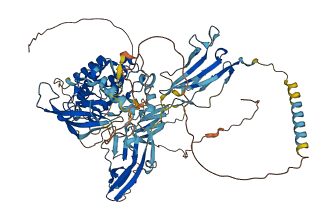
Descriptions
The autoinhibited protein was predicted that may have potential autoinhibitory elements via cis-regPred.
Autoinhibitory domains (AIDs)
Target domain |
|
Relief mechanism |
|
Assay |
cis-regPred |
Accessory elements
619-644 (Activation loop from InterPro)
Target domain |
457-746 (Protein kinase domain) |
Relief mechanism |
|
Assay |
|
Autoinhibited structure

Activated structure
1 structures for Q91287
| Entry ID | Method | Resolution | Chain | Position | Source |
|---|---|---|---|---|---|
| AF-Q91287-F1 | Predicted | AlphaFoldDB |
No variants for Q91287
| Variant ID(s) | Position | Change | Description | Diseaes Association | Provenance |
|---|---|---|---|---|---|
| No variants for Q91287 | |||||
No associated diseases with Q91287
16 regional properties for Q91287
| Type | Name | Position | InterPro Accession |
|---|---|---|---|
| domain | Protein kinase domain | 457 - 746 | IPR000719 |
| domain | Serine-threonine/tyrosine-protein kinase, catalytic domain | 457 - 733 | IPR001245 |
| domain | Immunoglobulin subtype 2 | 47 - 109 | IPR003598-1 |
| domain | Immunoglobulin subtype 2 | 156 - 224 | IPR003598-2 |
| domain | Immunoglobulin subtype 2 | 255 - 335 | IPR003598-3 |
| domain | Immunoglobulin subtype | 41 - 119 | IPR003599-1 |
| domain | Immunoglobulin subtype | 150 - 235 | IPR003599-2 |
| domain | Immunoglobulin subtype | 249 - 346 | IPR003599-3 |
| domain | Immunoglobulin-like domain | 29 - 119 | IPR007110-1 |
| domain | Immunoglobulin-like domain | 140 - 233 | IPR007110-2 |
| domain | Immunoglobulin-like domain | 239 - 344 | IPR007110-3 |
| active_site | Tyrosine-protein kinase, active site | 598 - 610 | IPR008266 |
| domain | Immunoglobulin I-set | 155 - 234 | IPR013098-1 |
| domain | Immunoglobulin I-set | 251 - 345 | IPR013098-2 |
| binding_site | Protein kinase, ATP binding site | 463 - 493 | IPR017441 |
| domain | Tyrosine-protein kinase, catalytic domain | 457 - 733 | IPR020635 |
Functions
| Description | ||
|---|---|---|
| EC Number | 2.7.10.1 | Protein-tyrosine kinases |
| Subcellular Localization |
|
|
| PANTHER Family | ||
| PANTHER Subfamily | ||
| PANTHER Protein Class | ||
| PANTHER Pathway Category | No pathway information available | |
2 GO annotations of cellular component
| Name | Definition |
|---|---|
| integral component of membrane | The component of a membrane consisting of the gene products and protein complexes having at least some part of their peptide sequence embedded in the hydrophobic region of the membrane. |
| plasma membrane | The membrane surrounding a cell that separates the cell from its external environment. It consists of a phospholipid bilayer and associated proteins. |
2 GO annotations of molecular function
| Name | Definition |
|---|---|
| ATP binding | Binding to ATP, adenosine 5'-triphosphate, a universally important coenzyme and enzyme regulator. |
| fibroblast growth factor receptor activity | Combining with a fibroblast growth factor receptor ligand and transmitting the signal across the plasma membrane to initiate a change in cell activity. |
2 GO annotations of biological process
| Name | Definition |
|---|---|
| apoptotic process | A programmed cell death process which begins when a cell receives an internal (e.g. DNA damage) or external signal (e.g. an extracellular death ligand), and proceeds through a series of biochemical events (signaling pathway phase) which trigger an execution phase. The execution phase is the last step of an apoptotic process, and is typically characterized by rounding-up of the cell, retraction of pseudopodes, reduction of cellular volume (pyknosis), chromatin condensation, nuclear fragmentation (karyorrhexis), plasma membrane blebbing and fragmentation of the cell into apoptotic bodies. When the execution phase is completed, the cell has died. |
| positive regulation of cell population proliferation | Any process that activates or increases the rate or extent of cell proliferation. |
No homologous proteins in AiPD
| UniProt AC | Gene Name | Protein Name | Species | Evidence Code |
|---|---|---|---|---|
| No homologous proteins | ||||
| 10 | 20 | 30 | 40 | 50 | 60 |
| MLVWLCGLCL | VTLAGGRSAA | RLPLTEGRPT | ADFLPGDASL | VEELLFGTGD | TIELSCTTPG |
| 70 | 80 | 90 | 100 | 110 | 120 |
| SSVSVVWFKD | GISVDPPTWS | HTGQKLLKII | NVSYDDSGVY | SCKARQSSEV | LRNVTVRVTD |
| 130 | 140 | 150 | 160 | 170 | 180 |
| SPSSGDDEDD | DEESESANAP | KFTRPEWMEK | KLLAVPAANT | VRFRCPAAGK | PTPSITWLKN |
| 190 | 200 | 210 | 220 | 230 | 240 |
| GKEFKGEHRI | GGIKLRHQQW | SLVMESVVPS | DRGNYTCVVA | NKYGTIRETY | TLDVLERTPH |
| 250 | 260 | 270 | 280 | 290 | 300 |
| RPILQAGFRS | NKTVVVGSDV | EFHCKVYSDA | QPHIQWLKHV | EVNGSKFGPD | GNPYVTVLKT |
| 310 | 320 | 330 | 340 | 350 | 360 |
| AGVNTSDKEL | EIQFLRNVTF | EDAGEYTCLA | GNSIGYSHHS | AWLTVLPPAE | PVPDVDTSVS |
| 370 | 380 | 390 | 400 | 410 | 420 |
| ILAAAGCVAV | VILVVIIIFT | YKMKMPSKKT | MNTATVHKVS | KFPLKRQVSL | ESNSSMNSNT |
| 430 | 440 | 450 | 460 | 470 | 480 |
| PLVRITRLSS | SDGPMLANVS | ELELPADPKW | ELSRSRLTLG | KPLGEGCFGQ | VVMADAVGIE |
| 490 | 500 | 510 | 520 | 530 | 540 |
| KDKPNKATSV | AVKMLKDDAT | DKDLSDLVSE | MEMMKMIGKH | KNIINLLGAC | TQDGPLYVLV |
| 550 | 560 | 570 | 580 | 590 | 600 |
| EYASKGNLRE | YLRARRPPGM | DYSFDTCKLP | EEQLTFKDLV | SCAYQVARGM | EYLASQKCIH |
| 610 | 620 | 630 | 640 | 650 | 660 |
| RDLAARNVLV | TDDNVMKIAD | FGLARDVHNI | DYYKKTTNGR | LPVKWMAPEA | LFDRVYTHQS |
| 670 | 680 | 690 | 700 | 710 | 720 |
| DVWSFGVLLW | EIFTLGGSPY | PGIPVEELFK | LLKEGHRMDK | PANCTHELYM | IMRECWHAVP |
| 730 | 740 | 750 | 760 | 770 | 780 |
| SQRPTFKQLV | EDLDRVLTVT | STDEYLDLSV | PFEQYSPACP | DSHSSCSSGD | DSVFAHDLPE |
| 790 | |||||
| EPCLPKHQQY | NGVIRT |