Q90578
Gene name |
|
Protein name |
Vitamin D3 hydroxylase-associated protein |
Names |
VDHAP |
Species |
Gallus gallus (Chicken) |
KEGG Pathway |
gga:395824 |
EC number |
|
Protein Class |
|
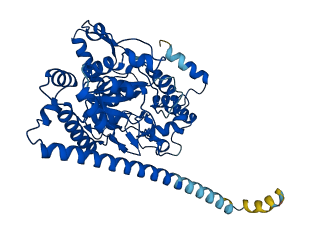
Descriptions
The autoinhibited protein was predicted that may have potential autoinhibitory elements via cis-regPred.
Autoinhibitory domains (AIDs)
Target domain |
|
Relief mechanism |
|
Assay |
cis-regPred |
Accessory elements
No accessory elements
Autoinhibited structure

Activated structure
1 structures for Q90578
| Entry ID | Method | Resolution | Chain | Position | Source |
|---|---|---|---|---|---|
| AF-Q90578-F1 | Predicted | AlphaFoldDB |
No variants for Q90578
| Variant ID(s) | Position | Change | Description | Diseaes Association | Provenance |
|---|---|---|---|---|---|
| No variants for Q90578 | |||||
No associated diseases with Q90578
2 GO annotations of cellular component
| Name | Definition |
|---|---|
| mitochondrial inner membrane | The inner, i.e. lumen-facing, lipid bilayer of the mitochondrial envelope. It is highly folded to form cristae. |
| mitochondrion | A semiautonomous, self replicating organelle that occurs in varying numbers, shapes, and sizes in the cytoplasm of virtually all eukaryotic cells. It is notably the site of tissue respiration. |
2 GO annotations of molecular function
| Name | Definition |
|---|---|
| amidase activity | Catalysis of the reaction: a monocarboxylic acid amide + H2O = a monocarboxylate + NH3. |
| fatty acid amide hydrolase activity | Catalysis of the hydrolysis of a fatty acid amide to yield a fatty acid. |
1 GO annotations of biological process
| Name | Definition |
|---|---|
| fatty acid catabolic process | The chemical reactions and pathways resulting in the breakdown of a fatty acid, any of the aliphatic monocarboxylic acids that can be liberated by hydrolysis from naturally occurring fats and oils. Fatty acids are predominantly straight-chain acids of 4 to 24 carbon atoms, which may be saturated or unsaturated; branched fatty acids and hydroxy fatty acids also occur, and very long chain acids of over 30 carbons are found in waxes. |
No homologous proteins in AiPD
| UniProt AC | Gene Name | Protein Name | Species | Evidence Code |
|---|---|---|---|---|
| No homologous proteins | ||||
| 10 | 20 | 30 | 40 | 50 | 60 |
| MTLERLWQVL | DPLWADPRVL | SALFCGSAMA | VVLLKRLGHR | RIQQKMEEAR | RARDLALERM |
| 70 | 80 | 90 | 100 | 110 | 120 |
| EKAARRFKQE | NPGTQTAHIL | SLTMVELAEK | LKEGSLSPES | VLYSYMGKAL | EVNREVNCVI |
| 130 | 140 | 150 | 160 | 170 | 180 |
| DFIHGCEDQL | QKVKQQKEKG | LLYGIPVSIK | DHIDCKGHVS | SAGLVKFLGQ | VKEEDSVIVQ |
| 190 | 200 | 210 | 220 | 230 | 240 |
| VLKSQGAIPF | VKTNIPQTMI | NYDCSNLIFG | QTLNPLNHQK | TPGGSSGGEG | ALIAGGGSLL |
| 250 | 260 | 270 | 280 | 290 | 300 |
| GIGSDVAGSI | RLPSSFCGLC | GLKPTGFRIS | KLGVISPITG | MNSVIGMLGP | IARDVDSLAL |
| 310 | 320 | 330 | 340 | 350 | 360 |
| CMKALLCEEM | FRLDPTVPPI | PFDEEVYTSS | KPLRIGYYEE | DGYFQPSPSM | KRAVQQTRKL |
| 370 | 380 | 390 | 400 | 410 | 420 |
| LQEAGHTIVP | FAPPKIDYVV | DELFTRGIFS | DGAAHLVDSF | KGDIVDPNLK | SQFNTYKLPA |
| 430 | 440 | 450 | 460 | ||
| LVKRILAIIL | KPIYPRIARD | LSALCGVGSA | KNLWDQHTAV | GLPH |