Q8ZYE7
Gene name |
eno |
Protein name |
Enolase |
Names |
2-phospho-D-glycerate hydro-lyase, 2-phosphoglycerate dehydratase |
Species |
Pyrobaculum aerophilum (strain ATCC 51768 / DSM 7523 / JCM 9630 / CIP 104966 / NBRC 100827 / IM2) |
KEGG Pathway |
pai:PAE0812 |
EC number |
4.2.1.11: Hydro-lyases |
Protein Class |
|
Descriptions
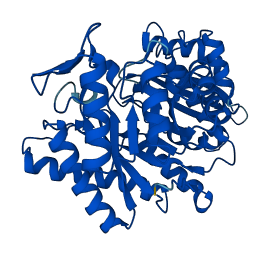
The autoinhibited protein was predicted that may have potential autoinhibitory elements via cis-regPred.
Autoinhibitory domains (AIDs)
Target domain |
|
Relief mechanism |
|
Assay |
cis-regPred |
Accessory elements
No accessory elements
Autoinhibited structure

Activated structure
1 structures for Q8ZYE7
| Entry ID | Method | Resolution | Chain | Position | Source |
|---|---|---|---|---|---|
| AF-Q8ZYE7-F1 | Predicted | AlphaFoldDB |
No variants for Q8ZYE7
| Variant ID(s) | Position | Change | Description | Diseaes Association | Provenance |
|---|---|---|---|---|---|
| No variants for Q8ZYE7 | |||||
No associated diseases with Q8ZYE7
Functions
| Description | ||
|---|---|---|
| EC Number | 4.2.1.11 | Hydro-lyases |
| Subcellular Localization |
|
|
| PANTHER Family | ||
| PANTHER Subfamily | ||
| PANTHER Protein Class | ||
| PANTHER Pathway Category | No pathway information available | |
3 GO annotations of cellular component
| Name | Definition |
|---|---|
| cell surface | The external part of the cell wall and/or plasma membrane. |
| extracellular region | The space external to the outermost structure of a cell. For cells without external protective or external encapsulating structures this refers to space outside of the plasma membrane. This term covers the host cell environment outside an intracellular parasite. |
| phosphopyruvate hydratase complex | A multimeric enzyme complex, usually a dimer or an octamer, that catalyzes the conversion of 2-phospho-D-glycerate to phosphoenolpyruvate and water. |
2 GO annotations of molecular function
| Name | Definition |
|---|---|
| magnesium ion binding | Binding to a magnesium (Mg) ion. |
| phosphopyruvate hydratase activity | Catalysis of the reaction: 2-phospho-D-glycerate = phosphoenolpyruvate + H2O. |
1 GO annotations of biological process
| Name | Definition |
|---|---|
| glycolytic process | The chemical reactions and pathways resulting in the breakdown of a carbohydrate into pyruvate, with the concomitant production of a small amount of ATP and the reduction of NAD(P) to NAD(P)H. Glycolysis begins with the metabolism of a carbohydrate to generate products that can enter the pathway and ends with the production of pyruvate. Pyruvate may be converted to acetyl-coenzyme A, ethanol, lactate, or other small molecules. |
No homologous proteins in AiPD
| UniProt AC | Gene Name | Protein Name | Species | Evidence Code |
|---|---|---|---|---|
| No homologous proteins | ||||
| 10 | 20 | 30 | 40 | 50 | 60 |
| MQISDAWIRK | VFTGRGDVTV | EVELTVEDSV | TGDVLVTRAA | APAGASRGAH | EVLYFPEGGV |
| 70 | 80 | 90 | 100 | 110 | 120 |
| DAALAAFEKL | VAPEIVGLDV | TEPYSTDGKL | EEVDGTQRFE | KIGGAVAIAT | SFAAAEAGAA |
| 130 | 140 | 150 | 160 | 170 | 180 |
| SLGVPLYSFI | GGAYARRLPL | PLGNVIGGGK | HSRGLGPDIQ | EFLAMPLNPP | DIYTAVYTNV |
| 190 | 200 | 210 | 220 | 230 | 240 |
| EIHKRVLKYI | LKVDTSFTGG | KNDEGAWTPR | ISSTTALKIL | REAAREVSGE | LGVEVGIGVD |
| 250 | 260 | 270 | 280 | 290 | 300 |
| VAASSLWNGE | KYVYKNEGVE | RDPREQFEFI | AKLIEEYDLV | YVEDPFHEED | FQSFAELRDR |
| 310 | 320 | 330 | 340 | 350 | 360 |
| FKDRLIVGDD | LFVTNPERIK | KGGKIGAATG | VIIKPDQIGT | LLRAHQAVSA | AREFGMRVIV |
| 370 | 380 | 390 | 400 | 410 | |
| SHRSGDTEYK | TLAHIAVGFG | AEVIKTGIMG | GERTAKLNEL | IRIGDYLGKW | ATITQIRIH |