Q8ZWK7
Gene name |
gap |
Protein name |
Glyceraldehyde-3-phosphate dehydrogenase |
Names |
GAPDH, NAD(P)-dependent glyceraldehyde-3-phosphate dehydrogenase |
Species |
Pyrobaculum aerophilum (strain ATCC 51768 / DSM 7523 / JCM 9630 / CIP 104966 / NBRC 100827 / IM2) |
KEGG Pathway |
pai:PAE1740 |
EC number |
1.2.1.59: With NAD(+) or NADP(+) as acceptor |
Protein Class |
|
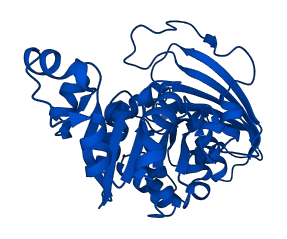
Descriptions
The autoinhibited protein was predicted that may have potential autoinhibitory elements via cis-regPred.
Autoinhibitory domains (AIDs)
Target domain |
|
Relief mechanism |
|
Assay |
cis-regPred |
Accessory elements
No accessory elements
Autoinhibited structure

Activated structure
1 structures for Q8ZWK7
| Entry ID | Method | Resolution | Chain | Position | Source |
|---|---|---|---|---|---|
| AF-Q8ZWK7-F1 | Predicted | AlphaFoldDB |
No variants for Q8ZWK7
| Variant ID(s) | Position | Change | Description | Diseaes Association | Provenance |
|---|---|---|---|---|---|
| No variants for Q8ZWK7 | |||||
No associated diseases with Q8ZWK7
15 regional properties for Q8ZWK7
| Type | Name | Position | InterPro Accession |
|---|---|---|---|
| domain | Immunodeficiency lentiviral matrix, N-terminal | 2 - 127 | IPR000071 |
| domain | Reverse transcriptase domain | 631 - 821 | IPR000477 |
| domain | Integrase, C-terminal, retroviral | 1370 - 1417 | IPR001037 |
| domain | Integrase, catalytic core | 1201 - 1351 | IPR001584 |
| domain | Zinc finger, CCHC-type | 392 - 408 | IPR001878-1 |
| domain | Zinc finger, CCHC-type | 413 - 429 | IPR001878-2 |
| active_site | Aspartic peptidase, active site | 510 - 521 | IPR001969 |
| domain | Peptidase A2A, retrovirus, catalytic | 508 - 577 | IPR001995 |
| domain | Ribonuclease H domain | 1021 - 1144 | IPR002156 |
| domain | Integrase, N-terminal zinc-binding domain | 1150 - 1191 | IPR003308 |
| domain | Reverse transcriptase connection | 905 - 1006 | IPR010659 |
| domain | Reverse transcriptase thumb | 829 - 890 | IPR010661 |
| domain | Retropepsins | 494 - 585 | IPR018061 |
| domain | Retropepsin-like catalytic domain | 499 - 579 | IPR034170 |
| domain | Retroviral nucleocapsid Gag protein p24, C-terminal domain | 277 - 349 | IPR045345 |
Functions
| Description | ||
|---|---|---|
| EC Number | 1.2.1.59 | With NAD(+) or NADP(+) as acceptor |
| Subcellular Localization |
|
|
| PANTHER Family | ||
| PANTHER Subfamily | ||
| PANTHER Protein Class | ||
| PANTHER Pathway Category | No pathway information available | |
1 GO annotations of cellular component
| Name | Definition |
|---|---|
| cytoplasm | The contents of a cell excluding the plasma membrane and nucleus, but including other subcellular structures. |
5 GO annotations of molecular function
| Name | Definition |
|---|---|
| 4-hydroxy-tetrahydrodipicolinate reductase | Catalysis of the reaction: (S)-2,3,4,5-tetrahydropyridine-2,6-dicarboxylate + NAD(P)+ + H2O = (2S,4S)-4-hydroxy-2,3,4,5-tetrahydrodipicolinate + NAD(P)H + H+. |
| glyceraldehyde-3-phosphate dehydrogenase (NAD+) (phosphorylating) activity | Catalysis of the reaction: D-glyceraldehyde 3-phosphate + phosphate + NAD+ = 3-phospho-D-glyceroyl phosphate + NADH + H+. |
| glyceraldehyde-3-phosphate dehydrogenase (NADP+) (phosphorylating) activity | Catalysis of the reaction: phosphate + NADP+ + glyceraldehyde-3-phosphate = NADPH + 3-phospho-D-glyceroyl-phosphate. |
| NAD binding | Binding to nicotinamide adenine dinucleotide, a coenzyme involved in many redox and biosynthetic reactions; binding may be to either the oxidized form, NAD+, or the reduced form, NADH. |
| NADP binding | Binding to nicotinamide-adenine dinucleotide phosphate, a coenzyme involved in many redox and biosynthetic reactions; binding may be to either the oxidized form, NADP+, or the reduced form, NADPH. |
2 GO annotations of biological process
| Name | Definition |
|---|---|
| glycolytic process | The chemical reactions and pathways resulting in the breakdown of a carbohydrate into pyruvate, with the concomitant production of a small amount of ATP and the reduction of NAD(P) to NAD(P)H. Glycolysis begins with the metabolism of a carbohydrate to generate products that can enter the pathway and ends with the production of pyruvate. Pyruvate may be converted to acetyl-coenzyme A, ethanol, lactate, or other small molecules. |
| lysine biosynthetic process via diaminopimelate | The chemical reactions and pathways resulting in the formation of lysine, via the intermediate diaminopimelate. |
No homologous proteins in AiPD
| UniProt AC | Gene Name | Protein Name | Species | Evidence Code |
|---|---|---|---|---|
| No homologous proteins | ||||
| 10 | 20 | 30 | 40 | 50 | 60 |
| MIRVGIVGFG | TIGKRIADAV | AAQDDMKISG | VLKVTPDYEA | KIAVERGFKV | YTLPDGLDKF |
| 70 | 80 | 90 | 100 | 110 | 120 |
| KKAGIEPAGT | IEDLIEASDI | IVDASPEDVG | RENKEKYYIK | FNKPVIFQGG | EDADVAEVSF |
| 130 | 140 | 150 | 160 | 170 | 180 |
| NALANFEEAA | GRRYVRVVSC | NTTGITRVLS | SLMLNGIKIK | KARIFIARRG | ADPKEHKKGP |
| 190 | 200 | 210 | 220 | 230 | 240 |
| INDVVPNPVT | VPSHHGPDAQ | TVLKNIDIVT | MAVAVPVTIM | HMHMAYLELD | GSYTKEAVIE |
| 250 | 260 | 270 | 280 | 290 | 300 |
| AFAKTPRIFL | ADVGAGFQSL | AQIIEYARDL | GRPRGDFPEV | AVFRDSVTVN | GNELYLMYGV |
| 310 | 320 | 330 | 340 | ||
| HQESIVVPEN | IDAVRAVLGL | APKWRSIEKT | DKSLKLITEG | KRYG |