Q8ZVF3
Gene name |
sucC |
Protein name |
Succinate--CoA ligase [ADP-forming] subunit beta |
Names |
Succinyl-CoA synthetase subunit beta, SCS-beta |
Species |
Pyrobaculum aerophilum (strain ATCC 51768 / DSM 7523 / JCM 9630 / CIP 104966 / NBRC 100827 / IM2) |
KEGG Pathway |
pai:PAE2312 |
EC number |
6.2.1.5: Acid--thiol ligases |
Protein Class |
|
Descriptions
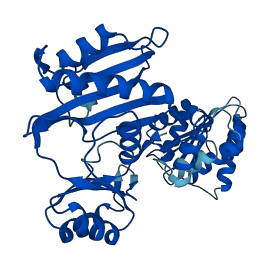
The autoinhibited protein was predicted that may have potential autoinhibitory elements via cis-regPred.
Autoinhibitory domains (AIDs)
Target domain |
|
Relief mechanism |
|
Assay |
cis-regPred |
Accessory elements
No accessory elements
Autoinhibited structure

Activated structure
1 structures for Q8ZVF3
| Entry ID | Method | Resolution | Chain | Position | Source |
|---|---|---|---|---|---|
| AF-Q8ZVF3-F1 | Predicted | AlphaFoldDB |
No variants for Q8ZVF3
| Variant ID(s) | Position | Change | Description | Diseaes Association | Provenance |
|---|---|---|---|---|---|
| No variants for Q8ZVF3 | |||||
No associated diseases with Q8ZVF3
4 regional properties for Q8ZVF3
| Type | Name | Position | InterPro Accession |
|---|---|---|---|
| domain | ATP-citrate lyase/succinyl-CoA ligase | 260 - 376 | IPR005811 |
| domain | ATP-grasp fold | 9 - 245 | IPR011761 |
| domain | ATP-grasp fold, succinyl-CoA synthetase-type | 2 - 196 | IPR013650 |
| conserved_site | Succinyl-CoA synthetase, beta subunit, conserved site | 253 - 278 | IPR017866 |
Functions
| Description | ||
|---|---|---|
| EC Number | 6.2.1.5 | Acid--thiol ligases |
| Subcellular Localization |
|
|
| PANTHER Family | ||
| PANTHER Subfamily | ||
| PANTHER Protein Class | ||
| PANTHER Pathway Category | No pathway information available | |
1 GO annotations of cellular component
| Name | Definition |
|---|---|
| succinate-CoA ligase complex | A heterodimeric enzyme complex, usually composed of an alpha and beta chain. Functions in the TCA cycle, hydrolyzing succinyl-CoA into succinate and CoA, thereby forming ATP or GTP. |
3 GO annotations of molecular function
| Name | Definition |
|---|---|
| ATP binding | Binding to ATP, adenosine 5'-triphosphate, a universally important coenzyme and enzyme regulator. |
| magnesium ion binding | Binding to a magnesium (Mg) ion. |
| succinate-CoA ligase (ADP-forming) activity | Catalysis of the reaction: ATP + succinate + CoA = ADP + succinyl-CoA + phosphate. |
2 GO annotations of biological process
| Name | Definition |
|---|---|
| succinyl-CoA metabolic process | The chemical reactions and pathways involving succinyl-CoA, a compound composed of the monovalent acyl group 3-carboxypropanoyl, derived from succinic acid by loss of one OH group, linked to coenzyme A. |
| tricarboxylic acid cycle | A nearly universal metabolic pathway in which the acetyl group of acetyl coenzyme A is effectively oxidized to two CO2 and four pairs of electrons are transferred to coenzymes. The acetyl group combines with oxaloacetate to form citrate, which undergoes successive transformations to isocitrate, 2-oxoglutarate, succinyl-CoA, succinate, fumarate, malate, and oxaloacetate again, thus completing the cycle. In eukaryotes the tricarboxylic acid is confined to the mitochondria. See also glyoxylate cycle. |
No homologous proteins in AiPD
| UniProt AC | Gene Name | Protein Name | Species | Evidence Code |
|---|---|---|---|---|
| No homologous proteins | ||||
| 10 | 20 | 30 | 40 | 50 | 60 |
| MKLHEYEAKE | LFSKYGVKIP | PGKVALTPEE | VLKIAREIGA | PVVLKAQVVV | AGRGKAGGIK |
| 70 | 80 | 90 | 100 | 110 | 120 |
| VANSPEEAYE | LSKRMFGMNI | KGLIVKKLYV | TKFVEVEREM | YLSLIIDRAS | RRYLFLASPV |
| 130 | 140 | 150 | 160 | 170 | 180 |
| GGMDIEEIAK | TSPEKIKRVY | VDPATGLRDY | HVRSIVSWLG | FKQGTSQWQQ | AASIVQAMYR |
| 190 | 200 | 210 | 220 | 230 | 240 |
| IMVDYDAELV | ESNPLAVTKE | GEVIPLDARV | IVDDNALFKH | PELEKALEED | PRDVTEFEAY |
| 250 | 260 | 270 | 280 | 290 | 300 |
| AKKIGFHYVE | LDGDVGIIGN | GAGLTMATMD | LVYHFGGRPA | NFLDIGGGAS | REVVKEAVKV |
| 310 | 320 | 330 | 340 | 350 | 360 |
| LLHHPRVKVI | FVNIFGGITR | ADEVALGIKE | ALAESGGTNK | KIVVRMKGTN | EELGRAILAE |
| 370 | 380 | ||||
| IGVPLFDSAE | EAAKKAVELA | RV |