Q8ZBK0
Gene name |
cueO (YPO3409, y0777, YP_0276) |
Protein name |
Multicopper oxidase CueO |
Names |
MCO, Copper efflux oxidase, Cu efflux oxidase, Cuprous oxidase |
Species |
Yersinia pestis |
KEGG Pathway |
ypm:YP_0276 |
EC number |
1.16.3.4: With oxygen as acceptor |
Protein Class |
|
Descriptions
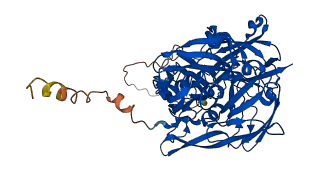
The autoinhibited protein was predicted that may have potential autoinhibitory elements via cis-regPred.
Autoinhibitory domains (AIDs)
Target domain |
|
Relief mechanism |
|
Assay |
cis-regPred |
Accessory elements
No accessory elements
Autoinhibited structure

Activated structure
1 structures for Q8ZBK0
| Entry ID | Method | Resolution | Chain | Position | Source |
|---|---|---|---|---|---|
| AF-Q8ZBK0-F1 | Predicted | AlphaFoldDB |
No variants for Q8ZBK0
| Variant ID(s) | Position | Change | Description | Diseaes Association | Provenance |
|---|---|---|---|---|---|
| No variants for Q8ZBK0 | |||||
No associated diseases with Q8ZBK0
6 regional properties for Q8ZBK0
| Type | Name | Position | InterPro Accession |
|---|---|---|---|
| domain | Multicopper oxidase, second cupredoxin domain | 221 - 290 | IPR001117 |
| binding_site | Multicopper oxidase, copper-binding site | 514 - 525 | IPR002355 |
| conserved_site | Twin-arginine translocation pathway, signal sequence | 1 - 28 | IPR006311 |
| domain | Multicopper oxidase, C-terminal | 416 - 532 | IPR011706 |
| domain | Multicopper oxidase, N-terminal | 53 - 166 | IPR011707 |
| conserved_site | Twin-arginine translocation pathway, signal sequence, bacterial/archaeal | 1 - 23 | IPR019546 |
Functions
| Description | ||
|---|---|---|
| EC Number | 1.16.3.4 | With oxygen as acceptor |
| Subcellular Localization |
|
|
| PANTHER Family | ||
| PANTHER Subfamily | ||
| PANTHER Protein Class | ||
| PANTHER Pathway Category | No pathway information available | |
1 GO annotations of cellular component
| Name | Definition |
|---|---|
| outer membrane-bounded periplasmic space | The region between the inner (cytoplasmic or plasma) membrane and outer membrane of organisms with two membranes such as Gram negative bacteria. These periplasmic spaces are relatively thick and contain a thin peptidoglycan layer (PGL), also referred to as a thin cell wall. |
3 GO annotations of molecular function
| Name | Definition |
|---|---|
| copper ion binding | Binding to a copper (Cu) ion. |
| ferroxidase activity | Catalysis of the reaction: 4 Fe2+ + 4 H+ + O2 = 4 Fe3+ + 2 H2O. |
| oxidoreductase activity | Catalysis of an oxidation-reduction (redox) reaction, a reversible chemical reaction in which the oxidation state of an atom or atoms within a molecule is altered. One substrate acts as a hydrogen or electron donor and becomes oxidized, while the other acts as hydrogen or electron acceptor and becomes reduced. |
No GO annotations of biological process
| Name | Definition |
|---|---|
| No GO annotations for biological process |
No homologous proteins in AiPD
| UniProt AC | Gene Name | Protein Name | Species | Evidence Code |
|---|---|---|---|---|
| No homologous proteins | ||||
| 10 | 20 | 30 | 40 | 50 | 60 |
| MHRRDFLKLT | AALGAATSLP | LWSRAALAAD | FSPLPIPPLL | QPDANGKINL | NIQTGSVVWL |
| 70 | 80 | 90 | 100 | 110 | 120 |
| PSTATQTWGY | NGNLLGPAIR | LQRGKAVTID | ITNALPEATT | VHWHGLEIPG | EVDGGPQALI |
| 130 | 140 | 150 | 160 | 170 | 180 |
| QPGAKRQVTF | AVEQPAATCW | FHPHTHSKTG | HQVAMGLGGL | VLIDDSDSET | LPLPKQWGVD |
| 190 | 200 | 210 | 220 | 230 | 240 |
| DIPVILQDKL | LDKHGQVDYQ | LDVMTAAVGW | FGDRMLTNGV | PYPQQITPRG | WVRLRLLNGC |
| 250 | 260 | 270 | 280 | 290 | 300 |
| NARSLNLALS | DGRPMYVIAS | DGGLLAEPVV | VRELPILMGE | RFEVLVDTRD | GQSLDLVTLP |
| 310 | 320 | 330 | 340 | 350 | 360 |
| VTQMGMTLAP | FDQPLPVLRI | QPSLAIGSQV | LPESLVVIPE | LADVTGVQER | WFQLMMDPKL |
| 370 | 380 | 390 | 400 | 410 | 420 |
| DMLGMQALVA | RYGMKAMAGM | NMNHGDMGAM | DHGNRPDMSQ | GKMKGMDHGT | MNGAPAFNFS |
| 430 | 440 | 450 | 460 | 470 | 480 |
| HANRINGKAF | SMTEPAFDAK | QGKYEKWTIS | GEGDMMLHPF | HVHGTQFRIL | TENGKPPAEH |
| 490 | 500 | 510 | 520 | 530 | |
| RRGWKDIVRV | EGARSEILVR | FNYLAPASTP | YMAHCHLLEH | EDTGMMLGFT | VSA |