Q8Y7K9
Gene name |
clpX |
Protein name |
ATP-dependent Clp protease ATP-binding subunit ClpX |
Names |
|
Species |
Listeria monocytogenes serovar 1/2a (strain ATCC BAA-679 / EGD-e) |
KEGG Pathway |
lmo:lmo1268 |
EC number |
|
Protein Class |
|
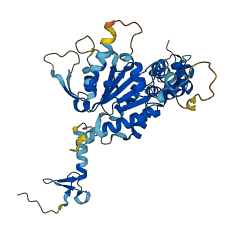
Descriptions
The autoinhibited protein was predicted that may have potential autoinhibitory elements via cis-regPred.
Autoinhibitory domains (AIDs)
Target domain |
|
Relief mechanism |
|
Assay |
cis-regPred |
Accessory elements
No accessory elements
Autoinhibited structure

Activated structure
2 structures for Q8Y7K9
| Entry ID | Method | Resolution | Chain | Position | Source |
|---|---|---|---|---|---|
| 6SFW | EM | 600 A | O/P/Q/R/S/T | 1-419 | PDB |
| AF-Q8Y7K9-F1 | Predicted | AlphaFoldDB |
No variants for Q8Y7K9
| Variant ID(s) | Position | Change | Description | Diseaes Association | Provenance |
|---|---|---|---|---|---|
| No variants for Q8Y7K9 | |||||
No associated diseases with Q8Y7K9
1 GO annotations of cellular component
| Name | Definition |
|---|---|
| HslUV protease complex | A protein complex that possesses ATP-dependent protease activity; consists of an ATPase large subunit with homology to other ClpX family ATPases and a peptidase small subunit related to the proteasomal beta-subunits of eukaryotes. In the E. coli complex, a double ring-shaped homohexamer of HslV is capped on each side by a ring-shaped HslU homohexamer. |
6 GO annotations of molecular function
| Name | Definition |
|---|---|
| ATP binding | Binding to ATP, adenosine 5'-triphosphate, a universally important coenzyme and enzyme regulator. |
| ATP hydrolysis activity | Catalysis of the reaction: ATP + H2O = ADP + H+ phosphate. ATP hydrolysis is used in some reactions as an energy source, for example to catalyze a reaction or drive transport against a concentration gradient. |
| ATP-dependent protein folding chaperone | Binding to a protein or a protein-containing complex to assist the protein folding process, driven by ATP hydrolysis. |
| protein dimerization activity | The formation of a protein dimer, a macromolecular structure consists of two noncovalently associated identical or nonidentical subunits. |
| unfolded protein binding | Binding to an unfolded protein. |
| zinc ion binding | Binding to a zinc ion (Zn). |
2 GO annotations of biological process
| Name | Definition |
|---|---|
| cell division | The process resulting in division and partitioning of components of a cell to form more cells; may or may not be accompanied by the physical separation of a cell into distinct, individually membrane-bounded daughter cells. |
| proteolysis involved in protein catabolic process | The hydrolysis of a peptide bond or bonds within a protein as part of the chemical reactions and pathways resulting in the breakdown of a protein by individual cells. |
No homologous proteins in AiPD
| UniProt AC | Gene Name | Protein Name | Species | Evidence Code |
|---|---|---|---|---|
| No homologous proteins | ||||
| 10 | 20 | 30 | 40 | 50 | 60 |
| MFKFNDEKGQ | LKCSFCGKTQ | DQVRKLVAGP | GVYICDECIE | LCNEIIEEEL | GISEFVDFGE |
| 70 | 80 | 90 | 100 | 110 | 120 |
| VPKPQEIRHI | LSDYVIGQER | AKKALAVAVY | NHYKRINSNE | TKEDEVELSK | SNICLIGPTG |
| 130 | 140 | 150 | 160 | 170 | 180 |
| SGKTLLAQTL | ARILNVPFAI | ADATSLTEAG | YVGEDVENIL | LKLIQSADYD | VEKAEKGIIY |
| 190 | 200 | 210 | 220 | 230 | 240 |
| IDEIDKVARK | SENPSITRDV | SGEGVQQALL | KILEGTVASV | PPQGGRKHPH | QELIQIDTGN |
| 250 | 260 | 270 | 280 | 290 | 300 |
| ILFIVGGAFD | GIEQIVKNRM | GEKVIGFGTD | NAKLKDDETY | LSRVVPEDLL | KFGLIPEFIG |
| 310 | 320 | 330 | 340 | 350 | 360 |
| RLPVIATLEQ | LDEAALVSIL | TEPKNALVKQ | YKRMLELDDV | ELEFEPTALI | EIAKEAIERK |
| 370 | 380 | 390 | 400 | 410 | |
| TGARGLRSII | EQIMLEVMFE | IPSRDDITKC | IITEKAARGE | EEPQLQLEDG | SIIPIKTSA |