Q8X1P0
Gene name |
CAT1 |
Protein name |
Catalase |
Names |
|
Species |
Blumeria hordei (Barley powdery mildew) (Blumeria graminis f sp hordei) |
KEGG Pathway |
|
EC number |
1.11.1.6: Peroxidases |
Protein Class |
|
Descriptions
The autoinhibited protein was predicted that may have potential autoinhibitory elements via cis-regPred.
Autoinhibitory domains (AIDs)
Target domain |
|
Relief mechanism |
|
Assay |
cis-regPred |
Accessory elements
No accessory elements
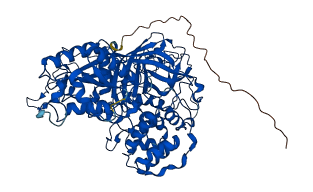
Autoinhibited structure

Activated structure
1 structures for Q8X1P0
| Entry ID | Method | Resolution | Chain | Position | Source |
|---|---|---|---|---|---|
| AF-Q8X1P0-F1 | Predicted | AlphaFoldDB |
No variants for Q8X1P0
| Variant ID(s) | Position | Change | Description | Diseaes Association | Provenance |
|---|---|---|---|---|---|
| No variants for Q8X1P0 | |||||
No associated diseases with Q8X1P0
Functions
| Description | ||
|---|---|---|
| EC Number | 1.11.1.6 | Peroxidases |
| Subcellular Localization |
|
|
| PANTHER Family | ||
| PANTHER Subfamily | ||
| PANTHER Protein Class | ||
| PANTHER Pathway Category | No pathway information available | |
No GO annotations of cellular component
| Name | Definition |
|---|---|
| No GO annotations for cellular component |
3 GO annotations of molecular function
| Name | Definition |
|---|---|
| catalase activity | Catalysis of the reaction: 2 hydrogen peroxide = O2 + 2 H2O. |
| heme binding | Binding to a heme, a compound composed of iron complexed in a porphyrin (tetrapyrrole) ring. |
| metal ion binding | Binding to a metal ion. |
2 GO annotations of biological process
| Name | Definition |
|---|---|
| hydrogen peroxide catabolic process | The chemical reactions and pathways resulting in the breakdown of hydrogen peroxide (H2O2). |
| response to oxidative stress | Any process that results in a change in state or activity of a cell or an organism (in terms of movement, secretion, enzyme production, gene expression, etc.) as a result of oxidative stress, a state often resulting from exposure to high levels of reactive oxygen species, e.g. superoxide anions, hydrogen peroxide (H2O2), and hydroxyl radicals. |
No homologous proteins in AiPD
| UniProt AC | Gene Name | Protein Name | Species | Evidence Code |
|---|---|---|---|---|
| No homologous proteins | ||||
| 10 | 20 | 30 | 40 | 50 | 60 |
| MRLSLWNLLG | LSGLVVASCP | YMSGEDQEYH | ISHIQARGTD | SEFLDQFKVE | DSNSYLTTDA |
| 70 | 80 | 90 | 100 | 110 | 120 |
| GGPIQDDASL | KAGERGPTLL | EDFIFRQKIQ | HFDHERVPER | AVHARGAGAY | GTFTSYADWT |
| 130 | 140 | 150 | 160 | 170 | 180 |
| NITAASFLNS | KGKETPVFVR | FSTVAGSRGS | ADTVRDVHGF | ATRFYTDEGN | FDIVGNNIPV |
| 190 | 200 | 210 | 220 | 230 | 240 |
| FFIQDAILFP | DLVHAVKPSP | DSEIPQAATG | HDSAWDFFSQ | QPSTLHTLFW | AMSGHGIPRS |
| 250 | 260 | 270 | 280 | 290 | 300 |
| YRHMDGFGVH | TMRLVTDDGK | SKLVKWHWKT | KQGKASLVWE | EAQILAGKNP | DFHRQDLWDD |
| 310 | 320 | 330 | 340 | 350 | 360 |
| INAGNGPEWE | LGVQIVDEED | VQAFGFDLLD | PTKFLPEELV | PVTILGKMKL | TDNPTNYFAE |
| 370 | 380 | 390 | 400 | 410 | 420 |
| TEQVMFQPGH | IVRGVDFSDD | PLLQGRIYSY | LDTQLNRNGG | PNFEQLPVNR | PRTKVHNNNR |
| 430 | 440 | 450 | 460 | 470 | 480 |
| DGAGQMFIHT | NKAPYSPNSL | SGGNPKQANQ | TKGRGFFTAP | SRKVVGSLHR | GTASSFADVW |
| 490 | 500 | 510 | 520 | 530 | 540 |
| SQPRMFYNSL | IPSEQQFLVN | AIRFEISQLK | SDLIKKNTLM | QLNRVSNDLA | TRVAAVIGYK |
| 550 | 560 | 570 | 580 | 590 | 600 |
| PLDPSPEFYT | NATTDYVTIF | GKPLPSVVGF | TVGILASTSS | STSISQAAQL | ATSFSSRGIR |
| 610 | 620 | 630 | 640 | 650 | 660 |
| AVIVGESLLS | GTDQTYSSAD | ATAFDAVVVT | MGAETLFGPV | AKPNTLFPSG | RPSQILHDAY |
| 670 | 680 | 690 | 700 | 710 | |
| RWGKPVGAVS | KASVVLEPLP | GTKNQGGVYR | VESVNELATS | IAKGLETFRF | VDRFPLDS |