Q8VHK5
Gene name |
Mlc1 |
Protein name |
Membrane protein MLC1 |
Names |
|
Species |
Mus musculus (Mouse) |
KEGG Pathway |
mmu:170790 |
EC number |
|
Protein Class |
|
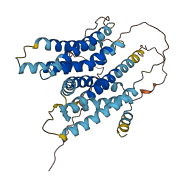
Descriptions
The autoinhibited protein was predicted that may have potential autoinhibitory elements via cis-regPred.
Autoinhibitory domains (AIDs)
Target domain |
|
Relief mechanism |
|
Assay |
cis-regPred |
Accessory elements
No accessory elements
Autoinhibited structure

Activated structure
1 structures for Q8VHK5
| Entry ID | Method | Resolution | Chain | Position | Source |
|---|---|---|---|---|---|
| AF-Q8VHK5-F1 | Predicted | AlphaFoldDB |
17 variants for Q8VHK5
| Variant ID(s) | Position | Change | Description | Diseaes Association | Provenance |
|---|---|---|---|---|---|
| rs3389343534 | 16 | M>I | No | EVA | |
| rs3389372656 | 21 | R>K | No | EVA | |
| rs3389300101 | 27 | G>R | No | EVA | |
| rs3389377478 | 35 | T>I | No | EVA | |
| rs3389343530 | 55 | Y>N | No | EVA | |
| rs38999983 | 107 | G>E | No | EVA | |
| rs3389384511 | 136 | G>E | No | EVA | |
| rs3389379891 | 148 | I>T | No | EVA | |
| rs3389343581 | 155 | L>F | No | EVA | |
| rs237113049 | 188 | S>T | No | EVA | |
| rs3389332731 | 200 | V>I | No | EVA | |
| rs3389300063 | 255 | T>I | No | EVA | |
| rs3389382105 | 272 | S>I | No | EVA | |
| rs3389300105 | 356 | A>E | No | EVA | |
| rs3389300036 | 358 | E>K | No | EVA | |
| rs3406769398 | 362 | G>D | No | EVA | |
| rs3389384514 | 379 | Q>H | No | EVA |
No associated diseases with Q8VHK5
No regional properties for Q8VHK5
| Type | Name | Position | InterPro Accession |
|---|---|---|---|
| No domain, repeats, and functional sites for Q8VHK5 | |||
Functions
17 GO annotations of cellular component
| Name | Definition |
|---|---|
| apical plasma membrane | The region of the plasma membrane located at the apical end of the cell. |
| astrocyte end-foot | Terminal process of astrocyte abutting non-neuronal surfaces in the brain. |
| basolateral plasma membrane | The region of the plasma membrane that includes the basal end and sides of the cell. Often used in reference to animal polarized epithelial membranes, where the basal membrane is the part attached to the extracellular matrix, or in plant cells, where the basal membrane is defined with respect to the zygotic axis. |
| caveola | A membrane raft that forms small pit, depression, or invagination that communicates with the outside of a cell and extends inward, indenting the cytoplasm and the cell membrane. Examples include flask-shaped invaginations of the plasma membrane in adipocytes associated with caveolin proteins, and minute pits or incuppings of the cell membrane formed during pinocytosis. Caveolae may be pinched off to form free vesicles within the cytoplasm. |
| cell-cell junction | A cell junction that forms a connection between two or more cells of an organism; excludes direct cytoplasmic intercellular bridges, such as ring canals in insects. |
| cytoplasm | The contents of a cell excluding the plasma membrane and nucleus, but including other subcellular structures. |
| cytoplasmic vesicle | A vesicle found in the cytoplasm of a cell. |
| cytosol | The part of the cytoplasm that does not contain organelles but which does contain other particulate matter, such as protein complexes. |
| early endosome | A membrane-bounded organelle that receives incoming material from primary endocytic vesicles that have been generated by clathrin-dependent and clathrin-independent endocytosis; vesicles fuse with the early endosome to deliver cargo for sorting into recycling or degradation pathways. |
| endoplasmic reticulum | The irregular network of unit membranes, visible only by electron microscopy, that occurs in the cytoplasm of many eukaryotic cells. The membranes form a complex meshwork of tubular channels, which are often expanded into slitlike cavities called cisternae. The ER takes two forms, rough (or granular), with ribosomes adhering to the outer surface, and smooth (with no ribosomes attached). |
| endosome | A vacuole to which materials ingested by endocytosis are delivered. |
| integral component of membrane | The component of a membrane consisting of the gene products and protein complexes having at least some part of their peptide sequence embedded in the hydrophobic region of the membrane. |
| lysosome | A small lytic vacuole that has cell cycle-independent morphology found in most animal cells and that contains a variety of hydrolases, most of which have their maximal activities in the pH range 5-6. The contained enzymes display latency if properly isolated. About 40 different lysosomal hydrolases are known and lysosomes have a great variety of morphologies and functions. |
| membrane raft | Any of the small (10-200 nm), heterogeneous, highly dynamic, sterol- and sphingolipid-enriched membrane domains that compartmentalize cellular processes. Small rafts can sometimes be stabilized to form larger platforms through protein-protein and protein-lipid interactions. |
| perinuclear region of cytoplasm | Cytoplasm situated near, or occurring around, the nucleus. |
| plasma membrane | The membrane surrounding a cell that separates the cell from its external environment. It consists of a phospholipid bilayer and associated proteins. |
| recycling endosome | An organelle consisting of a network of tubules that functions in targeting molecules, such as receptors transporters and lipids, to the plasma membrane. |
2 GO annotations of molecular function
| Name | Definition |
|---|---|
| identical protein binding | Binding to an identical protein or proteins. |
| protein-containing complex binding | Binding to a macromolecular complex. |
7 GO annotations of biological process
| Name | Definition |
|---|---|
| caveolin-mediated endocytosis | An endocytosis process that begins when material is taken up into plasma membrane caveolae, which then pinch off to form endocytic caveolar carriers. |
| cellular response to cholesterol | Any process that results in a change in state or activity of a cell (in terms of movement, secretion, enzyme production, gene expression, etc.) as a result of a cholesterol stimulus. |
| ion transport | The directed movement of charged atoms or small charged molecules into, out of or within a cell, or between cells, by means of some agent such as a transporter or pore. |
| positive regulation of intracellular transport | Any process that activates or increases the frequency, rate or extent of the directed movement of substances within cells. |
| protein transport | The directed movement of proteins into, out of or within a cell, or between cells, by means of some agent such as a transporter or pore. |
| regulation of response to osmotic stress | Any process that modulates the rate or extent of the response to osmotic stress. |
| vesicle-mediated transport | A cellular transport process in which transported substances are moved in membrane-bounded vesicles; transported substances are enclosed in the vesicle lumen or located in the vesicle membrane. The process begins with a step that directs a substance to the forming vesicle, and includes vesicle budding and coating. Vesicles are then targeted to, and fuse with, an acceptor membrane. |
1 homologous proteins in AiPD
| UniProt AC | Gene Name | Protein Name | Species | Evidence Code |
|---|---|---|---|---|
| Q15049 | MLC1 | Membrane protein MLC1 | Homo sapiens (Human) | PR |
| 10 | 20 | 30 | 40 | 50 | 60 |
| MTREGQFREE | LGYDRMPTLE | RGRQDAGRQD | PGSYTPDSKP | KDLQLSKRLP | PCFSYKTWVF |
| 70 | 80 | 90 | 100 | 110 | 120 |
| SVLMGSCLLV | TSGFSLYLGN | VFPSEMDYLR | CAAGSCIPSA | IVSFAVGRRN | VSAIPNFQIL |
| 130 | 140 | 150 | 160 | 170 | 180 |
| FVSTFAVTTT | CLIWFGCKLI | LNPSAININF | NLILLLLLEL | LMAATVIISA | RSSEEPCKKK |
| 190 | 200 | 210 | 220 | 230 | 240 |
| KGSISDGSNI | LDEVTFPARV | LKSYSVVEVI | AGVSAVLGGV | IALNVEEAVS | GPHLSVTFFW |
| 250 | 260 | 270 | 280 | 290 | 300 |
| ILVACFPSAI | ASHVTAECPS | KCLVEVLIAI | SSLTSPLLFT | ASGYLSFSVM | RVVEIFKDYP |
| 310 | 320 | 330 | 340 | 350 | 360 |
| PAIKSYDVLL | LLLLLLLLLQ | GGLNTGTAIQ | CVSFKVSARL | QAASWDPQSC | PQERPAGEVV |
| 370 | 380 | ||||
| RGPLKEFDKE | KAWRAVVVQM | AQ |