Q8SQC1
Gene name |
SCARB1 |
Protein name |
Scavenger receptor class B member 1 |
Names |
Leukocyte antigen CD97, SRB1, High density lipoprotein receptor SR-BI, SR-BI |
Species |
Sus scrofa (Pig) |
KEGG Pathway |
ssc:397018 |
EC number |
|
Protein Class |
|
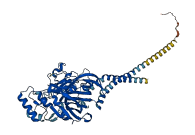
Descriptions
The autoinhibited protein was predicted that may have potential autoinhibitory elements via cis-regPred.
Autoinhibitory domains (AIDs)
Target domain |
|
Relief mechanism |
|
Assay |
cis-regPred |
Accessory elements
No accessory elements
Autoinhibited structure

Activated structure
1 structures for Q8SQC1
| Entry ID | Method | Resolution | Chain | Position | Source |
|---|---|---|---|---|---|
| AF-Q8SQC1-F1 | Predicted | AlphaFoldDB |
No variants for Q8SQC1
| Variant ID(s) | Position | Change | Description | Diseaes Association | Provenance |
|---|---|---|---|---|---|
| No variants for Q8SQC1 | |||||
No associated diseases with Q8SQC1
No regional properties for Q8SQC1
| Type | Name | Position | InterPro Accession |
|---|---|---|---|
| No domain, repeats, and functional sites for Q8SQC1 | |||
Functions
6 GO annotations of cellular component
| Name | Definition |
|---|---|
| apical plasma membrane | The region of the plasma membrane located at the apical end of the cell. |
| basolateral plasma membrane | The region of the plasma membrane that includes the basal end and sides of the cell. Often used in reference to animal polarized epithelial membranes, where the basal membrane is the part attached to the extracellular matrix, or in plant cells, where the basal membrane is defined with respect to the zygotic axis. |
| caveola | A membrane raft that forms small pit, depression, or invagination that communicates with the outside of a cell and extends inward, indenting the cytoplasm and the cell membrane. Examples include flask-shaped invaginations of the plasma membrane in adipocytes associated with caveolin proteins, and minute pits or incuppings of the cell membrane formed during pinocytosis. Caveolae may be pinched off to form free vesicles within the cytoplasm. |
| cytoplasm | The contents of a cell excluding the plasma membrane and nucleus, but including other subcellular structures. |
| integral component of membrane | The component of a membrane consisting of the gene products and protein complexes having at least some part of their peptide sequence embedded in the hydrophobic region of the membrane. |
| plasma membrane | The membrane surrounding a cell that separates the cell from its external environment. It consists of a phospholipid bilayer and associated proteins. |
4 GO annotations of molecular function
| Name | Definition |
|---|---|
| high-density lipoprotein particle receptor activity | Combining with a high-density lipoprotein particle and delivering the high-density lipoprotein into the cell via endocytosis. |
| lipid binding | Binding to a lipid. |
| low-density lipoprotein particle binding | Binding to a low-density lipoprotein particle, a lipoprotein particle that is rich in cholesterol esters and low in triglycerides, is typically composed of APOB100 and APOE, and has a density of 1.02-1.06 g/ml and a diameter of between 20-25 nm. |
| scavenger receptor activity | Combining with any modified low-density lipoprotein (LDL) or other polyanionic ligand and delivering the ligand into the cell via endocytosis. Ligands include acetylated and oxidized LDL, Gram-positive and Gram-negative bacteria, apoptotic cells, amyloid-beta fibrils, and advanced glycation end products (AGEs). |
5 GO annotations of biological process
| Name | Definition |
|---|---|
| cholesterol efflux | The directed movement of cholesterol, cholest-5-en-3-beta-ol, out of a cell or organelle. |
| cholesterol import | The directed movement of cholesterol into a cell or organelle. |
| plasma lipoprotein particle clearance | The process in which a lipoprotein particle is removed from the blood via receptor-mediated endocytosis and its constituent parts degraded. |
| recognition of apoptotic cell | The process in which a cell interprets signals (in the form of specific proteins and lipids) on the surface of a dying cell which it will engulf and remove by phagocytosis. |
| transcytosis | The directed movement of endocytosed material through the cell and its exocytosis from the plasma membrane at the opposite side. |
No homologous proteins in AiPD
| UniProt AC | Gene Name | Protein Name | Species | Evidence Code |
|---|---|---|---|---|
| No homologous proteins | ||||
| 10 | 20 | 30 | 40 | 50 | 60 |
| MGSRSRARQV | AAALGFVGLL | LAALGAVMIV | MVPSIIKQQV | LKNVRIDPSS | LSFNMWKEIP |
| 70 | 80 | 90 | 100 | 110 | 120 |
| VPFYLSVYFF | DVINPNEILQ | GQKPQVRERG | PYVYREFRHK | SNITFNDNDT | VSFLEYRSYQ |
| 130 | 140 | 150 | 160 | 170 | 180 |
| FQPHKSRGLE | SDYIVIPNIL | VLSASVMMED | RPMSLKLIMT | FAFSALGERA | FVNRTVGEIM |
| 190 | 200 | 210 | 220 | 230 | 240 |
| WGYEDPLIHL | INKYFPNMFP | FKGKFGLFAE | LNNSDSGLFT | VFTGVKDFSR | IHLVDKWNGL |
| 250 | 260 | 270 | 280 | 290 | 300 |
| SKVNFWHSDQ | CNMINGTSGQ | MWAPFMTPES | SLEFYSPEAC | RSMKLIYKEQ | GVFEGIPTFR |
| 310 | 320 | 330 | 340 | 350 | 360 |
| FVAPNTLFAN | GSVYPPNEGF | CPCMESGIQN | VSTCRFNAPL | FLSHPHFYNA | DPVLAEAVSG |
| 370 | 380 | 390 | 400 | 410 | 420 |
| LHPNTEEHSL | FLDIHPVTGI | PMNCSVKLQL | SLYIKSVKGI | GQTGKIEPVV | LPLLWFAESG |
| 430 | 440 | 450 | 460 | 470 | 480 |
| AMEGETLQTF | YTQLVLMPKV | LHYAQYVLLA | LGCVLLFIPI | VYQIRSQEKC | YLFWSSSKKG |
| 490 | 500 | ||||
| SKDKEAIQAY | SESLMTPAPK | GTVLQEARL |