Q8RQL3
Gene name |
ppc (CE1703) |
Protein name |
Phosphoenolpyruvate carboxylase |
Names |
PEPC, PEPCase |
Species |
Corynebacterium efficiens (strain DSM 44549 / YS-314 / AJ 12310 / JCM 11189 / NBRC 100395) |
KEGG Pathway |
cef:CE1703 |
EC number |
4.1.1.31: Carboxy-lyases |
Protein Class |
|
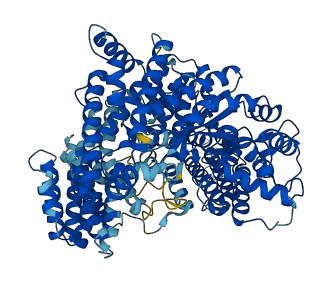
Descriptions
The autoinhibited protein was predicted that may have potential autoinhibitory elements via cis-regPred.
Autoinhibitory domains (AIDs)
Target domain |
|
Relief mechanism |
|
Assay |
cis-regPred |
Accessory elements
No accessory elements
Autoinhibited structure

Activated structure
1 structures for Q8RQL3
| Entry ID | Method | Resolution | Chain | Position | Source |
|---|---|---|---|---|---|
| AF-Q8RQL3-F1 | Predicted | AlphaFoldDB |
No variants for Q8RQL3
| Variant ID(s) | Position | Change | Description | Diseaes Association | Provenance |
|---|---|---|---|---|---|
| No variants for Q8RQL3 | |||||
No associated diseases with Q8RQL3
Functions
| Description | ||
|---|---|---|
| EC Number | 4.1.1.31 | Carboxy-lyases |
| Subcellular Localization |
|
|
| PANTHER Family | ||
| PANTHER Subfamily | ||
| PANTHER Protein Class | ||
| PANTHER Pathway Category | No pathway information available | |
No GO annotations of cellular component
| Name | Definition |
|---|---|
| No GO annotations for cellular component |
2 GO annotations of molecular function
| Name | Definition |
|---|---|
| magnesium ion binding | Binding to a magnesium (Mg) ion. |
| phosphoenolpyruvate carboxylase activity | Catalysis of the reaction: phosphate + oxaloacetate = phosphoenolpyruvate + HCO3-. |
3 GO annotations of biological process
| Name | Definition |
|---|---|
| carbon fixation | A metabolic process in which carbon (usually derived from carbon dioxide) is incorporated into organic compounds (usually carbohydrates). |
| oxaloacetate metabolic process | The chemical reactions and pathways involving oxaloacetate, the anion of oxobutanedioic acid, an important intermediate in metabolism, especially as a component of the TCA cycle. |
| tricarboxylic acid cycle | A nearly universal metabolic pathway in which the acetyl group of acetyl coenzyme A is effectively oxidized to two CO2 and four pairs of electrons are transferred to coenzymes. The acetyl group combines with oxaloacetate to form citrate, which undergoes successive transformations to isocitrate, 2-oxoglutarate, succinyl-CoA, succinate, fumarate, malate, and oxaloacetate again, thus completing the cycle. In eukaryotes the tricarboxylic acid is confined to the mitochondria. See also glyoxylate cycle. |
No homologous proteins in AiPD
| UniProt AC | Gene Name | Protein Name | Species | Evidence Code |
|---|---|---|---|---|
| No homologous proteins | ||||
| 10 | 20 | 30 | 40 | 50 | 60 |
| MNELLRDDIR | YLGRILGEVI | SEQEGHHVFE | LVERARRTSF | DIAKGRAEMD | SLVEVFAGID |
| 70 | 80 | 90 | 100 | 110 | 120 |
| PEDATPVARA | FTHFALLANL | AEDLHDAAQR | EQALNSGEPA | PDSTLEATWV | KLDDAGVGSG |
| 130 | 140 | 150 | 160 | 170 | 180 |
| EVAAVIRNAL | VAPVLTAHPT | ETRRRTVFDA | QKHITALMEE | RHLLLALPTH | ARTQSKLDDI |
| 190 | 200 | 210 | 220 | 230 | 240 |
| ERNIRRRITI | LWQTALIRVA | RPRIEDEVEV | GLRYYKLSLL | AEIPRINHDV | TVELARRFGG |
| 250 | 260 | 270 | 280 | 290 | 300 |
| DIPTTAMVRP | GSWIGGDHDG | NPFVTAETVT | YATHRAAETV | LKYYVKQLHA | LEHELSLSDR |
| 310 | 320 | 330 | 340 | 350 | 360 |
| MNVISDELRV | LADAGQNDMP | SRVDEPYRRA | IHGMRGRMLA | TTAALIGEEA | VEGTWFKTFT |
| 370 | 380 | 390 | 400 | 410 | 420 |
| PYTDTHEFKR | DLDIVDGSLR | MSRDDIIADD | RLAMLRSALD | SFGFNLYSLD | LRQNSDGFED |
| 430 | 440 | 450 | 460 | 470 | 480 |
| VLTELFATAQ | TEKNYRGLTE | AEKLDLLIRE | LSTPRPLIPH | GDPDYSEATN | RELGIFSKAA |
| 490 | 500 | 510 | 520 | 530 | 540 |
| EAVRKFGPLM | VPHCIISMAS | SVTDILEPMV | LLKEFGLIRA | NGKNPTGSVD | VIPLFETIDD |
| 550 | 560 | 570 | 580 | 590 | 600 |
| LQRGAGILEE | LWDIDLYRNY | LEQRDNVQEV | MLGYSDSNKD | GGYFAANWAL | YDAELRLVEL |
| 610 | 620 | 630 | 640 | 650 | 660 |
| CRGRNVKLRL | FHGRGGTVGR | GGGPSYDAIL | AQPKGAVRGA | VRVTEQGEII | SAKYGNPDTA |
| 670 | 680 | 690 | 700 | 710 | 720 |
| RRNLEALVSA | TLEASLLDDV | ELPNRERAHQ | IMGEISELSF | RRYSSLVHED | PGFIQYFTQS |
| 730 | 740 | 750 | 760 | 770 | 780 |
| TPLQEIGSLN | IGSRPSSRKQ | TNTVEDLRAI | PWVLSWSQSR | VMLPGWFGVG | TALREWIGEG |
| 790 | 800 | 810 | 820 | 830 | 840 |
| EGAAERIAEL | QELNRCWPFF | TSVLDNMAQV | MSKAELRLAR | LYADLIPDRE | VADRIYETIF |
| 850 | 860 | 870 | 880 | 890 | 900 |
| GEYFLTKEMF | CTITGSQDLL | DDNPALARSV | RSRFPYLLPL | NVIQVEMMRR | YRSGDEGTAV |
| 910 | |||||
| PRNIRLTMNG | LSTALRNSG |