Q8R507
Gene name |
Fktn |
Protein name |
Ribitol-5-phosphate transferase FKTN |
Names |
Fukutin, Fukuyama-type congenital muscular dystrophy protein, Ribitol-5-phosphate transferase |
Species |
Mus musculus (Mouse) |
KEGG Pathway |
mmu:246179 |
EC number |
|
Protein Class |
|
Descriptions
The autoinhibited protein was predicted that may have potential autoinhibitory elements via cis-regPred.
Autoinhibitory domains (AIDs)
Target domain |
|
Relief mechanism |
|
Assay |
cis-regPred |
Accessory elements
No accessory elements
Autoinhibited structure

Activated structure
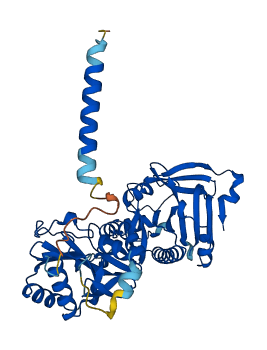
1 structures for Q8R507
| Entry ID | Method | Resolution | Chain | Position | Source |
|---|---|---|---|---|---|
| AF-Q8R507-F1 | Predicted | AlphaFoldDB |
15 variants for Q8R507
| Variant ID(s) | Position | Change | Description | Diseaes Association | Provenance |
|---|---|---|---|---|---|
| rs3388682745 | 20 | F>V | No | EVA | |
| rs3388689692 | 48 | V>I | No | EVA | |
| rs3388680694 | 58 | V>D | No | EVA | |
| rs3388677254 | 63 | M>I | No | EVA | |
| rs218038131 | 88 | E>K | No | EVA | |
| rs249166623 | 88 | E>V | No | EVA | |
| rs3388685111 | 141 | E>D | No | EVA | |
| rs3388685158 | 217 | P>Q | No | EVA | |
| rs3388682709 | 221 | Q>* | No | EVA | |
| rs249897898 | 290 | D>E | No | EVA | |
| rs254252893 | 360 | K>E | No | EVA | |
| rs3388686017 | 406 | D>G | No | EVA | |
| rs3388684398 | 408 | K>R | No | EVA | |
| rs243723852 | 431 | I>V | No | EVA | |
| rs3388682852 | 448 | I>V | No | EVA |
No associated diseases with Q8R507
1 regional properties for Q8R507
| Type | Name | Position | InterPro Accession |
|---|---|---|---|
| domain | Ribitol-5-phosphate transferase FKTN, N-terminal | 1 - 278 | IPR045587 |
Functions
6 GO annotations of cellular component
| Name | Definition |
|---|---|
| cis-Golgi network | The network of interconnected tubular and cisternal structures located at the convex side of the Golgi apparatus, which abuts the endoplasmic reticulum. |
| endoplasmic reticulum | The irregular network of unit membranes, visible only by electron microscopy, that occurs in the cytoplasm of many eukaryotic cells. The membranes form a complex meshwork of tubular channels, which are often expanded into slitlike cavities called cisternae. The ER takes two forms, rough (or granular), with ribosomes adhering to the outer surface, and smooth (with no ribosomes attached). |
| Golgi apparatus | A membrane-bound cytoplasmic organelle of the endomembrane system that further processes the core oligosaccharides (e.g. N-glycans) added to proteins in the endoplasmic reticulum and packages them into membrane-bound vesicles. The Golgi apparatus operates at the intersection of the secretory, lysosomal, and endocytic pathways. |
| Golgi membrane | The lipid bilayer surrounding any of the compartments of the Golgi apparatus. |
| integral component of Golgi membrane | The component of the Golgi membrane consisting of the gene products and protein complexes having at least some part of their peptide sequence embedded in the hydrophobic region of the membrane. |
| nucleus | A membrane-bounded organelle of eukaryotic cells in which chromosomes are housed and replicated. In most cells, the nucleus contains all of the cell's chromosomes except the organellar chromosomes, and is the site of RNA synthesis and processing. In some species, or in specialized cell types, RNA metabolism or DNA replication may be absent. |
1 GO annotations of molecular function
| Name | Definition |
|---|---|
| phosphotransferase activity, for other substituted phosphate groups | Catalysis of the transfer of a substituted phosphate group, other than diphosphate or nucleotidyl residues, from one compound (donor) to a another (acceptor). |
7 GO annotations of biological process
| Name | Definition |
|---|---|
| negative regulation of cell population proliferation | Any process that stops, prevents or reduces the rate or extent of cell proliferation. |
| negative regulation of JNK cascade | Any process that stops, prevents, or reduces the frequency, rate or extent of signal transduction mediated by the JNK cascade. |
| neuron migration | The characteristic movement of an immature neuron from germinal zones to specific positions where they will reside as they mature. |
| protein glycosylation | A protein modification process that results in the addition of a carbohydrate or carbohydrate derivative unit to a protein amino acid, e.g. the addition of glycan chains to proteins. |
| protein O-linked glycosylation | A protein glycosylation process in which a carbohydrate or carbohydrate derivative unit is added to a protein via the hydroxyl group of peptidyl-serine, peptidyl-threonine, peptidyl-hydroxylysine, or peptidyl-hydroxyproline, or via the phenol group of peptidyl-tyrosine, forming an O-glycan. |
| protein O-linked mannosylation | The transfer of mannose from dolichyl activated mannose to the hydroxyl group of a seryl or threonyl residue of a protein acceptor molecule, to form an O-linked protein-sugar linkage. |
| regulation of protein glycosylation | Any process that modulates the frequency, rate or extent of protein glycosylation. Protein glycosylation is the addition of a carbohydrate or carbohydrate derivative unit to a protein amino acid, e.g. the addition of glycan chains to proteins. |
1 homologous proteins in AiPD
| UniProt AC | Gene Name | Protein Name | Species | Evidence Code |
|---|---|---|---|---|
| O75072 | FKTN | Ribitol-5-phosphate transferase FKTN | Homo sapiens (Human) | PR |
| 10 | 20 | 30 | 40 | 50 | 60 |
| MSRINKNVVL | ALLTLTSSAF | LLFQLYYYKH | YLSARNGPGS | SKSKGNRVGF | DSTQWRAVKK |
| 70 | 80 | 90 | 100 | 110 | 120 |
| FIMLTSSQNV | PVFLIDPWIL | ESINKNFEQV | KNASQGPASE | CRFFCVPRDF | TAFALQYHLW |
| 130 | 140 | 150 | 160 | 170 | 180 |
| KNEDGWFRIA | ENMGFQCLKT | ESKDPRLDGI | DSLSGTEIPL | HYVCKLTTHA | IHLVVFHERS |
| 190 | 200 | 210 | 220 | 230 | 240 |
| GNYLWHGHLR | LKGHMDRKFV | PFRKLQFGRY | PGAFDRPELQ | QVTVDGLDML | IPKDPGRFLE |
| 250 | 260 | 270 | 280 | 290 | 300 |
| EVPHSRFIEC | RYKEARAFLQ | QYIDDNTVDA | MVFRKRAKEL | LQLAAKTLKD | LGVPFWLSSG |
| 310 | 320 | 330 | 340 | 350 | 360 |
| TCLGWYRQCG | IIPYSKDVDL | GIFIQDYKPD | IILAFQEAGL | PLKHKFGKVE | DSLELSFQGK |
| 370 | 380 | 390 | 400 | 410 | 420 |
| NDVKLDIFFF | YEEADHLWNG | GTQARTGKKF | KYLFPKFTLC | WTEFVDIKVH | VPCETVDYIE |
| 430 | 440 | 450 | 460 | ||
| ANYGKTWKIP | IKTWDWKSSP | PNVQPNGIWP | ISEWDEVIQL | Y |