Q8R3H7
Gene name |
Hs2st1 (Hs2st) |
Protein name |
Heparan sulfate 2-O-sulfotransferase 1 |
Names |
2-O-sulfotransferase, 2-OST, 2OST |
Species |
Mus musculus (Mouse) |
KEGG Pathway |
mmu:23908 |
EC number |
|
Protein Class |
|
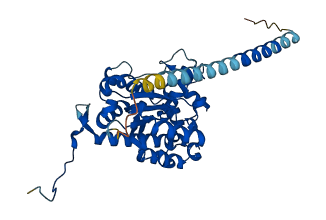
Descriptions
The autoinhibited protein was predicted that may have potential autoinhibitory elements via cis-regPred.
Autoinhibitory domains (AIDs)
Target domain |
|
Relief mechanism |
|
Assay |
cis-regPred |
Accessory elements
No accessory elements
Autoinhibited structure

Activated structure
1 structures for Q8R3H7
| Entry ID | Method | Resolution | Chain | Position | Source |
|---|---|---|---|---|---|
| AF-Q8R3H7-F1 | Predicted | AlphaFoldDB |
11 variants for Q8R3H7
| Variant ID(s) | Position | Change | Description | Diseaes Association | Provenance |
|---|---|---|---|---|---|
| rs244162358 | 75 | I>V | No | EVA | |
| rs3388666776 | 91 | N>S | No | EVA | |
| rs3388667983 | 151 | F>L | No | EVA | |
| rs3388655476 | 158 | I>F | No | EVA | |
| rs3388655506 | 177 | L>P | No | EVA | |
| rs3388649396 | 179 | F>L | No | EVA | |
| rs3388665441 | 249 | F>Y | No | EVA | |
| rs3388661663 | 269 | P>S | No | EVA | |
| rs3388670487 | 286 | H>L | No | EVA | |
| rs31116606 | 299 | Q>H | No | EVA | |
| rs3388657945 | 314 | N>I | No | EVA |
No associated diseases with Q8R3H7
No regional properties for Q8R3H7
| Type | Name | Position | InterPro Accession |
|---|---|---|---|
| No domain, repeats, and functional sites for Q8R3H7 | |||
3 GO annotations of cellular component
| Name | Definition |
|---|---|
| Golgi apparatus | A membrane-bound cytoplasmic organelle of the endomembrane system that further processes the core oligosaccharides (e.g. N-glycans) added to proteins in the endoplasmic reticulum and packages them into membrane-bound vesicles. The Golgi apparatus operates at the intersection of the secretory, lysosomal, and endocytic pathways. |
| Golgi membrane | The lipid bilayer surrounding any of the compartments of the Golgi apparatus. |
| integral component of membrane | The component of a membrane consisting of the gene products and protein complexes having at least some part of their peptide sequence embedded in the hydrophobic region of the membrane. |
2 GO annotations of molecular function
| Name | Definition |
|---|---|
| heparan sulfate 2-O-sulfotransferase activity | Catalysis of the reaction: 3'-phosphoadenosine 5'-phosphosulfate + heparan sulfate = adenosine 3',5'-bisphosphate + heparan sulfate 2-O-sulfate; results in 2-O-sulfation of iduronic acid residues in heparan sulfate. |
| sulfotransferase activity | Catalysis of the transfer of a sulfate group from 3'-phosphoadenosine 5'-phosphosulfate to the hydroxyl group of an acceptor, producing the sulfated derivative and 3'-phosphoadenosine 5'-phosphate. |
6 GO annotations of biological process
| Name | Definition |
|---|---|
| gene expression | The process in which a gene's sequence is converted into a mature gene product (protein or RNA). This includes the production of an RNA transcript and its processing, translation and maturation for protein-coding genes. |
| heparan sulfate proteoglycan biosynthetic process | The chemical reactions and pathways resulting in the formation of the heparan sulfate proteoglycan, a glycosaminoglycan with repeat unit consisting of alternating alpha-(1->4)-linked hexuronic acid and glucosamine residues; the former are a mixture of sulfated and nonsulfated D-glucuronic acid and L-iduronic acid; the L-iduronic acid is either sulfated or acetylated on its amino group as well as being sulfated on one of its hydroxyl groups; heparan sulfate chains are covalently linked to peptidyl-serine by a glycosidic attachment through the trisaccharide galactosyl-galactosyl-xylosyl to serine residues. |
| heparan sulfate proteoglycan biosynthetic process, enzymatic modification | The modification, often by sulfation, of sugars incorporated into heparan sulfate after polymerization. |
| heparan sulfate proteoglycan biosynthetic process, polysaccharide chain biosynthetic process | The chemical reactions and pathways resulting in the formation of polysaccharide chain component of heparan sulfate proteoglycan. |
| heparin metabolic process | The chemical reactions and pathways involving heparin, any member of a group of glycosaminoglycans found mainly as an intracellular component of mast cells. They are similar to heparan sulfates but are of somewhat higher average Mr (6000-20000) and contain fewer N-acetyl groups and more N-sulfate and O-sulfate groups; they may be attached in the same manner to protein, forming proteoglycans. They consist predominantly of alternating alpha-(1->4)-linked D-galactose and N-acetyl-D-glucosamine-6-sulfate residues. |
| ureteric bud formation | The developmental process pertaining to the initial formation of the ureteric bud from the Wolffian duct. This process begins when the bud protrudes from the duct and ends when it is a recognizable bud. |
| 10 | 20 | 30 | 40 | 50 | 60 |
| MGLLRIMMPP | KLQLLAVVAF | AVAMLFLENQ | IQKLEESRAK | LERAIARHEV | REIEQRHTMD |
| 70 | 80 | 90 | 100 | 110 | 120 |
| GPRQDATLDE | EEDIIIIYNR | VPKTASTSFT | NIAYDLCAKN | RYHVLHINTT | KNNPVMSLQD |
| 130 | 140 | 150 | 160 | 170 | 180 |
| QVRFVKNITT | WNEMKPGFYH | GHISYLDFAK | FGVKKKPIYI | NVIRDPIERL | VSYYYFLRFG |
| 190 | 200 | 210 | 220 | 230 | 240 |
| DDYRPGLRRR | KQGDKKTFDE | CVAEGGSDCA | PEKLWLQIPF | FCGHSSECWN | VGSRWAMDQA |
| 250 | 260 | 270 | 280 | 290 | 300 |
| KSNLINEYFL | VGVTEELEDF | IMLLEAALPR | FFRGATDLYR | TGKKSHLRKT | TEKKLPTKQT |
| 310 | 320 | 330 | 340 | 350 | |
| IAKLQQSDIW | KMENEFYEFA | LEQFQFIRAH | AVREKDGDLY | ILAQNFFYEK | IYPKSN |