Q8R326
Gene name |
Pspc1 (Psp1) |
Protein name |
Paraspeckle component 1 |
Names |
Paraspeckle protein 1, mPSP1 |
Species |
Mus musculus (Mouse) |
KEGG Pathway |
mmu:66645 |
EC number |
|
Protein Class |
|
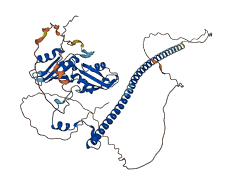
Descriptions
The autoinhibited protein was predicted that may have potential autoinhibitory elements via cis-regPred.
Autoinhibitory domains (AIDs)
Target domain |
|
Relief mechanism |
|
Assay |
cis-regPred |
Accessory elements
No accessory elements
Autoinhibited structure

Activated structure
1 structures for Q8R326
| Entry ID | Method | Resolution | Chain | Position | Source |
|---|---|---|---|---|---|
| AF-Q8R326-F1 | Predicted | AlphaFoldDB |
10 variants for Q8R326
| Variant ID(s) | Position | Change | Description | Diseaes Association | Provenance |
|---|---|---|---|---|---|
| rs228734679 | 29 | S>N | No | EVA | |
| rs3389333561 | 391 | M>* | No | EVA | |
| rs3389344374 | 439 | P>S | No | EVA | |
| rs3389255756 | 444 | G>R | No | EVA | |
| rs3389297025 | 445 | P>Q | No | EVA | |
| rs3389335003 | 459 | N>D | No | EVA | |
| rs3389335404 | 466 | R>S | No | EVA | |
| rs3389334922 | 486 | E>D | No | EVA | |
| rs3389332518 | 493 | S>G | No | EVA | |
| rs3389324125 | 516 | G>C | No | EVA |
No associated diseases with Q8R326
4 regional properties for Q8R326
| Type | Name | Position | InterPro Accession |
|---|---|---|---|
| domain | RNA recognition motif domain | 81 - 153 | IPR000504-1 |
| domain | RNA recognition motif domain | 155 - 236 | IPR000504-2 |
| domain | NOPS | 228 - 279 | IPR012975 |
| domain | PSP1, RNA recognition motif 1 | 80 - 150 | IPR034522 |
Functions
7 GO annotations of cellular component
| Name | Definition |
|---|---|
| cytoplasm | The contents of a cell excluding the plasma membrane and nucleus, but including other subcellular structures. |
| fibrillar center | A structure found most metazoan nucleoli, but not usually found in lower eukaryotes; surrounded by the dense fibrillar component; the zone of transcription from multiple copies of the pre-rRNA genes is in the border region between these two structures. |
| nuclear matrix | The dense fibrillar network lying on the inner side of the nuclear membrane. |
| nuclear speck | A discrete extra-nucleolar subnuclear domain, 20-50 in number, in which splicing factors are seen to be localized by immunofluorescence microscopy. |
| nucleoplasm | That part of the nuclear content other than the chromosomes or the nucleolus. |
| nucleus | A membrane-bounded organelle of eukaryotic cells in which chromosomes are housed and replicated. In most cells, the nucleus contains all of the cell's chromosomes except the organellar chromosomes, and is the site of RNA synthesis and processing. In some species, or in specialized cell types, RNA metabolism or DNA replication may be absent. |
| paraspeckles | Discrete subnuclear bodies in the interchromatin nucleoplasmic space, often located adjacent to nuclear specks. 10-20 paraspeckles are typically found in human cell nuclei. |
1 GO annotations of molecular function
| Name | Definition |
|---|---|
| RNA binding | Binding to an RNA molecule or a portion thereof. |
6 GO annotations of biological process
| Name | Definition |
|---|---|
| activation of innate immune response | Any process that initiates an innate immune response. Innate immune responses are defense responses mediated by germline encoded components that directly recognize components of potential pathogens. Examples of this process include activation of the hypersensitive response of Arabidopsis thaliana and activation of any NOD or TLR signaling pathway in vertebrate species. |
| innate immune response | Innate immune responses are defense responses mediated by germline encoded components that directly recognize components of potential pathogens. |
| negative regulation of DNA-templated transcription | Any process that stops, prevents, or reduces the frequency, rate or extent of cellular DNA-templated transcription. |
| regulation of circadian rhythm | Any process that modulates the frequency, rate or extent of a circadian rhythm. A circadian rhythm is a biological process in an organism that recurs with a regularity of approximately 24 hours. |
| regulation of DNA-templated transcription | Any process that modulates the frequency, rate or extent of cellular DNA-templated transcription. |
| rhythmic process | Any process pertinent to the generation and maintenance of rhythms in the physiology of an organism. |
| 10 | 20 | 30 | 40 | 50 | 60 |
| MMLRGNLKQV | RIEKNPARLR | ALESAAGESE | PVAAAAMALT | LAGEQAPPPA | PSEEHPDEEL |
| 70 | 80 | 90 | 100 | 110 | 120 |
| GFTIDIKSFL | KPGEKTYTQR | CRLFVGNLPT | DITEEDFKRL | FERYGEPSEV | FINRDRGFGF |
| 130 | 140 | 150 | 160 | 170 | 180 |
| IRLESRTLAE | IAKAELDGTI | LKSRPLRIRF | ATHGAALTVK | NLSPVVSNEL | LEQAFSQFGP |
| 190 | 200 | 210 | 220 | 230 | 240 |
| VEKAVVVVDD | RGRATGKGFV | EFAAKPPARK | ALERCGDGAF | LLTTTPRPVI | VEPMEQFDDE |
| 250 | 260 | 270 | 280 | 290 | 300 |
| DGLPEKLMQK | TQQYHKEREQ | PPRFAQPGTF | EFEYASRWKA | LDEMEKQQRE | QVDRNIREAK |
| 310 | 320 | 330 | 340 | 350 | 360 |
| EKLEAEMEAA | RHEHQLMLMR | QDLMRRQEEL | RRLEELRNQE | LQKRKQIQLR | HEEEHRRREE |
| 370 | 380 | 390 | 400 | 410 | 420 |
| EMIRHREQEE | LRRQQEGGFK | PNYMENREQE | MRMGDMGPRG | AINMGDAFSP | APAGTQGPPP |
| 430 | 440 | 450 | 460 | 470 | 480 |
| MMGMNMNNRG | TIPGPPMGPG | PAMGPEGAAN | MGTPMIPDNG | AVHNDRFPQG | PPSQMGSPMG |
| 490 | 500 | 510 | 520 | ||
| NRTGSETPQA | PMSGVGPVSG | GPGGFGRGSQ | GGNFEGPNKR | RRY |