Q8R0S4
Gene name |
Cacnb4 |
Protein name |
Voltage-dependent L-type calcium channel subunit beta-4 |
Names |
CAB4, Calcium channel voltage-dependent subunit beta 4 |
Species |
Mus musculus (Mouse) |
KEGG Pathway |
mmu:12298 |
EC number |
|
Protein Class |
|
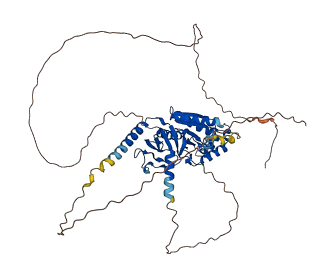
Descriptions
The autoinhibited protein was predicted that may have potential autoinhibitory elements via cis-regPred.
Autoinhibitory domains (AIDs)
Target domain |
|
Relief mechanism |
|
Assay |
cis-regPred |
Accessory elements
No accessory elements
Autoinhibited structure

Activated structure
1 structures for Q8R0S4
| Entry ID | Method | Resolution | Chain | Position | Source |
|---|---|---|---|---|---|
| AF-Q8R0S4-F1 | Predicted | AlphaFoldDB |
15 variants for Q8R0S4
| Variant ID(s) | Position | Change | Description | Diseaes Association | Provenance |
|---|---|---|---|---|---|
| rs3388552713 | 36 | D>G | No | EVA | |
| rs3388553481 | 63 | V>I | No | EVA | |
| rs3388554810 | 68 | D>N | No | EVA | |
| rs243210629 | 81 | A>T | No | EVA | |
| rs3388554797 | 105 | A>V | No | EVA | |
| rs3388552208 | 223 | L>* | No | EVA | |
| rs3388550518 | 255 | I>T | No | EVA | |
| rs3388550535 | 256 | T>I | No | EVA | |
| rs3388549624 | 281 | R>C | No | EVA | |
| rs3391472119 | 310 | L>V | No | EVA | |
| rs3388551206 | 399 | R>C | No | EVA | |
| rs3391607096 | 412 | L>V | No | EVA | |
| rs3391459505 | 413 | L>M | No | EVA | |
| rs3388552189 | 468 | K>M | No | EVA | |
| rs3388555213 | 488 | E>V | No | EVA |
No associated diseases with Q8R0S4
8 GO annotations of cellular component
| Name | Definition |
|---|---|
| cytoplasm | The contents of a cell excluding the plasma membrane and nucleus, but including other subcellular structures. |
| glutamatergic synapse | A synapse that uses glutamate as a neurotransmitter. |
| nuclear speck | A discrete extra-nucleolar subnuclear domain, 20-50 in number, in which splicing factors are seen to be localized by immunofluorescence microscopy. |
| nucleolus | A small, dense body one or more of which are present in the nucleus of eukaryotic cells. It is rich in RNA and protein, is not bounded by a limiting membrane, and is not seen during mitosis. Its prime function is the transcription of the nucleolar DNA into 45S ribosomal-precursor RNA, the processing of this RNA into 5.8S, 18S, and 28S components of ribosomal RNA, and the association of these components with 5S RNA and proteins synthesized outside the nucleolus. This association results in the formation of ribonucleoprotein precursors; these pass into the cytoplasm and mature into the 40S and 60S subunits of the ribosome. |
| plasma membrane | The membrane surrounding a cell that separates the cell from its external environment. It consists of a phospholipid bilayer and associated proteins. |
| presynapse | The part of a synapse that is part of the presynaptic cell. |
| synapse | The junction between an axon of one neuron and a dendrite of another neuron, a muscle fiber or a glial cell. As the axon approaches the synapse it enlarges into a specialized structure, the presynaptic terminal bouton, which contains mitochondria and synaptic vesicles. At the tip of the terminal bouton is the presynaptic membrane; facing it, and separated from it by a minute cleft (the synaptic cleft) is a specialized area of membrane on the receiving cell, known as the postsynaptic membrane. In response to the arrival of nerve impulses, the presynaptic terminal bouton secretes molecules of neurotransmitters into the synaptic cleft. These diffuse across the cleft and transmit the signal to the postsynaptic membrane. |
| voltage-gated calcium channel complex | A protein complex that forms a transmembrane channel through which calcium ions may pass in response to changes in membrane potential. |
4 GO annotations of molecular function
| Name | Definition |
|---|---|
| high voltage-gated calcium channel activity | Enables the transmembrane transfer of a calcium ion by a high voltage-gated channel. A high voltage-gated channel is a channel whose open state is dependent on high voltage across the membrane in which it is embedded. |
| protein kinase binding | Binding to a protein kinase, any enzyme that catalyzes the transfer of a phosphate group, usually from ATP, to a protein substrate. |
| voltage-gated calcium channel activity | Enables the transmembrane transfer of a calcium ion by a voltage-gated channel. A voltage-gated channel is a channel whose open state is dependent on the voltage across the membrane in which it is embedded. |
| voltage-gated calcium channel activity involved in positive regulation of presynaptic cytosolic calcium levels | Positive regulation of presynaptic cytosolic calcium ion concentrations via the directed movement of calcium ions across the plasma-membrane into the cytosol via the action of voltage-gated calcium ion channels. This is the first step in synaptic transmission. |
24 GO annotations of biological process
| Name | Definition |
|---|---|
| adult walking behavior | The behavior of an adult relating to the progression of that organism along the ground by the process of lifting and setting down each leg. |
| calcium ion transport | The directed movement of calcium (Ca) ions into, out of or within a cell, or between cells, by means of some agent such as a transporter or pore. |
| cAMP metabolic process | The chemical reactions and pathways involving the nucleotide cAMP (cyclic AMP, adenosine 3',5'-cyclophosphate). |
| cellular response to leukemia inhibitory factor | Any process that results in a change in state or activity of a cell (in terms of movement, secretion, enzyme production, gene expression, etc.) as a result of a leukemia inhibitory factor stimulus. |
| chemical synaptic transmission | The vesicular release of classical neurotransmitter molecules from a presynapse, across a chemical synapse, the subsequent activation of neurotransmitter receptors at the postsynapse of a target cell (neuron, muscle, or secretory cell) and the effects of this activation on the postsynaptic membrane potential and ionic composition of the postsynaptic cytosol. This process encompasses both spontaneous and evoked release of neurotransmitter and all parts of synaptic vesicle exocytosis. Evoked transmission starts with the arrival of an action potential at the presynapse. |
| detection of light stimulus involved in visual perception | The series of events involved in visual perception in which a light stimulus is received and converted into a molecular signal. |
| gamma-aminobutyric acid secretion | The regulated release of gamma-aminobutyric acid by a cell or a tissue. The gamma-aminobutyric acid is the principal inhibitory neurotransmitter in the brain but is also found in several extraneural tissues. |
| gamma-aminobutyric acid signaling pathway | The series of molecular signals generated by the binding of gamma-aminobutyric acid (GABA, 4-aminobutyrate), an amino acid which acts as a neurotransmitter in some organisms, to its receptor on the surface of a target cell. |
| muscle cell development | The process whose specific outcome is the progression of a muscle cell over time, from its formation to the mature structure. Muscle cell development does not include the steps involved in committing an unspecified cell to the muscle cell fate. |
| negative regulation of cell population proliferation | Any process that stops, prevents or reduces the rate or extent of cell proliferation. |
| negative regulation of G1/S transition of mitotic cell cycle | Any signalling pathway that decreases or inhibits the activity of a cell cycle cyclin-dependent protein kinase to modulate the switch from G1 phase to S phase of the mitotic cell cycle. |
| nervous system process | A organ system process carried out by any of the organs or tissues of neurological system. |
| neuromuscular junction development | A process that is carried out at the cellular level which results in the assembly, arrangement of constituent parts, or disassembly of a neuromuscular junction. |
| neuronal action potential propagation | The propagation of an action potential along an axon, away from the soma. |
| Peyer's patch development | The process whose specific outcome is the progression of Peyer's patches over time, from their formation to the mature structure. Peyer's patches are typically found as nodules associated with gut epithelium with distinct internal structures including B- and T-zones for the activation of lymphocytes. |
| positive regulation of protein localization to nucleolus | Any process that activates or increases the frequency, rate or extent of protein localization to nucleolus. |
| positive regulation of voltage-gated calcium channel activity | Any process that activates or increases the frequency, rate or extent of voltage-gated calcium channel activity. |
| regulation of membrane potential | Any process that modulates the establishment or extent of a membrane potential, the electric potential existing across any membrane arising from charges in the membrane itself and from the charges present in the media on either side of the membrane. |
| regulation of synaptic vesicle exocytosis | Any process that modulates the frequency, rate or extent of synaptic vesicle exocytosis. |
| regulation of voltage-gated calcium channel activity | Any process that modulates the frequency, rate or extent of voltage-gated calcium channel activity. |
| spleen development | The process whose specific outcome is the progression of the spleen over time, from its formation to the mature structure. The spleen is a large vascular lymphatic organ composed of white and red pulp, involved both in hemopoietic and immune system functions. |
| synaptic transmission, glutamatergic | The vesicular release of glutamate from a presynapse, across a chemical synapse, the subsequent activation of glutamate receptors at the postsynapse of a target cell (neuron, muscle, or secretory cell) and the effects of this activation on the postsynaptic membrane potential and ionic composition of the postsynaptic cytosol. This process encompasses both spontaneous and evoked release of neurotransmitter and all parts of synaptic vesicle exocytosis. Evoked transmission starts with the arrival of an action potential at the presynapse. |
| T cell receptor signaling pathway | The series of molecular signals initiated by the cross-linking of an antigen receptor on a T cell. |
| thymus development | The process whose specific outcome is the progression of the thymus over time, from its formation to the mature structure. The thymus is a symmetric bi-lobed organ involved primarily in the differentiation of immature to mature T cells, with unique vascular, nervous, epithelial, and lymphoid cell components. |
No homologous proteins in AiPD
| UniProt AC | Gene Name | Protein Name | Species | Evidence Code |
|---|---|---|---|---|
| No homologous proteins | ||||
| 10 | 20 | 30 | 40 | 50 | 60 |
| MSSSYGKNGA | ADGPHSPSSQ | VARGTTTRRS | RLKRSDGSTT | STSFILRQGS | ADSYTSRPSD |
| 70 | 80 | 90 | 100 | 110 | 120 |
| SDVSLEEDRE | AIRQEREQQA | AIQLERAKSK | PVAFAVKTNV | SYCGALDEDV | PVPSTAISFD |
| 130 | 140 | 150 | 160 | 170 | 180 |
| AKDFLHIKEK | YNNDWWIGRL | VKEGCEIGFI | PSPLRLENIR | IQQEQKRGRF | HGGKSSGNSS |
| 190 | 200 | 210 | 220 | 230 | 240 |
| SSLGEMVSGT | FRATPTTTAK | QKQKVTEHIP | PYDVVPSMRP | VVLVGPSLKG | YEVTDMMQKA |
| 250 | 260 | 270 | 280 | 290 | 300 |
| LFDFLKHRFD | GRISITRVTA | DISLAKRSVL | NNPSKRAIIE | RSNTRSSLAE | VQSEIERIFE |
| 310 | 320 | 330 | 340 | 350 | 360 |
| LARSLQLVVL | DADTINHPAQ | LIKTSLAPII | VHVKVSSPKV | LQRLIKSRGK | SQSKHLNVQL |
| 370 | 380 | 390 | 400 | 410 | 420 |
| VAADKLAQCP | PEMFDVILDE | NQLEDACEHL | GEYLEAYWRA | THTSSSTPMT | PLLGRNVGST |
| 430 | 440 | 450 | 460 | 470 | 480 |
| ALSPYPTAIS | GLQSQRMRHS | NHSTENSPIE | RRSLMTSDEN | YHNERARKSR | NRLSSSSQHS |
| 490 | 500 | 510 | |||
| RDHYPLVEED | YPDSYQDTYK | PHRNRGSPGG | CSHDSRHRL |