Q8R0H9
Gene name |
Gga1 |
Protein name |
ADP-ribosylation factor-binding protein GGA1 |
Names |
Gamma-adaptin-related protein 1, Golgi-localized, gamma ear-containing, ARF-binding protein 1 |
Species |
Homo sapiens (Human) |
KEGG Pathway |
mmu:106039 |
EC number |
2.3.2.27: Aminoacyltransferases |
Protein Class |
TNF RECEPTOR ASSOCIATED FACTOR (PTHR10131) |
Descriptions
The Tumor Necrosis Factor (TNF) Receptor Associated Factor (TRAF) class of intracellular signal transducers is responsible for mediating many of the activation events initiated by TNF receptor (TNFR) and Toll-like/Interleukin-1, 17 and 18 receptor (TIR) families. These receptors can, both directly and indirectly, activate TRAF6 via specific binding of proteins containing TRAF Interacting Motif (TIM) peptides to a groove on the carboxyl-terminal MATH domain.
TRAF6 is autoinhibited by an intramolecular interaction between the RING-Zinc (RZ) region and MATH domain. The interaction renders TRAF6 inactive and structurally closed, as well as incapable of auto-ubiquitination. RING-Zinc fingers region and the MATH domain are targets for ubiquitination. TRAF autoubiquitination in trans is a means of sustaining an open conformation active in downstream signaling.
Autoinhibitory domains (AIDs)
Target domain |
8-147 (VHS domain) |
Relief mechanism |
PTM |
Assay |
|
Accessory elements
No accessory elements
Autoinhibited structure

Activated structure
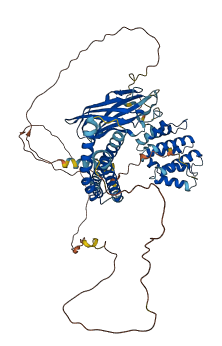
1 structures for Q8R0H9
| Entry ID | Method | Resolution | Chain | Position | Source |
|---|---|---|---|---|---|
| AF-Q8R0H9-F1 | Predicted | AlphaFoldDB |
3 variants for Q8R0H9
| Variant ID(s) | Position | Change | Description | Diseaes Association | Provenance |
|---|---|---|---|---|---|
| rs221719202 | 76 | S>N | No | Ensembl | |
| rs235343013 | 344 | S>N | No | Ensembl | |
| rs228963591 | 400 | A>V | No | Ensembl |
No associated diseases with Q8R0H9
No regional properties for Q8R0H9
| Type | Name | Position | InterPro Accession |
|---|---|---|---|
| No domain, repeats, and functional sites for Q8R0H9 | |||
Functions
| Description | ||
|---|---|---|
| EC Number | 2.3.2.27 | Aminoacyltransferases |
| Subcellular Localization |
|
|
| PANTHER Family | PTHR10131 | TNF RECEPTOR ASSOCIATED FACTOR |
| PANTHER Subfamily | PTHR10131:SF131 | TNF RECEPTOR-ASSOCIATED FACTOR 6 |
| PANTHER Protein Class | scaffold/adaptor protein | |
| PANTHER Pathway Category |
CCKR signaling map TRAF6 p38 MAPK pathway TRAF6 Toll receptor signaling pathway TRAF6 |
|
7 GO annotations of cellular component
| Name | Definition |
|---|---|
| cytosol | The part of the cytoplasm that does not contain organelles but which does contain other particulate matter, such as protein complexes. |
| early endosome | A membrane-bounded organelle that receives incoming material from primary endocytic vesicles that have been generated by clathrin-dependent and clathrin-independent endocytosis; vesicles fuse with the early endosome to deliver cargo for sorting into recycling or degradation pathways. |
| early endosome membrane | The lipid bilayer surrounding an early endosome. |
| Golgi apparatus | A membrane-bound cytoplasmic organelle of the endomembrane system that further processes the core oligosaccharides (e.g. N-glycans) added to proteins in the endoplasmic reticulum and packages them into membrane-bound vesicles. The Golgi apparatus operates at the intersection of the secretory, lysosomal, and endocytic pathways. |
| intracellular membrane-bounded organelle | Organized structure of distinctive morphology and function, bounded by a single or double lipid bilayer membrane and occurring within the cell. Includes the nucleus, mitochondria, plastids, vacuoles, and vesicles. Excludes the plasma membrane. |
| nucleoplasm | That part of the nuclear content other than the chromosomes or the nucleolus. |
| protein-containing complex | A stable assembly of two or more macromolecules, i.e. proteins, nucleic acids, carbohydrates or lipids, in which at least one component is a protein and the constituent parts function together. |
3 GO annotations of molecular function
| Name | Definition |
|---|---|
| phosphatidylinositol binding | Binding to an inositol-containing glycerophospholipid, i.e. phosphatidylinositol (PtdIns) and its phosphorylated derivatives. |
| small GTPase binding | Binding to a small monomeric GTPase. |
| ubiquitin binding | Binding to ubiquitin, a protein that when covalently bound to other cellular proteins marks them for proteolytic degradation. |
9 GO annotations of biological process
| Name | Definition |
|---|---|
| Golgi to plasma membrane protein transport | The directed movement of proteins from the Golgi to the plasma membrane in transport vesicles that move from the trans-Golgi network to the plasma membrane. |
| Golgi to plasma membrane transport | The directed movement of substances from the Golgi to the plasma membrane in transport vesicles that move from the trans-Golgi network to the plasma membrane, where they fuse and release their contents by exocytosis. |
| intracellular protein transport | The directed movement of proteins in a cell, including the movement of proteins between specific compartments or structures within a cell, such as organelles of a eukaryotic cell. |
| positive regulation of protein catabolic process | Any process that activates or increases the frequency, rate or extent of the chemical reactions and pathways resulting in the breakdown of a protein by the destruction of the native, active configuration, with or without the hydrolysis of peptide bonds. |
| protein localization | Any process in which a protein is transported to, or maintained in, a specific location. |
| protein localization to cell surface | A process in which a protein is transported to, or maintained in, a location within the external part of the cell wall and/or plasma membrane. |
| protein localization to ciliary membrane | A process in which a protein is transported to, or maintained in, a location within a ciliary membrane. |
| retrograde transport, endosome to Golgi | The directed movement of membrane-bounded vesicles from endosomes back to the trans-Golgi network where they are recycled for further rounds of transport. |
| toxin transport | The directed movement of a toxin into, out of or within a cell, or between cells, by means of some agent such as a transporter or pore. |
5 homologous proteins in AiPD
| UniProt AC | Gene Name | Protein Name | Species | Evidence Code |
|---|---|---|---|---|
| Q9UJY4 | GGA2 | ADP-ribosylation factor-binding protein GGA2 | Homo sapiens (Human) | SS |
| Q9UJY5 | GGA1 | ADP-ribosylation factor-binding protein GGA1 | Homo sapiens (Human) | EV |
| Q9NZ52 | GGA3 | ADP-ribosylation factor-binding protein GGA3 | Homo sapiens (Human) | EV |
| Q8BMI3 | Gga3 | ADP-ribosylation factor-binding protein GGA3 | Mus musculus (Mouse) | SS |
| Q6P5E6 | Gga2 | ADP-ribosylation factor-binding protein GGA2 | Mus musculus (Mouse) | SS |
| 10 | 20 | 30 | 40 | 50 | 60 |
| MSLLNCENSC | GSSQSESDCC | VAMASSCSAV | TKDDSVGGTA | STGNLSSSFM | EEIQGYDVEF |
| 70 | 80 | 90 | 100 | 110 | 120 |
| DPPLESKYEC | PICLMALREA | VQTPCGHRFC | KACIIKSIRD | AGHKCPVDNE | ILLENQLFPD |
| 130 | 140 | 150 | 160 | 170 | 180 |
| NFAKREILSL | MVKCPNEGCL | HKMELRHLED | HQAHCEFALM | DCPQCQRPFQ | KFHINIHILK |
| 190 | 200 | 210 | 220 | 230 | 240 |
| DCPRRQVSCD | NCAASMAFED | KEIHDQNCPL | ANVICEYCNT | ILIREQMPNH | YDLDCPTAPI |
| 250 | 260 | 270 | 280 | 290 | 300 |
| PCTFSTFGCH | EKMQRNHLAR | HLQENTQSHM | RMLAQAVHSL | SVIPDSGYIS | EVRNFQETIH |
| 310 | 320 | 330 | 340 | 350 | 360 |
| QLEGRLVRQD | HQIRELTAKM | ETQSMYVSEL | KRTIRTLEDK | VAEIEAQQCN | GIYIWKIGNF |
| 370 | 380 | 390 | 400 | 410 | 420 |
| GMHLKCQEEE | KPVVIHSPGF | YTGKPGYKLC | MRLHLQLPTA | QRCANYISLF | VHTMQGEYDS |
| 430 | 440 | 450 | 460 | 470 | 480 |
| HLPWPFQGTI | RLTILDQSEA | PVRQNHEEIM | DAKPELLAFQ | RPTIPRNPKG | FGYVTFMHLE |
| 490 | 500 | 510 | 520 | ||
| ALRQRTFIKD | DTLLVRCEVS | TRFDMGSLRR | EGFQPRSTDA | GV |