Q8QGC4
Gene name |
pbx1 (pbx1b) |
Protein name |
Pre-B-cell leukemia transcription factor 1 |
Names |
Xpbx1, Homeobox protein pbx1, Pre-B-cell leukemia transcription factor 1b, Xpbx1b |
Species |
Xenopus laevis (African clawed frog) |
KEGG Pathway |
xla:399184 |
EC number |
|
Protein Class |
|
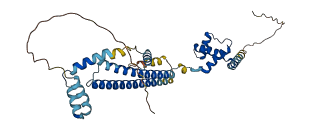
Descriptions
The autoinhibited protein was predicted that may have potential autoinhibitory elements via cis-regPred.
Autoinhibitory domains (AIDs)
Target domain |
|
Relief mechanism |
|
Assay |
cis-regPred |
Accessory elements
No accessory elements
Autoinhibited structure

Activated structure
1 structures for Q8QGC4
| Entry ID | Method | Resolution | Chain | Position | Source |
|---|---|---|---|---|---|
| AF-Q8QGC4-F1 | Predicted | AlphaFoldDB |
No variants for Q8QGC4
| Variant ID(s) | Position | Change | Description | Diseaes Association | Provenance |
|---|---|---|---|---|---|
| No variants for Q8QGC4 | |||||
No associated diseases with Q8QGC4
3 GO annotations of cellular component
| Name | Definition |
|---|---|
| midbody | A thin cytoplasmic bridge formed between daughter cells at the end of cytokinesis. The midbody forms where the contractile ring constricts, and may persist for some time before finally breaking to complete cytokinesis. |
| nucleus | A membrane-bounded organelle of eukaryotic cells in which chromosomes are housed and replicated. In most cells, the nucleus contains all of the cell's chromosomes except the organellar chromosomes, and is the site of RNA synthesis and processing. In some species, or in specialized cell types, RNA metabolism or DNA replication may be absent. |
| transcription regulator complex | A protein complex that is capable of associating with DNA by direct binding, or via other DNA-binding proteins or complexes, and regulating transcription. |
2 GO annotations of molecular function
| Name | Definition |
|---|---|
| DNA-binding transcription factor activity, RNA polymerase II-specific | A DNA-binding transcription factor activity that modulates the transcription of specific gene sets transcribed by RNA polymerase II. |
| sequence-specific DNA binding | Binding to DNA of a specific nucleotide composition, e.g. GC-rich DNA binding, or with a specific sequence motif or type of DNA e.g. promotor binding or rDNA binding. |
5 GO annotations of biological process
| Name | Definition |
|---|---|
| cranial skeletal system development | The process whose specific outcome is the progression of a cranial skeletal system over time, from its formation to the mature structure. The cranial skeletal system is the skeletal subdivision of the head, and includes the skull (cranium plus mandible), pharyngeal and/or hyoid apparatus. |
| nervous system development | The process whose specific outcome is the progression of nervous tissue over time, from its formation to its mature state. |
| neural crest cell fate specification | The process in which a cell becomes capable of differentiating autonomously into a neural crest cell in an environment that is neutral with respect to the developmental pathway; upon specification, the cell fate can be reversed. |
| positive regulation of DNA-templated transcription | Any process that activates or increases the frequency, rate or extent of cellular DNA-templated transcription. |
| positive regulation of transcription by RNA polymerase II | Any process that activates or increases the frequency, rate or extent of transcription from an RNA polymerase II promoter. |
No homologous proteins in AiPD
| UniProt AC | Gene Name | Protein Name | Species | Evidence Code |
|---|---|---|---|---|
| No homologous proteins | ||||
| 10 | 20 | 30 | 40 | 50 | 60 |
| MDDQPRLMHS | HPGVGMAGHP | SLSQHMQDGT | GANEGDVGRK | QDIGDILQQI | MTITDQSLDE |
| 70 | 80 | 90 | 100 | 110 | 120 |
| AQARKHALNC | HRMKPALFNV | LCEIKEKTVL | SIRGAQEEEP | SDPQLMRLDN | MLLAEGVAGP |
| 130 | 140 | 150 | 160 | 170 | 180 |
| EKGGGSAAAA | AAAAASGGAG | ADNSTEHSDY | RAKLSQIRQI | YHTELEKYEQ | ACNEFTTHVM |
| 190 | 200 | 210 | 220 | 230 | 240 |
| NLLREQSRTR | PISPKEIERM | VSIIHRKFSS | IQMQLKQSTC | EAVMILRSRF | LDARRKRRNF |
| 250 | 260 | 270 | 280 | 290 | 300 |
| NKQATEILNE | YFYSHLSNPY | PSEEAKEELA | KKCAITVSQV | SNWFGNKRIR | YKKNIGKFQE |
| 310 | 320 | 330 | 340 | ||
| EANIYAAKTA | VNATNVSVHG | SQANSPSTPS | SAGGYPSPCY | QSDRRIQ |