Descriptions
The autoinhibited protein was predicted that may have potential autoinhibitory elements via cis-regPred.
Autoinhibitory domains (AIDs)
Target domain |
|
Relief mechanism |
|
Assay |
cis-regPred |
Accessory elements
No accessory elements
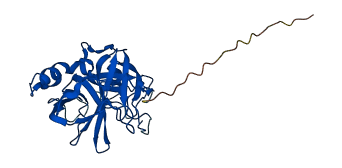
Autoinhibited structure

Activated structure
1 structures for Q8QG86
| Entry ID | Method | Resolution | Chain | Position | Source |
|---|---|---|---|---|---|
| AF-Q8QG86-F1 | Predicted | AlphaFoldDB |
No variants for Q8QG86
| Variant ID(s) | Position | Change | Description | Diseaes Association | Provenance |
|---|---|---|---|---|---|
| No variants for Q8QG86 | |||||
No associated diseases with Q8QG86
3 regional properties for Q8QG86
1 GO annotations of cellular component
| Name | Definition |
|---|---|
| extracellular region | The space external to the outermost structure of a cell. For cells without external protective or external encapsulating structures this refers to space outside of the plasma membrane. This term covers the host cell environment outside an intracellular parasite. |
2 GO annotations of molecular function
| Name | Definition |
|---|---|
| serine-type endopeptidase activity | Catalysis of the hydrolysis of internal, alpha-peptide bonds in a polypeptide chain by a catalytic mechanism that involves a catalytic triad consisting of a serine nucleophile that is activated by a proton relay involving an acidic residue (e.g. aspartate or glutamate) and a basic residue (usually histidine). |
| toxin activity | Interacting selectively with one or more biological molecules in another (target) organism, initiating pathogenesis (leading to an abnormal, generally detrimental state) in the target organism. The activity should refer to an evolved function of the active gene product, i.e. one that was selected for. Examples include the activity of botulinum toxin, and snake venom. |
1 GO annotations of biological process
| Name | Definition |
|---|---|
| proteolysis | The hydrolysis of proteins into smaller polypeptides and/or amino acids by cleavage of their peptide bonds. |
No homologous proteins in AiPD
| UniProt AC | Gene Name | Protein Name | Species | Evidence Code |
|---|---|---|---|---|
| No homologous proteins | ||||
| 10 | 20 | 30 | 40 | 50 | 60 |
| MVLIRVIANL | LILQVSYAQK | SSELVVGGDE | CDINEHPFLA | FLYSHGYFCG | LTLINQEWVL |
| 70 | 80 | 90 | 100 | 110 | 120 |
| TAAHCDRRFM | RIYLGIHARS | VANDDEVIRY | PKEKFICPNK | NMSDEKDKDI | MLIRLNRPVK |
| 130 | 140 | 150 | 160 | 170 | 180 |
| NSTHIAPISL | PSNPPSVGSV | CRVMGWGSIT | IPNDTYPDVP | HCANINLVND | TVCRGAYKRF |
| 190 | 200 | 210 | 220 | 230 | 240 |
| PAKSRTLCAG | VLQGGKDTCV | GDSGGPLICN | GTFQGIVSWG | GKVCARPRKP | ALYTKVFDYL |
| 250 | |||||
| PWIQSIIAGN | KTATCPP |