Q8PPT1
Gene name |
treA |
Protein name |
Periplasmic trehalase |
Names |
Alpha,alpha-trehalase, Alpha,alpha-trehalose glucohydrolase |
Species |
Xanthomonas axonopodis pv citri (strain 306) |
KEGG Pathway |
xac:XAC0604 |
EC number |
3.2.1.28: Glycosidases, ie enzymes hydrolyzing O- and S-glycosyl compounds |
Protein Class |
|
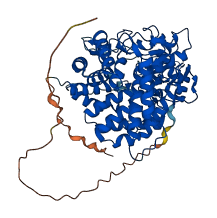
Descriptions
The autoinhibited protein was predicted that may have potential autoinhibitory elements via cis-regPred.
Autoinhibitory domains (AIDs)
Target domain |
|
Relief mechanism |
|
Assay |
cis-regPred |
Accessory elements
No accessory elements
Autoinhibited structure

Activated structure
1 structures for Q8PPT1
| Entry ID | Method | Resolution | Chain | Position | Source |
|---|---|---|---|---|---|
| AF-Q8PPT1-F1 | Predicted | AlphaFoldDB |
No variants for Q8PPT1
| Variant ID(s) | Position | Change | Description | Diseaes Association | Provenance |
|---|---|---|---|---|---|
| No variants for Q8PPT1 | |||||
No associated diseases with Q8PPT1
2 regional properties for Q8PPT1
| Type | Name | Position | InterPro Accession |
|---|---|---|---|
| conserved_site | Glycoside hydrolase, family 37, conserved site | 166 - 179 | IPR018232-1 |
| conserved_site | Glycoside hydrolase, family 37, conserved site | 461 - 470 | IPR018232-2 |
Functions
| Description | ||
|---|---|---|
| EC Number | 3.2.1.28 | Glycosidases, ie enzymes hydrolyzing O- and S-glycosyl compounds |
| Subcellular Localization |
|
|
| PANTHER Family | ||
| PANTHER Subfamily | ||
| PANTHER Protein Class | ||
| PANTHER Pathway Category | No pathway information available | |
1 GO annotations of cellular component
| Name | Definition |
|---|---|
| periplasmic space | The region between the inner (cytoplasmic) and outer membrane (Gram-negative Bacteria) or cytoplasmic membrane and cell wall (Fungi and Gram-positive Bacteria). |
1 GO annotations of molecular function
| Name | Definition |
|---|---|
| alpha,alpha-trehalase activity | Catalysis of the reaction: alpha,alpha-trehalose + H2O = 2 D-glucose. |
2 GO annotations of biological process
| Name | Definition |
|---|---|
| cellular hyperosmotic response | Any process that results in a change in state or activity of a cell (in terms of movement, secretion, enzyme production, gene expression, etc.) as a result of detection of, or exposure to, a hyperosmotic environment, i.e. an environment with a higher concentration of solutes than the organism or cell. |
| trehalose catabolic process | The chemical reactions and pathways resulting in the breakdown of trehalose, a disaccharide isomeric with sucrose and obtained from certain lichens and fungi. |
No homologous proteins in AiPD
| UniProt AC | Gene Name | Protein Name | Species | Evidence Code |
|---|---|---|---|---|
| No homologous proteins | ||||
| 10 | 20 | 30 | 40 | 50 | 60 |
| MPYATARSGD | VMSSAAPPCC | TSLLGLSLSM | FVAPGTLTAA | PLDAPVVNAP | APTPPTPDLA |
| 70 | 80 | 90 | 100 | 110 | 120 |
| YPELFQAVQR | GELFDDQKHF | VDFLPLRDPA | LINADYLAQH | DHPGFDLRKF | VDANFEESPP |
| 130 | 140 | 150 | 160 | 170 | 180 |
| VQTDAIRQDT | ALREHIDLLW | PKLVRSQNHV | PPHSSLLALP | HPYVVPGGRF | REVYYWDSYF |
| 190 | 200 | 210 | 220 | 230 | 240 |
| TMLGLVKSGE | TTLSRQMLDN | FAYLIDTYGH | IPNGNRTYYL | SRSQPPFFSY | MVELQAGVEG |
| 250 | 260 | 270 | 280 | 290 | 300 |
| EAVYQRYLPQ | LQKEYAYWMQ | GSDDLQPGQA | ARHVVRLADG | SVLNRYWDER | DTPRPEAWLH |
| 310 | 320 | 330 | 340 | 350 | 360 |
| DTRTAAEVTD | RPAAEVYRDL | RAGAESGWDY | TSRWLADGQN | LRTIRTTAIL | PIDLNSLLYH |
| 370 | 380 | 390 | 400 | 410 | 420 |
| LERTLALACA | QPGAECTRDY | AALAQQRKQA | IDAHLWNTAG | YYADYDWQTR | TLSNQVTAAA |
| 430 | 440 | 450 | 460 | 470 | 480 |
| LYPLFAGLAS | DDHAKRTAST | VRKTLLRPGG | LATTAVKTGQ | QWDEPNGWAP | LQWVAVDGLR |
| 490 | 500 | 510 | 520 | 530 | 540 |
| RYGEDALART | IGERFLAQVQ | ALFAREHKLV | EKYGLETDAA | GGGGGEYALQ | DGFGWTNGVT |
| 550 | 560 | ||||
| LMLLNLYPGK | DTKAAPAKRV | RKPEAAAR |