Q8MLZ3
Gene name |
pdeD (gbpA, pde5, DDB_G0274383) |
Protein name |
cGMP-dependent 3',5'-cGMP phosphodiesterase A |
Names |
Cyclic GMP-binding protein A, Phosphodiesterase 5, DdPDE5, Phosphodiesterase D |
Species |
Dictyostelium discoideum (Slime mold) |
KEGG Pathway |
ddi:DDB_G0274383 |
EC number |
3.1.4.35: Phosphoric diester hydrolases |
Protein Class |
|
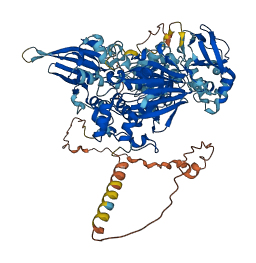
Descriptions
The autoinhibited protein was predicted that may have potential autoinhibitory elements via cis-regPred.
Autoinhibitory domains (AIDs)
Target domain |
|
Relief mechanism |
|
Assay |
cis-regPred |
Accessory elements
No accessory elements
Autoinhibited structure

Activated structure
1 structures for Q8MLZ3
| Entry ID | Method | Resolution | Chain | Position | Source |
|---|---|---|---|---|---|
| AF-Q8MLZ3-F1 | Predicted | AlphaFoldDB |
No variants for Q8MLZ3
| Variant ID(s) | Position | Change | Description | Diseaes Association | Provenance |
|---|---|---|---|---|---|
| No variants for Q8MLZ3 | |||||
No associated diseases with Q8MLZ3
6 regional properties for Q8MLZ3
| Type | Name | Position | InterPro Accession |
|---|---|---|---|
| domain | Biotin/lipoyl attachment | 4 - 78 | IPR000089-1 |
| domain | Biotin/lipoyl attachment | 122 - 196 | IPR000089-2 |
| domain | 2-oxoacid dehydrogenase acyltransferase, catalytic domain | 326 - 552 | IPR001078 |
| binding_site | 2-oxo acid dehydrogenase, lipoyl-binding site | 28 - 57 | IPR003016-1 |
| binding_site | 2-oxo acid dehydrogenase, lipoyl-binding site | 146 - 175 | IPR003016-2 |
| domain | Peripheral subunit-binding domain | 250 - 287 | IPR004167 |
Functions
| Description | ||
|---|---|---|
| EC Number | 3.1.4.35 | Phosphoric diester hydrolases |
| Subcellular Localization |
|
|
| PANTHER Family | ||
| PANTHER Subfamily | ||
| PANTHER Protein Class | ||
| PANTHER Pathway Category | No pathway information available | |
1 GO annotations of cellular component
| Name | Definition |
|---|---|
| cytosol | The part of the cytoplasm that does not contain organelles but which does contain other particulate matter, such as protein complexes. |
3 GO annotations of molecular function
| Name | Definition |
|---|---|
| 3',5'-cyclic-GMP phosphodiesterase activity | Catalysis of the reaction: 3',5'-cyclic GMP + H2O = GMP + H+. |
| cGMP binding | Binding to cGMP, the nucleotide cyclic GMP (guanosine 3',5'-cyclophosphate). |
| metal ion binding | Binding to a metal ion. |
10 GO annotations of biological process
| Name | Definition |
|---|---|
| aggregation involved in sorocarp development | The process whose specific outcome is the progression of the aggregate over time, from its formation to the point when a slug is formed. Aggregate development begins in response to starvation and continues by the chemoattractant-mediated movement of cells toward each other. The aggregate is a multicellular structure that gives rise to the slug. |
| cGMP catabolic process | The chemical reactions and pathways resulting in the breakdown of cyclic GMP, guanosine 3',5'-phosphate. |
| cGMP-mediated signaling | Any intracellular signal transduction in which the signal is passed on within the cell via cyclic GMP (cGMP). Includes production of cGMP, and downstream effectors that further transmit the signal within the cell. |
| chemotaxis to cAMP | The directed movement of a motile cell or organism in response to the presence of 3',5'-cAMP. |
| negative regulation of actin filament polymerization | Any process that stops, prevents, or reduces the frequency, rate or extent of actin polymerization. |
| negative regulation of GTPase activity | Any process that stops or reduces the rate of GTP hydrolysis by a GTPase. |
| negative regulation of phosphatidylinositol 3-kinase signaling | Any process that stops, prevents, or reduces the frequency, rate or extent of signal transduction mediated by the phosphatidylinositol 3-kinase cascade. |
| positive regulation of myosin II filament assembly | Any process that activates or increases the frequency, rate or extent of myosin II filament assembly. |
| protein localization to cell cortex | A process in which a protein is transported to, or maintained in, the cell cortex. |
| signal transduction | The cellular process in which a signal is conveyed to trigger a change in the activity or state of a cell. Signal transduction begins with reception of a signal (e.g. a ligand binding to a receptor or receptor activation by a stimulus such as light), or for signal transduction in the absence of ligand, signal-withdrawal or the activity of a constitutively active receptor. Signal transduction ends with regulation of a downstream cellular process, e.g. regulation of transcription or regulation of a metabolic process. Signal transduction covers signaling from receptors located on the surface of the cell and signaling via molecules located within the cell. For signaling between cells, signal transduction is restricted to events at and within the receiving cell. |
No homologous proteins in AiPD
| UniProt AC | Gene Name | Protein Name | Species | Evidence Code |
|---|---|---|---|---|
| No homologous proteins | ||||
| 10 | 20 | 30 | 40 | 50 | 60 |
| MMFSKRKSIR | FNPEGDYTEL | PRGGYVVPSK | LGGIQFGVPP | ETIKDSMALK | IDVPTIYVFP |
| 70 | 80 | 90 | 100 | 110 | 120 |
| EELWDRKTGI | NAAEAEFPAY | FNYFILKRKV | SFVCTKEQEQ | RIRIVFQETL | LGPPEFNTGI |
| 130 | 140 | 150 | 160 | 170 | 180 |
| IINSSSSTTD | TSKTSPIKKQ | TSSSSPPLSP | QQQQPPPPLV | KQPSQQQLEE | LATMDTCHYH |
| 190 | 200 | 210 | 220 | 230 | 240 |
| HHHHHQEVND | NDNNNNTTTN | NNNIEILEQQ | QQQQQQQQQQ | QDEDSTDVDE | EFQKEFSSTF |
| 250 | 260 | 270 | 280 | 290 | 300 |
| PRSEIPNLEK | ECKYLRTFNS | VDELFDFILF | DDNGIAKLSD | DVEIHFQEDQ | SLFKVLQFEE |
| 310 | 320 | 330 | 340 | 350 | 360 |
| TGKGNKVQTL | VATIPSKILF | PDMINSISTI | NDNKIFDPPT | FGITIIGSSH | GFDPKKSTTG |
| 370 | 380 | 390 | 400 | 410 | 420 |
| FVLWINKRGI | MVDPPLNSSS | FLQSQGVPTR | MVDHIILTHC | HADHDSGTFQ | KLLEEYQITV |
| 430 | 440 | 450 | 460 | 470 | 480 |
| VTTPTILGSF | LRKYGALSNL | STDLLRRLFI | FRPVMIGEPM | IISGAEFRFF | YTIHTIPTIS |
| 490 | 500 | 510 | 520 | 530 | 540 |
| FEVFYGGKSI | FYSGDTCYDP | NRIKDMNKRG | IMKTSRMKFF | LRPWNHTVVL | HEAGVPPIHT |
| 550 | 560 | 570 | 580 | 590 | 600 |
| PVSVLRALPD | EVKNRLYLVH | ISEHTLPAGS | GLKIAKEGVA | HTLSLDVMKS | SHSEAVDILK |
| 610 | 620 | 630 | 640 | 650 | 660 |
| LVESVDIFRS | IPLTQACEIL | QTATKRKYSQ | GSVIIARDTE | PDAFYVVASG | VVCVNIGELK |
| 670 | 680 | 690 | 700 | 710 | 720 |
| KNLIVGDYFG | EMSLVMGGLR | SANVQAVTDV | EVLSFNKEDF | LSITRNSTES | IQFITRLWEM |
| 730 | 740 | 750 | 760 | 770 | 780 |
| RNEKSWETMS | LNSVFSRCTN | SQKTAIQSIL | VRELIKKDET | LWCKGEEALF | GCLVAEGSFV |
| 790 | 800 | 810 | 820 | 830 | 840 |
| FKEDDSLESF | SQGSFLGDIN | AMTTQPPSIH | KTTVVAKEES | VIYKVLSQDL | IKFFSNNPGI |
| 850 | 860 | ||||
| QLAFLDTIFV | DALRDQVQQL | VNSKLTY |